Showing posts with label manual therapy. Show all posts

Sunday, September 04, 2011

About treatment boundaries

Yesterday, I commented about treatment boundaries in this post. I want to elaborate. I want to explain how explaining pain to a patient can be woven straight into the constructing a safe psychological, social, therapeutic container to work within, while utilizing physical contact.

Guys, especially, seem very reluctant to take on gentle manual therapy. They are concerned they could be misinterpreted. (Maybe this is why they seem to head off in large droves toward ortho and other structural, manipulative technical approaches and away from physiological change approaches - they don't want their physical contact to be misunderstood.)
I say, then, make the situation be completely transparent. Ask for and get permission every step of the way. 

Let's say you had a patient with some kind of pain problem. Let's make you a guy, and the patient female. Let's make her a tough case: anxious, known drug user/abuser. Chances are, you are scared of using gentle manual therapy. You worry that she might cling, rapidly become dependent.

You can avoid any danger of creating dependency by setting a simple but firm treatment boundary: Something like:

Quote:
"We could try to help the part of the brain that is making the pain figure out a way to stop. I'd like to try some hands-on work, if that would be OK with you. (Pause and wait for an indication the patient is interested.)

"It may help, although I wouldn't know for sure, without us trying it first - it helps most people in a pretty straightforward way; what I am sure about is that if it we do a few sessions and it hasn't helped yet (changed the pain significantly right away, so that it is less severe, less bothersome, less frequent, stays away for longer periods of time, one of those things or some combination of those things) then it wouldn't be worth pursuing further. 
"I'm saying, it's something we could try, and see what happens, and if it doesn't help, we haven't really lost anything by trying. So, what do you think? Would you be interested in seeing if it could help your brain to stop giving you this foot (or back, or leg, or arm) pain?" (Pause and wait for an indication the patient is interested)
The next set of treatment boundaries involves explaining the patient's nervous system and how it mounts a pain presentation. This does a number of things:
1. It explains pain to the cognitive part of the patient's brain, which will give her the idea that you consider her worthy of learning it and capable of understanding it (respect).

2. It creates a conceptualization that "she" is something apart from the rest of her own brain, that you would ask for her cooperation in helping you, so that together, you (plural) can detach from the pain, watch the nervous system (with minimal input from you) solve the "problem" which is something in the rest of the nervous system (recruitment of patient's cooperation, mostly her dorsolateral prefrontal cortex).

3. It also gives her non-conscious brain time to mount reward expectation mechanisms and dopamine (if she has any of her own left), all that anticipation stuff. This wouldn't be a bad place to reassure her that you aren't going to hurt her with your handling, that you want her to tell you if anything you do, any grip, feels uncomfortable to her, because you aren't in there and can't feel her nervous system the way she can, and you certainly can't feel her pain experience, only its manifestations. So you are relying on her to help. You don't think it's prudent to have her nervous system, which is a learning machine, learning to have to deal with more pain, associated with you - your job, as you see it, is to help it learn how to feel less pain.(You are assigning her a job, a role, and indicating that she has locus of control over your handling, are giving her veto control over it, and therefore over all your physical contact with her.)
The third set of treatment boundaries involves explaining the actual physical contact, what position you would like her to lie down in, what you are going to touch, how you are going to land, then what you're going to do once you've landed, what she can expect, what you'd like her to pay attention to, to breath, etc. Then before you actually touch her, ask her permission one more time.

These are little things, mostly good manners, but they add up into setting a treatment relationship/contract that is OK for either of you to walk away from at any time. It's egalitarian and fair. It should not give her any opening to become a cling-on.  It permits the dance between nervous systems to develop to the point of helping the patient get out of the way such that his or her nervous system can resolve its problem, can fix itself, all the while, as you provide it with clear, boundaried messages and feedback, both verbal and kinesthetic, and ask for the same from the patient.

You have the right to end the (manual) treatment relationship if you sense it's not helping, and she knows from what you've said, that she has to carry a lot of responsibility for any success, and her nervous system carries the rest; if she doesn't get this, then I'd recommend stop manually treating her and move to other management methods.

Saturday, September 03, 2011

What we don't even know that we don't know


LINK ->>>  What Do We Know For Sure, Really? (For therapists)

The blog post is by Alice Sanvito, at www.massage-stlouis.com, a thoughtful massage therapist, interviewed lately by Will Stewart (who calls himself thrill96) on his blog-radio show:  Russian Massage and Neuroscience: Interview w/ Alice Sanvito.

Alice is somebody who isn't afraid to change, who isn't afraid to think about things a bit differently, who isn't afraid of the unknown or of uncertainty. It's a rare quality in a manual therapist - most want to convey the impression that they are experts. Much of the time, I imagine, a patient can feel a level of expertise through their own somatosensory afferent system. If the attitude and the handling don't match, I think it's better that the handling be "expert" rather than the claim.


What constitutes "expert" handling? Well, every nervous system is different. Every pain problem is as unique as the person's fingerprints. So, rather than claiming some sort of "expertise" in some technique or other, i.e., a set of cookbook approaches learned at a class, it's way better to stay humble, let treatment be at the pace of the nervous system with which one's own is interacting, let treatment be more about exploring than performing, watch for settling, watch for deepening of breathing, watch for long periods of silence, encourage the same without being dominating. One lets processes occur until they stop. These are easy to feel through sensitive aware handling - warming, softening, sense of lengthening, pulsing, etc. All these indicate nervous system corrections. Let the patient become fascinated with feeling their own body's life. Let them describe what they can sense. Much of it will be a surprise to them. Give them room to enjoy new afferent experiencing, the feelings that arise when nervous systems self-correct in response to the most minimal and non-invasive input you can manage. 


How does one become "expert" at handling another's nervous system? One learns manners, and boundaries, remembering to "ask permission", not just verbally but also kinesthetically. One maintains these throughout the entire therapeutic encounter. One adapts, matches oneself to the patient. Something as simple as learning to separate one's own breathing from one's own contact with the patient can buffer a lot of unintentional "noise" from a nervous system that is sensitive. This means, literally being aware of your own breath and controlling it, or resting elbows somehow so that breathing motion doesn't travel all the way down your arms to the patient's body. Little things like that. 


Thank you, Alice Sanvito, for being a fellow traveler in the world of deepening into whatever it is we do. I don't think we can, or ever will, know anything for sure, because manual therapy is a verb, in the moment, not a noun, ever, in spite of how many conceptualizations are dreamed up to try to package it or analyze it or measure it scientifically. One thing is for sure, though: we cannot "touch" (directly) anything but the nervous system, as represented in the skin. All the rest is stuff we make up, an "as if" story.


Wednesday, March 30, 2011

Ooh... my my. That does not look comfortable at all.

The time: 1936
The place: Somewhere in the UK, I guess.

Sir Herbert Barker's manipulative technique Part 1

Background information


Sir Herbert Barker's manipulative technique Part 2

Background information

Note the tension level exhibited by the patient throughout the manipulative ordeal. This is exactly why I have never learned to appreciate ortho manual therapy. It's too hard to relax when your salience detectors are on full blast working overtime pouring on the coals in the insular cortex. If the patient does not have any opportunity to practice having or experiencing an internal locus of control, he or she will never learn to use it.

Saturday, October 16, 2010

New bursts of energy

I think going to school is good for me. My brain seems to be working better again.

Lately I had thoughts about going back "to work" - i.e., treating patients again. I mentioned to my mother at Thanksgiving that I had been thinking about something simple, something that would leave me in control of my time, something like doing home visits. I even told her the name I picked - "Sensible Solutions". I don't have business cards yet, but I know a place where I can get some made, and I went out during the week, picked out a file cabinet, had it delivered, moved my office all round and repositioned and reorganized all my book shelves, moved the desk to make more room but still get a lot of light from the window, made a space for my computer setup - two large screen computers in a nice little semi-circular nest, for "going to university"; I still had room for a small oak roll top desk which will become the place where I sit to write patient files. Today I went out and bought bright yellow file hangers to put in the new file cabinet. It has three large drawers. Lots of room to expand if/when my new "practice" takes off, and meanwhile, lots of storage. :-)

If it does take off, I'll have to get a car soon. Drat. :-[
But I'll think about that if/when.

I got my first official call this morning, and first appointment arranged today at 5PM - a friend of my mom's, 83 with back pain. She had surgery last year to remove no-longer-useful organs which were growing cells that no one thought would do her any good in the long term, but allowed none of this to stop her from participating in the senior Olympics here in Canada and taking home all the gold medals in her category... she is the only entrant in her category, but that's kind of beside the point. She goes to the lovely rec center here and trains several days a week, so I know she's motivated.

Now, at last, so am I.
Whatever my brain needed a rest in order to go off and do, it looks like it's close to being done, and after having had an opportunity to marinate in sunshine for the last 15 months, is getting ready for a new life, mental molt finally over with.

I've got two bags to carry over to her place (she's only a block away) - one contains a foam bolster and the other my treatment gadgets - block wedges, foam rubber square to give me more traction on skin, stretchy tape and scissors. I will take a treatment gown along. Got lots of those.

Monday, October 11, 2010

"Touch is good" - HumanPrimateSocialGrooming manual

In a recent SBM post, Mark Crislip discussed reflexology among other things.

He said,
“Monkeys, and other animals, groom each other often with a marked reduction in stress. Touch is good, and one doesn’t need to wrap it up in pseudoscientific nonsense for it to be beneficial.”


To which I replied, in the comment section,
"Thank you for saying that Mark; I’ve been saying the same thing for years. I call it “human primate social grooming.” Most human primate social grooming professions/professionals dislike the term, for some weird reason. Oh well.

Diane, human primate social groomer and manual therapist with a PT license to touch people."


Another commenter suggested that it was more succinct to use the term "pedicurist", which I took as an opportunity to explain the difference between operator model of human primate social grooming and interactor model of social grooming. So, I replied,
"Well, strictly speaking, any profession that is licensed to touch human beings for whatever reason including hair dressers, dentists, pedicurists and medicine, could all be considered human primate social groomers, I think.

It’s the “WHY-we-touch” that shakes the idea into layers, I think.

Those who touch to get a specific job done, like get a tooth out, get a toenail clipped or a callous scraped off, or hair cut, or appendix out etc., i.e., have an obvious, clear, objective purpose for both patient and practitioner to focus on; these practitioners have the option of being ’something more than just’ human primate social groomers. We could call these people “operator model” human primate social groomers.

Those who groom humans specifically to help them with nebulous perceptions and experiences of stress/pain, are (fundamentally) practitioners of what I would call the “interactor model” of human primate social grooming.

Could a desire to be more “operator” than “interactor”, to have some externalized reason for treating no matter how imaginary, i.e., a treatment “concept”, be a big reason *why* human primate social groomers (and now I’m talking about only the ones like me, interactor-model ones who touch to relieve stress and reduce pain perception/experience) made up (and still make up!) crazy ideas like acupuncture meridians? Trigger points? Subluxations? Untestable and unprovable? then go on to develop complicated ways of treating them?

I’m content just treating human primates with pain problems nowadays, supported by pain science and neuroscience, rather than trying to learn to treat crazy concepts some other groomer(s) invented once-upon-a-time for fun and profit. I guess this makes me a full-on, out-of-the-closet, interactor-model human primate social groomer on the lowest possible rung of the human practitioner hierarchy; oddly, though, I find it the most comfortable place to be, the most science-based, with the least distance to fall.

Diane, human primate social groomer and manual therapist with a PT license to touch people/many opinions on the matter"


I would add, any idea about anything anyone thinks they can affect below the surface of the skin must be put carefully through Occam's Mental Meat Grinder before being adopted as verifiable fact.

* The truth is, we can't literally touch anything but skin.
* The truth is, skin (cutis/subcutis, the actual organ of "skin") is thick. (It's also rubbery and full of physiology, busy-ology)
* The truth is, we can bend things around a bit, things that are located inside, beneath skin, but we cannot "touch" them - only if they are exposed, as in an operation, can we literally touch them.
* The truth is, we are probably mobilizing neural structure a lot more than anything else with manual therapy


Which means, when we treat, we are using our imaginations a LOT.
It's ok to use imagination, but it's not OK for one group of PT or manual therapy imagination users to claim higher scientific turf than some other group of PT or manual therapy imagination users.
Get real.
What do you think you're testing/treating? What you imagine you are touching/affecting, instead of what someone else imagines they are touching/affecting?? How is your science based on whatever you think you can "operate on" under the skin ever going to be more than more tooth-fairy science, based on some hypothesis which is implausible because you can't get your hands literally on the thing that you are trying to affect with your hands, and you cannot rule out the fact that the patient's brain/neuromatrix is being very attentive to you and anything you try to do to it with those same hands? Give me a break.


Adoption of an interactor model would slice the matter in several novel directions.
a) we would be more science-based.
b) it would place neuromatrix and biopsychosocial models of human pain/function/dysfunction ahead of orthopaedic and biomechanical and other (also largely pseudoscience) operator models.
c) it's already pretty hard to design experiments that can test aspects of manual therapy.
d) adopting an interactor model would make things even harder.
e) we would, however, as clinicians, be on much firmer scientific ground.
f) why strive so hard to build an evidence base, based on operator models of treatment that contain such implausible tissue-based hypotheses (biomechanical, craniosacral, myofascial, triggerpoint, joint-based, reflex zone, acupuncture, you name it) in the first place?
g) adoption of an interactor model would make things harder but also easier. We could work toward improving what already works, i.e., the verb of therapeutic contact, as a new social element of that individual's biopsychosocial, pre-existing landscape, the entry of oneself as a therapist, with a social-grooming interactor role, into that person's neuromatrix. Not have to try to substantiate the noun (and therefore, myth(!)) of some system for
- supposedly pushing a joint sideways and thereby supposedly decreasing nociceptive afferent stimuli, or
- supposedly bending a suture somehow and thereby supposedly squishing cerebral spinal fluid around thereby supposedly decreasing nociceptive afferent stimuli, or
- supposedly physically stretching fascia (of all things!), a tissue whose job is to keep an organism and its layers from falling apart..
- etcetcetc.....
h) what is the element common to both the operator model (even though the operators won't admit it) AND the interactors? Skin.
i) Which takes us all the way back round to the question, "What are we really handling?"

Answer: The surface of someone's body. All the representational maps stored in the brain of the individual we are touching. All the feelings, thoughts, beliefs, impressions, perceptions that individual has stored up over a life time. The person has the pain problem. We don't. The person has to fix his or her own pain problem. We have to try to help them.

It's that simple.

It's a grooming encounter and they have a pain nit they can't reach by themselves. They need someone outside to verify it, so they can begin to downregulate it. Maybe it's a little, buried, default primate social need our human primate brains still have. I don't know. But I know we don't have to press very hard for that. We only have to apply a bit of judicious and NON-nociceptive stimulus to that person, at the right speed, for the individual. They need to become more aware of their body and simultaneously less aware of their pain.

It's that simple.

Handling skin properly is simple: Do anything to it you want, just avoid hurting the person through it, and the person's brain will take care of all the rest. Bear in mind what I will now call the...
First Law of Human Primate Social Grooming: Do No Nocicepting

Stick to that law even if the patient seems to have a high nociceptive threshold, even if they "think" they should pay for gain with more pain, even if they kid around and act tough, even if they've been told by countless other treaters that it's OK, just suck it up. Don't get sucked into that movie, people. Stick to the First Law and you will never have to hold yourself responsible for having created a new chronic pain patient.

They are out there, you know... Life is a verb, not a noun. The brain is a verb, not a noun. It interacts continuously with its environment, both inner and outer. Those whose nervous systems aren't organized quite normally, who perhaps lack the means by which their cells can produce that absolutely crucial opioid receptor in quite the right synapse, or whose systems go haywire and produce way too much Substance P or some other excitatory substance which can jimmy the ordinary downregulatory system... those people are out there. Yes, they are rare, and yes, they might instinctively already "know" they don't tolerate rough-house well, but some of them may find their way into your clinic regardless. They only want what any patient wants - some professional interactive human primate social grooming from someone who will take them as a person and all their possible baggage into account while being in therapeutic contact with them, and leave them explicitly with the locus of control over the treatment. If it happens to be you, and you didn't interview them enough to pick up they aren't appropriate for your kind of manual treatment (or manual handling, period), don't set the context correctly, or you wander off into your own operator mentations inappropriately or at the wrong moment, or you haven't told your patient to tell you when your handling feels uncomfortable... congratulations![not] - chances are pretty high you may have just initiated another person to the (already too high) chronic pain population. Oops. You (and your treatment idea) became their tipping point. Now you'll have to live with that, and (much) worse, so will they. No one starts out thinking they'll end up in chronic pathophysiological pain - they just do. Don't play any role in making worse problems for people than they already have.

If you're going to be a human primate social groomer, for goodness sake be an intelligent one - think about stress reduction - get that person's stress levels down before you ever begin - set the stage. Make it easy for yourself, and for them. Make it clear they are in ultimate veto charge of you and your handling. Make it a habit to give them cognitive material in the form of pain education to work with. Human primates need that as part of the human primate grooming process; those big frontal lobes need information to chew on throughout the process. With stress levels down, the individual will be more apt to incorporate you and your contact into his or her body schema, and good things will have a better chance to result. Go slow - the slower you go the more that person's brain will be able to take in what's going on and use it best to help itself.

Additional reading:

1. Bennedetti: The Placebo and Nocebo Effect: How the Therapist’s Words Act on the Patient’s Brain

Friday, August 27, 2010

Yet another level

In manual therapy one is taught that one can push bits of body around, and that this makes them feel better to the person whose bits one is pushing.

I call this the "operator model" of manual therapy.

One quickly learns (or should) that manual therapy is much less about the bits one thinks one is pushing, much more about one's speed and force, mostly minimalizing thereof, waiting for the opening, waiting for the person's physicality to let one in.

I call this the "interactor model" of manual therapy.

However, it's quite possible to remain stuck in the operator model for good.
As one proceeds through life one begins to realize that it is impossible to prove to oneself or anyone, through any method, specifically scientific but also logical or philosophical, that what one "thinks" one is doing has any bearing on reality. I.e., you cannot prove, even to yourself, that the SI joint, actually is what you are "feeling" with your fingers, as you perform what has been taught to you as a "test" of its "function." Yes, you can feel stuff... stuff is moving, or not moving, but what one feels moving or not under one's fingers, from on top of skin, has absolutely NO bearing on whether or not a buried SI joint is literally moving. There are many layers and structures all moving on each other between skin and joint, even inside "skin" (cutis/subcutis) itself.

It's merely a convenient assumption. It's a belief. There is absolutely no way to show that it is or isn't moving, or that people can or can't palpate it clinically.

In this case, what do you do? You realize (with a sickening feeling) that you've managed to paint yourself into a conceptual corner. There is no way out, except:

1. ... tromp out over wet paint, spreading dirt and paint.

This is the equivalent of insisting that it's possible, it must be, you've always thought so, your patients' results have always verified your magic-hand ability to ferret out movement/non-movement in the SI (except for when they didn't), therefore the premise must be right. Right? (Those patients who don't fit, well, there are always a few patients who don't fit, outliers, right? We can ignore them, can't we?) Wrong.
Trying to set up tests to "prove" you are right/how right you are is a version of what Harriet Hall calls, tooth fairy science.


2. ... admit defeat, stop thinking about escape, sit in the corner, deal with your feelings, and wait for the paint to dry, however long that may take.

This is the equivalent of waking up yet another rational level on the manual therapy mesodermal mesmerization coma scale, reconfiguring/allowing reconfiguration of your own mentation to accept the facts as they are, including that you were a victim of your own conceptual hallucination, perceptual fantasy, that you were dreaming your own bad-logic dream. But it's OK, you're more awake now, and can move your mind differently, more reasonably. You can now reinterpret your work more correctly as interactive with somebody else's neuromatrix, and whatever it is you think you felt in the past, can go ahead and just be whatever it is/isn't, a mystery of function/dysfunction, not having to have any anatomical identity whatsoever. It will change anyway, just like patterns in clouds change. Continuously. That's a good thing, especially when the patterns are associated with something feeling 'wrong'.


Especially freeing is to know you don't have to prove anything, because there is nothing to prove. Instead from now on you can sit back and disprove, which is a heck of a lot more fun.

Saturday, July 31, 2010

Have we overlooked the skin in manual therapy?

In a recent post I showed some pictures of slides I would be using for a presentation a few days later. Since then I've been to Newfoundland, gave the talk, and have returned. Here is a google doc containing the slide show for anyone interested. It's a bit heavy at 37 MB, but anyone interested can download a pdf at this google link. Have we overlooked skin in manual therapy?

Wednesday, May 26, 2010

A short rest from Brazil...

Well, not really. In fact I think this blogpost series from Greg Laden is actually pertinent to the topic, and highlights some of the issues inherent in the first "Conversation" posted earlier today. I would submit that we could substitute "PT" in for "civilization," and "human primate social grooming (HPSG)" in for "primitive cultures," and it would all make sense.

Primitive Cultures are Simple, Civilization is Complex (A falsehood) I

Primitive Cultures are Simple, while Civilization is Complex: Part 2

Primitive Cultures are Simple, while Civilization is Complex: Part 3

Tuesday, May 25, 2010

The Congress

The congress venue was a 40 minute bumpy scary minivan ride away. I didn't mention that the minivans were often without working seatbelts. No matter - apparently I escaped unscathed. I'm back home and all in one piece.

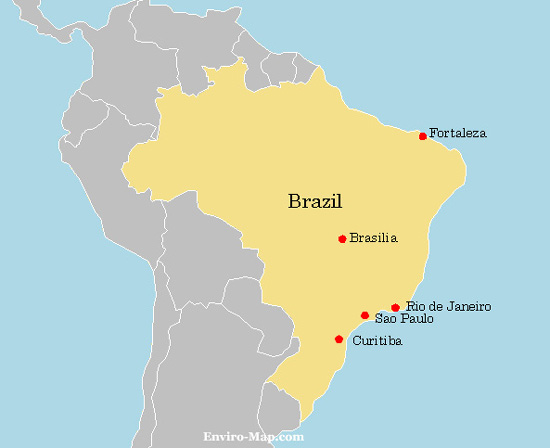
Here is a little map of where the venue, the Centro de Convençöes do Ceará, was located. It was pretty gigantic, with a large PT fair on the main level, the congress above on a mezzanine floor. There were large coolers of filtered water everywhere, and a stand for free coffee, so I was happy. The coffee was served in teesny tiny cups, but this was balanced by the fact that it had a lot of punch. Lunch was a large buffet service, included for free.

I did my first scheduled presentation Thursday, May 13. Here is a picture of me presenting. The woman to my right is Laura, the translator, who had lived in Toronto for a few years and spoke excellent English. She was staying at the same hotel and made herself available to go over the presentations with me beforehand.

I still can hardly believe that's me, wearing a skirt for the first time in about 20 years no less. There were about 1700 people in the room. Behind me were 5 large screens, stretched out in a line, so that everyone could see everything from wherever they were sitting.

I met many of the other presenters, listened to their presentations as best I could, not being fluent in anything but English (which was a surprise to many since I'm from a supposedly bilingual country, and finally, at this late stage of life an embarrassment to me that I never found French something my brain could wrap itself around as easily as it did Spanish).

A lot of the presentations seemed to be mostly 40 minute long advertisements for various schools of osteopathic mesodermalist thought. The Upledger institute was there, being promoted by somebody from Panama .. pictures of dolphins and babies, shots of its white-and-fluffy-haired founder. I thought about, but refrained from asking about, the therapy tragedy in the Netherlands - I had my own presentation to get through.

I was unprepared, actually, for what felt a bit like rock star treatment after I was done. Scores of beautiful young Brazilian PT students, both female and male, came up directly after and wanted their friends to take a picture of them with me, in ones, twos, small groups. It's quite the custom. The camera and I have never been close friends, more like distant acquaintances. So no picture of me ever makes me look good. Whatever. I complied.

Here is a picture of me (wearing my comfortable flat shoes, with foot scabs from a different pair of sandals that had chewed my feet up pretty good the day prior) looking very short, the little fashion schlub from Canada, beside the other women in their 4-6 inch platforms and heels and guapo men; Helder, the organizer, in his guapo suit. Sarah Mottram is second from left. Fourth from left is Marlene, who was Sarah's helper throughout, Palmiro beside her. I met the other two but don't have a working memory of who they are.

Monday, May 24, 2010

Leaving Rio for Fortaleza


With the workshop over, I had a chance to see old downtown Rio, visit an incredible pastry shop (see photo), and shop for a new shirt in Ipanama, fashionista that I am (not), with Adriana (Palmiro's girlfriend), a very nice woman with her own practice there.

I had been staying at the Vilamar Copacabana Hotel a number of days before I realized how close I was to Copacabana beach - only about three blocks. I didn't wander around by myself, thanks to Palmiro's warnings; when I did go out, it was usually with him or with other designated handlers, to some preplanned place for a specific task, so I had no clue the ocean was only meters away. On my last evening in Rio a small group of us went out to eat on the beach, and it finally sank in how close it was. We ate in a tent restaurant, right on the beach, the worst food I experienced in Rio (where the food was ordinarily fabulous) - dried out chicken and fries and watered down drinks, a too-loudly-miked-and-guitared singer singing Stairway to Heaven and other old songs, (annoyingly) in English.

The highlight of that last evening was insisting we walk down to the edge of the water, where my feet and the Atlantic ocean finally met and could greet each other. It was dark; a few lit-up ships sparkled in the distance, the air was still, the waves full and slow and warm. We couldn't linger though - the one slightly-built 20-something guy with us was nervous - possibly he had visions of his little flock of older foreign female responsibilities being total mugger bait, might have been overcome by the thought that he wouldn't be able to protect all of us all by himself. He soon wanted us to go back up to the street. So, an excellent moment, one of those rarest of moments that seems to hang suspended all by itself in eternity, one I wish could have lasted a lot longer, was over, and we walked back.

Next morning we were all up early to catch the plane to Fortaleza, 4 hours north, on the north coast of Brazil very near the equator. I had my first ever Congress presentation to make the next day, and stewed over my slides some more on the plane. I sat beside a nervous woman in the window seat who had never flown before and wanted the window cover down the whole time. Palmiro was on my other side. I was informed that Fortaleza was a dangerous city, that people had started noticing that plane loads of men came from everywhere just to buy sex with children, that authorities had begun to deal with the problem. When I asked how large the city was, I was told it was "just a small city," maybe 2 million. (Two million is huge in Canada. Double the entire population of the entire province of Sask. Oh well.) As it turns out, the size of Fortaleza is more like 3.5 million if you count in all the burbs.


What I was completely unprepared for and made me ecstatic was finding out the hotel faced the beach and that I had ended up in the ocean-facing side. I was able to look out every morning and say hello to this roiling turquoise marvel, right across the street from my 4th floor room.

Next, the congress.

Sunday, May 23, 2010

First leg - Rio

I had to get to Rio by flying to Sao Paulo on Air Canada and catching another local flight. The first flight was all night long (9 hours) and covered over 5000 km. I fussed over my slideshows some more and managed to curl up horizontally to sleep, as I had no seatmate. This nice part about flying north-south or south-north is that no jet lag is involved. It was the first time I'd ever been outside North and Central America. I'd never been south of the equator before. So many firsts.

Dinner (with wine) was served on the plane, and shortly thereafter, breakfast. The coolest part of the trip was that even the economy seats have a place to plug in one's computer so that one's battery stays juiced.

I was nervous landing in Sao Paulo. It seemed to take an hour just to fly over the city through smog cloud to get to the airport. It's 20 million people large, after all. I expected the Aeroporto Guarulhos to be enormous (it was), and I'd learned no Portuguese, hoping my rusty Spanish would suffice. How would I find my way around? I didn't have a lot of time between flights. Fortunately, customs there is a perfunctory matter, one's immigration card is merely glanced at, lines move fast, most of the people in uniform speak a bit of English, and there are many many people in uniform, standing around, changing the cloth bands between stands to facilitate new lines and faster movement. The signage is quite small and the distances huge. I did the default female thing and kept checking with new people as I walked along to make sure I was still going in the right direction. I reminded myself that I was English-speaking in a Brazil airport, not Polish-speaking in a Canadian airport.

Eventually I got to the proper gate in the correct wing of the port and on the TAM plane for the 45 minute local flight to Rio. At the Rio airport, things were even more brisk and easy. Palmiro was there to pick me up, so I could finally relax.

First things first - it took a good 45 minutes to get from the airport to the hotel, through Rio traffic. Rio is another huge Brazilian city, about 12 million. It has a bit of a smog bank too, although Rio citizens choose to downplay it. So beautiful though. In the car I was given a lesson on the social stratification of Brazil, and how to stay safe, not be a target. Palmiro has been around some and has had a chance to observe how life is in North America, so he took great pains to inform me about how in Brazil you can be killed for your cheap ten-dollar watch. He wasn't trying to scare me, just protect and inform me. I listened.

That evening I was introduced to caipirinhas and the sort of steak I can't ever remember tasting in my life. Delicious. Then we went up SugarLoaf Mountain in the cable car, in the dark, to see the lights of Rio way down in the distance. The next day we saw it again, in daytime. The other main tourist spot is Corcovado, on top of which is a giant Jesus statue. Giant Rio Jesus is apparently suffering from acid rain, was covered in restoration scaffolding when I visited.
The mountain is so high and the smog was so dense that I couldn't get any pictures of the city - I could not even see the city.


On the way down I took a bunch of pictures of a very dilapidated but still beautiful and elegant hotel, which is slated to be restored in time for the Rio Olympics, I think.


On the weekend I taught a two-day workshop to 26 people, the largest class I have ever taught. Palmiro had translated my treatment manual in Portuguese himself, ahead of time. A translator had been arranged. It couldn't have been a better organized event and it couldn't have been filled with better, more attentive, gentle students with hands like butter and minds like sponges. By the end of the second day several had already left to make flights etc. Here is a picture of who was left. Palmiro is in the back row, second from left. The translator, Dan, is beside him third from the left.

I learned to do Brazilian cheek-contact air-kissing on this first leg of the journey. I was struck, actually, at how contactful the culture in this branch of my human primate social troop. Such a welcome somatosensory, epicritic input.

Saturday, May 22, 2010

Brazil - Prelude

Yesterday I started to write a bit about this adventure-of-a-lifetime undertaken earlier in May. Here's how it transpired.

Last year in either March or April, during the time I was completely buried in preparing to move, I got an email from a perfect stranger in Brazil, Palmiro Torrieri Junior, a PT who teaches Mulligan* in Brazil and elsewhere in South America. He invited me to consider travelling to Brazil to participate in a Manual Therapy Congress scheduled to take place over a year later in Fortaleza.

I do not get these kinds of requests. Ever. Except... apparently Palmiro had tried to invite me two years prior and I had replied, "I never travel." I do not recall this - a lot of email comes my way that just gets automatically deleted or else ignored: it may well have happened - my memory has been pretty faulty, and, if the story is true, Palmiro is remarkably persistent besides being a gentleman and a scholar.

I told him I'd think about it. I did think about it. I also checked him out to make sure he was for real. He was. I told him I had no credentials other than a diploma from 40 years ago and no presenting experience, just a lot of self-study, a set of convictions based on neuroscience and biology, and an online presence. He said, no problem. I talked it over with my set of online PT friends - they all thought I'd be crazy if I didn't go. So, in the end, about a week later, I agreed to go.

Me being me, immediate self-doubt set in. Who did I think I was, anyway? I didn't linger for long with the self-doubt because I was too busy getting myself uprooted and moved away. And besides I had an entire year to come up with something. I didn't have to go out to work until long after it would be over with. I had enough time to come up with something, surely.

Palmiro was great - whenever I had a doubt or a hesitation about the trip he was right there in my inbox, with "No problem Diane, I will look after that." He had a translator. Everything was going to be paid. I would teach a 2-day class in Rio. He would organize the whole thing, find all the students. He would schedule my time so that I would have rest days between gigs. He would look after all the arrangements from the second I got off the plane until the second I got back on. He sent me a detailed itinerary of what we would be doing each day I was there. By email and later by Skype, I found his English to be really quite good (way better than my non-existent Portuguese), got to know him better and decided I would trust him.

Eventually the details at my end were all sorted and a visa, shots, new luggage, some tropic-appropriate clothing were obtained... I had learned to make slides, had put in many many 18-hour days reading and learning and sorting and thinking. I still wasn't satisfied with the presentations but they were as good as they were ever going to be and it was time to make the trip.

Next installment: Rio.
.........
* Mulligan (named after its creator, in standard ortho guru style) - a weird ortho combo of biomechanics and skin stretching, which I do not happen to find unconscionable because its over-arching emphasis is all about not creating more pain for the patient

Tuesday, February 16, 2010

It gives me grief and makes me mad

So.. It's high time, my brain has decided, for a bit of a rant.

My last sporadic post was about thinking I probably had chronic contemplation syndrome, and went sideways into being distracted by the Olympics, etc.

This post is about a few reasons why I seem to have chronic contemplation syndrome.

Lately I stumbled across this blogpost on Twitter: Infant Dies After Craniosacral Therapy: Therapist Gets Off Scot-Free. Something inside me seemed to galvanize just a little - I could feel it. The action I took was to post it to my Facebook page and let it sit there, as testament to wrong thinking, and how important it is for manual therapists to move away from piss-poor treatment concepts onto more science-based ones. Naturally there was a hue and cry and protest from a few who apparently thought I ought not mention such a scandal or whose "belief system" I had besmirched somehow. Was the therapist a PT or not? How is craniosacral therapy different in the Netherlands than in N. America? Surely it must be different, the kind "we" use "here" safer. I steadily asked questions, sent out feelers, got more links, as more information came along from those who speak/understand Dutch and are more familiar with the issue posted on the thread about it at SomaSimple.

How I feel about stuff like this, manual therapy memeplexes which are just plain indefensible or which can do real harm, is no secret - I wrote about it here, and here. What's different is that my life is organized such that I'm in a position to really be outspoken about it on many levels. I have time to write, to think, to organize, to present. I've been invited to speak at two separate venues about research I'm doing, opportunities to refute such ill-formed and misleading treatment concepts. I've worked like a Trojan online and offline to study, think, redesign my own brain, mesh the physicality of human primate social grooming with the neuroscientific and pain science basis, context, in which it all starts to make sense. It's a great opportunity.

But I'm mad at myself. For watching TV, for being disorganized, for not knowing how to find my own files on my own desktop, for having a messy bookmark list, messy messy messy, my life feels like it's still in a mess and like I still don't have a clue how to proceed. When I'm not mad at myself I easily get mad about stuff like what happened that poor Dutch therapist, stuff that happens because of very poor thought processes, because of not thinking something through first, because of adopting memeplexes that some extrovert dreamed up out of thin air then sold in a confident manner to gullible hungry-for-info people in a workshop who trusted whatever he said, applied it, then killed a baby. It makes me scream with anger. All of it. Then I look at myself again, and think, OK, I'm not gullible, I'm careful, I know that a stray thought here or an assumption there can make a big difference downstream, I've always sifted things carefully, always chucked out ideas that don't make legitimate sense without a second thought. But to DO that, to be that careful, takes a lot of inner stillness, which I'm now so good at that it feels like my brain has neuroplasticized itself into quite a rut, and when I add my ordinary introversion to it, it feels like I'll never be able to say what I want the way it needs to be said while at the same time smoothly managing to persuade the entire profession over into thinking about manual therapy in a new way, toward science and away from dangerous baseless mesodermal explanations for things. It's like I feel responsible for changing the world, all by myself, and I know that's a crazy unrealistic thing to be thinking. So I feel like screaming. Which is not a solution, just a feeling, so I rant for awhile instead.

Sunday, June 01, 2008

"The pain is gone"

To me, an old-fashioned human primate social groomer who has always leaned harder toward the "therapist" side of treatment rather than the "physical", but who uses manual therapy as my main intervention, the advantage of deep science-based pain models like my favorite, the pain neuromatrix model, is that one can remain connected to one's patient (i.e., in good therapeutic contact) while explaining to them what their experience of pain, or in this case radical pain relief, might mean, regardless of how strange it may seem to me or may have seemed to them.

Here is a diagram, famous by now I'm sure, of Melzack's neuromatrix model. Click on it to make it bigger, so you can read the detail.

I often haul out this little diagram and sit down with a patient, because a lot of times, simple handling isn't quite enough - they need answers.

Case in point: last week I saw a young woman for the first time. She had been sent to me by her massage therapist (who I've known for years) who had worked with her for many months. Let's called the patient Rosie (not her real name).

Rosie had had a prior history of low back pain for ten years, for which she had gone to a chiropractor semi-regularly. She had worked as a fund raiser for some outfit, until about two years ago; while nursing a sprained ankle (and on crutches) she was in a car accident. Now she had back pain, sprained ankle, and neck and shoulder pain. She was unable to do her fundraising job anymore and had had to quit.

She had endured persistent neck and shoulder pain for two years in spite of seeing 36 of the finest manual therapists, both conventional and alternative, that Canada has to offer, in two different provinces, and having attended a modern pain clinic.

Then, to her surprise, during a meditation retreat in December last year, her pain vanished. All of it. Gone.

Emboldened, she began a vigorous yoga program, and inadvertently overstretched something. Bam. She had felt instant leg pain and a lot of weakness in the quads. This had persisted beyond the massage therapist's expertise, and was why she had been sent to see me.

I learned that after she had given up fundraising after the MVA, she had become involved in an experiential psych counselling training program, where they let her learn from a physical position of comfort, i.e., horizontal.

At visit #1 I had taken her history and provided some manual treatment, some very rudimentary pain education, and showed her a neural glide to do for the leg. She'd been happy for something to do - anything.

Yesterday at visit #2, I was ready with a neuromatrix diagram and was planning more in depth pain ed.

She arrived.
I asked how she was doing, and she said, "Fine, I'm all better."

(I was thinking,... huh? Did she go on another retreat?)

I asked how she had managed it this time, and she replied that the evening prior she had invited two shamans in to work on her, and they had, with burning herbs and drumming, and lots of touching. Before they left, they had pronounced her cured.

And sure enough, she felt that way. No pain.

She really did seem better, could walk better, move better, sit comfortably, breathe better.. Wow, I thought. "Good for you," I said.

"Well," she said, "I still feel some stuff..."
"..It looks like the stuff you might still feel doesn't bother you anymore - is that how it feels?" I asked.
"Yes," she replied, "I still feel some stuff but it doesn't bother me at all. I didn't need to come today, but it was too late to cancel my appointment."

We had an hour to spend, so I decided to stick with the plan; I asked her if she was interested in learning some things about pain. She said yes, so I invited her to go through the neuromatrix diagram with me. We sat down and I began explaining how the center circle with circular arrows represented the entire nervous system, how it was always processing even at night during sleep, how it was more of a verb, therefore, than it was a noun, how the diagram depicted the movement of this neuromatrix through time... how it had three main inputs on a spectrum that ranged from mental (cognitive evaluative) to physical (sensory-discriminative) to physiological (motivational-affective) and three main outputs, one of which just so happened to be pain, which could be influenced by any of the three inputs and which in turn influenced the three main inputs plus the other two outputs...

As we wandered through the diagram, I plugged in pieces of info she'd given me, she asked questions, we talked about treatment crucibles, safe containers and catalysts, symbolism and shamanism, meditation and movement forward. During her shamanic experience she had had a great deal of novel sensory-discriminative input, through all her senses, not just kinesthetically. I told her it sounded like it had been enough to get her neuromatrix off the square it had been stuck on. I pointed out, based on the prior meditation/pain relief experience, how much more her particular pain matrix seemed to respond to shift of cognitive input than it did to sensory-discriminative input. I mentioned that for most people, sensory-discriminative input of the physical kind was often sufficient, but that she'd burned through 37 manual practitioners of various kinds, including me, without much help, and she nodded..

She told me this was all making more sense to her now.. that she was someone who just didn't "get" things through only her body, the way most people can if some reasonable sensory-discriminative input of a novel sort is provided... Instead things had to make sense to her through her emotions/mind.

Apparently long ago some other PT had loaned her the book "Explain Pain", for a few months, and she had diligently made notes and some photocopies, but it had never quite sunk in or gelled. Now it was finally starting to make sense. She said, "I wish I could read that book again. It was really good, as I recall." I replied that she could buy her own copy if she wanted.

We discussed rehab, and I told her about some options, but that wherever she went, to stay in complete control, not let anyone rush her, and to use "graded exposure" and "pacing", concepts she already knew about.

I showed her two chapters from Pain: A Textbook for Therapists and she took copies. She said this would help her learn the neurobiology for when she herself would be a therapist, counselling pain patients. I mentioned she would be able to buy this book online as well - that buying these two books for herself would be much cheaper in the long run than seeing a bunch of expensive therapists for sensory-discriminative input that her particular brain seemed to not be wired to be able to easily accept. She agreed.

I worked with her leg for a little while, and unlike the first time, this time she remarked on feeling heat and movement in the thigh, and non-painful sensation connected to the leg in other parts of her body. I asked her if she could do an active straight leg raise after, and to her surprise, she could.

She left very pleased with all the progress she had made in one week, by her own efforts. I didn't need to see her again in my opinion; her downregulation was well and truly hooked back up. She's away to her next adventure, all in one piece again finally.

Way to go, Rosie. Way to go.

Tuesday, April 08, 2008

Where did the term "human primate social grooming" come from?

I coined this term, have used it for a few years now. I suppose I should explain what I mean by it.

It arose out of thinking about the whole problem we have with PT having evolved as a culturally specific form of health care, along with most of the others, without good biological foundation (i.e., embryology and evolution), therefore rudderless. Although I've tried to grow myself a rudder, the profession lacks such a thing collectively.

Anywhere humans have a culture, there exists "healthcare." Culturally specific forms of health care we are familiar with in the western world include:

1. manual/physical therapies: PT, chiro, osteopathy, massage (many kinds), and the multitude of techniques named after individual originators who came out of the woodwork, Rolfing, Bowen, all these..
2. medical, surgical and nursing care for life-threatening trauma and disease
3. care for emotional, mental and psychological difficulties, e.g. psychotherapy, psychiatry

Other cultures combine these three main forms in other ways. All are categories of interventions sought, instinctively, by people who are undergoing life-disrupting or life-derailing problems with their bodies or their ability to think or relate appropriately.

Humans are primates, and primate survival is enhanced by being a member of a "troop". All three of these categories represent "help" extended to an individual who seeks it from the social human "troop" in times of either overt or perceived need. One can quibble over what constitutes "true" need; however, usually the most prioritized need is the one that bothers a given individual most within a given time frame. This would include such things as the "need" to breathe, to drink if thirsty, etc. Of the array of "need" states that can be defined, many of which the individual can instinctively take care of, a few seem to be recalcitrant to self-help for some people; e.g., pain is one (defined as a need state by Patrick Wall) that looms quite large for many people who have an active and functional nervous system. Pain is a frustrating phenomenon to endure; it can cause stress, and stress can in turn worsen pain. Pain can reduce one's ability to cope in a mature manner, thus interfering with relationship. Relationships interfered with may threaten one's place in a troop, and threat like that can lead straight to anxiety - for a primate - and more stress.

When stressed, primates (including human) seek social grooming. There will always be those among us who feel best when able to access "social grooming" of some sort for pain or distress or illness, and there will always be a supply of groomers ready to help, because humans are primates. Other primates groom each other instinctively, and so would we, if we were not constrained by "culture" and laws in place to regulate boundaried contact (for good reason). Social needs blurred into biological needs have a way of making culture adapt to them. Enter quintessentially "human" primate social grooming.

Also, enter the collision between who and what humans (collectively) think ourselves to be, and who or what humans (individually) default to in times of stress or physical need - biology takes over. Enter the "professional" splintering of a nurture behavior once fueled by nature into a bunch of modern (correction - let's make that postmodern, counter-enlightened) fragmented, rigorously (or not) regulated, politically defensive turf-raiding, territory-defending groups that are operationally primate troops in and of themselves to a great extent. Some are science-based while others are thoroughly a- or even anti-scientific. They exist in relation to each other, like rail cars on a train track, their position in the train having emerged by their relation to science; they all move along (some eagerly and some reluctantly), clashing, colliding, all ultimately pulled along through time by the chugging engine of Science and Society, the caboose of anti-science bringing up the rear, linked by that primate biological troop mandate "to help" and "to serve" and restore quantity and quality of living to fellow human primates, doomed to never escape the train - unless sidelined permanently, decommissioned due to dwindled popularity or de-legalized by future social contracts. This train is not bound for glory. It is slow and lurches uncomfortably. Cars routinely collide into each other. Any individual can climb aboard anytime onto any car of choice. Individuals that belong to one car can move about the train and visit other cars, check them out.

The whole point of the interaction of human primate social grooming (the non-medical kind, the more strictly manual therapy kind), or the establishment of any therapeutic relationship, is to get the right placebo response (in the Patrick Wall sense) started. All forms of health care are therefore veiled forms of human primate social grooming, and manual therapies are more direct forms, attempts to physically elicit said placebo response.

Social grooming started out as the simple 'nurture of nature', you might say - an animal activity, i.e., mammal mothers attentively licking their pups/kittens/calves etc. Primates took it further into wider social arenas, intra-troop behavior, maintenance of relationship.

Primatologists think one of the factors that may have driven development of our big brain in the first place was that it may have come in handy for keeping track of who was who, and to keep the peace (see Dunbar's number). The initial bonding that goes on between humans (e.g. parent/child) may well need to be reaffirmed artificially once in awhile, such as when there is a period of personal drama or trauma,, chaos or growth, which may or may not include physical injury. What we know for sure is that physical injury is certain to knock one off one's tracks for awhile; how it is handled socially, therapeutically, can be/often is pivotal to good resolution. See here, and here, for old blog posts about the insula.

If that's all true, then good old, non-nociceptive/unresolved 'pain', physical and/or psychological, is a need state all right, one that may require consummatory movement on a spectrum that ranges from just practicing some creative motor output at one end of the scale, further along to active physical relating e.g., hugging/sex with a partner, way over to the far end of the social spectrum to boundaried input of a physical sort from a therapeutic 'stranger', all depending on the individual. In the latter case perhaps the bond inside the patient, their intra-psychic balance, the bond they have, perhaps with their perceived relationship to their own biological life itself, can only be restored through physical human contact, from way outside the immediate family.

I think this is probably so fundamental that everyone just ignores it completely.

There are likely to be social groomers out there who because of human belief systems, won't entertain the possibility that we evolved instinctively doing this merely because of how healthy it feels, both for the groomer and the groomee. (Manipulation is likely more of a latecomer on the social grooming scene. It has its own unique sensory charm for some, I suppose.) There are still more who insist on trying to turn (manual) human primate social grooming into something quantifiable, standardized, objectified, reproducible... something more "human" (by mechanized western cultural standards), but possibly something at the same time less "humane" (by human primate social grooming standards). Still others get the kinesthetic part, love the kinesthetic part, but refuse to try to understand such a phenomenon scientifically - they even reject it, preferring to adopt mystical explanations instead, presumably because these "feel" better. We probably all get held back by all these proclivities.

This was once a huge problem/obstacle/quandary for me.. I could barely see the outline of it and it felt awfully big, like a chasm in the fog. When I came up against it in my own thinking I just didn't quite know where to go with it, how to dissect it, deconstruct it, deal with it, digest it. I understood it but not well enough to dispel it. I felt capable of nothing but blatting it out halfbaked. It made me feel cognitively dissonant, weak in the knees. Maybe the whole faintly nauseated feeling cognitive dissonance confers is what drives PTs and other "groomers" off to once again cling to religious anti-evolutionary belief systems. The truth (and I think this is truth) kinda sucks, doesn't it? - adds no glamour at all to our profession, makes us humble, puts us in our place at the bottom of the health care hierarchy, confronts us with the probability that we mostly deal with the non-human underpinnings of physical human existence, the deeper ways that bodies and nervous systems are connected. To go there boldly means confronting the fact we are primates, I think. And that like monkeys, our various manual therapy professions, by virtue of being "hands-on", and more primally primate than others, perhaps.

Yet, when I pondered the matter from another side, as one who instinctively moved toward this type of work when I was still a child, driven perhaps by overactive mirror neurons, it feels real and honest and natural and honorable by comparison with lots of other human activity going on that is greed-based and disgusting and destructive. What I find more disgusting is when human primate social grooming is dragged down further by greed and scam and dopamemes.

Fast forward a few years and I'm still not quite sure how all this fits together, but I think this sociological/evolutionary/psychological overview deserves at least a mention in the overall consideration of manual therapy. Acupuncturist/medical physician, Anthony Campbell, wrote:
"Among primates, we are the only species that does not routinely perform physical grooming. The manual therapies provide one of the few occasions when it is socially acceptable for comparative strangers to touch another's body in a manner that approximates to primate grooming. It seems likely to me that part of the success of the manual therapies depends on this, and differences in success rates among therapists are probably related to differences in how they apply touch.

The mechanism of touch as therapy is no doubt complex but is likely to involve the limbic system (cingulate gyrus) and release of oxytocin."
(See his whole comment in "Rapid Responses" after this article, Characteristic and incidental (placebo) effects in complex interventions such as acupuncture.)

Saturday, February 10, 2007

Manipulation and the Brain

This entry is a more edited version of a post I made on NOI in a discussion regarding manual therapies. I have included some references.

One of the participants asked, “If we discredit manipulation are we not at risk of undermining other manual type techniques for the same reason (myofascial, massage, mobilizations etc)???”

I answered with a prior version of this:
I don't think so. There is a layer of "brain" all around the outside of the body, a.k.a. skin, with fibres that go straight up to the insular cortex.1,2,3,4 We could consider manual therapies as altering the nervous system through THIS organ - I think all of the manual therapies you named do this anyway to a large extent, yet there is a conceptual void that needs filling; long ago manual therapies were named for the mesoderm (deep to the skin sensors) they were supposedly targeting (e.g. myofascial) or the sort of physical movement needed to perform them (e.g. massage, mobilization). These sorts of archaic designations deflect accurate therapeutic understanding from including the perspectives that patients' own unique nervous systems may have, keep our constructs off track, bias our self-image toward being PHYSICAL therapists instead of being physical THERAPISTS.

I doubt the actual therapy procedures, the physicality of them, are discreditable. These seem to be something humans evolved doing in order to help/comfort one another, cognitively consolidated action memeplexes that appear to stem from some deep ancestral well of primate social grooming. However, the constructs that attempt to explain and inform their use do nothing but describe such treatment as something we the treatment heroes "do" unto others. This perpetuates confusion, maintains invisibility/disregard of the highly variable nervous systems at the receiving end of the interactions as passive recipients, does nothing to consider or include the highly active role that nervous systems play in their own recovery by first accepting as non-threatening, then responding to, exteroceptive input.

Manual therapy ranging from skin touch only to active skin stretch to deeper pressure into underlying bones, muscles, neural tunnels, what have you, at varying speeds, should always be kept within our scope, but framed instead as varying kinds of exteroceptive input into a living perceiving system. Rather than being framed so strictly in biomechanical language, with its attendant and unavoidable misconceptions of cause and effect, the effects produced by manual therapies should be more carefully read as responses by the patient's living perceiving system. This necessitates seeing a patient's nervous system as more of a verb than a noun. This necessitates developing abilities to stay one step ahead of that nervous system, guiding it toward better behavior/output, not overtreating the mesodermal anatomy of it, or holding that foremost in our minds.

I'm all for retaining, but renaming, all forms of manual therapy interventions as a necessary part of their long overdue upgrade; new manual therapy names should include and reflect modern pain and nervous system concepts, and a sense of the interactivity of two nervous systems working together at every level to help one of them reduce pain and improve function/freedom. I would predict that as the perception of them shifted in us, the users of these therapies, the balance of usage of them would too; I think a trend more toward less intensive and slower forms would develop.

1. Unmyelinated tactile afferents signal touch and project to insular cortex; Nature Neuroscience (2003); H. Olausson, Y. Lamarre, H, Backlund, C. Morin, B.G. Wallin, G. Starck, S. Ekholm, I. Strigo, K. Worsley, Ã….B. Vallbo, and M.C. Bushnell.
2. Pain Mechanisms: Labeled Lines Versus Convergence in Central Processing, Annu. Rev. Neurosci. 2003; A.D. (Bud) Craig.
3. Antero-posterior somatotopy of innocuous cooling activation focus in human dorsal posterior insular cortex, open access 2005; L.H. Hua, I.A. Strigo, L.C. Baxter, S.C. Johnson, A.D. (Bud) Craig.
4. The Integrative Action of the Autonomic Nervous System: Neurobiology of Homeostasis 2006; W. Jänig.


I see the understanding of how to treat live people as inversely proportional to the amount of force used and the speed of its delivery. I see the misunderstanding of how to treat live people as directly proportional to the amount of force used and the speed of its delivery. I guess nothing will ever be able to make me change my mind on this, ever.