Dermoneuromodulation posts:
Views of a naturalist professional human primate social groomer and neuromatrician
Sunday, March 11, 2012
Dermoneuromodulation: Ascending pathways
This part of the neuroanatomy of touch, or exteroceptive skin reception, of manual therapy contact, has been well worked out. According to Olausson and his colleagues, information from Ruffini endings in skin, which respond to lateral skin stretch, and will continue to fire as long as the stretch is continuously applied, travel along dorsal column pathways, and reach beyond S1 to dorsolateral prefrontal cortex. (4)
![]() |
| Dorsal column pathways are fast. They go straight through to S1. |
The spinothalamic tract handles ascending traffic from thin, unmyelinated fibers. These fibers are "C" fibers. Nociceptors are among them, but C fibers are not restricted to only nociception. (1-5)
![]() |
| These pathways are slow. They transmit nociceptive information, AND, also, pleasurable sensation. |
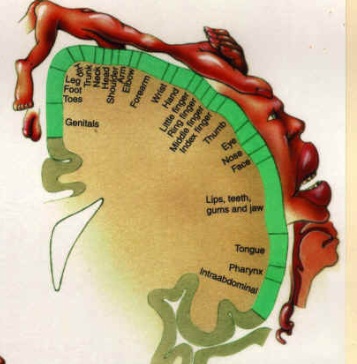
The main somatosensory map in the parietal cortex (S1) is non-judgemental - it records intensity only.
The affective network, the salience network, the threat-detecting "critter brain"(which includes the insular cortex and anterior cingulate cortex, part of the descending modulation/internal regulation system) is very judgey about contact. As manual therapists, if we know about this we can explain it to our patients so that when we touch them, they will be prepared in their "human" brain (4), for the contact we make with them. Then when we make that contact, they will be able to distance themselves from, or engage with, the sensations, as may be appropriate in the moment. They may even be better able to guide us, to help us help them better.
This is a picture of all the parts of the internal regulation system, and a description of its awesome powers. I call this the "critter brain." Our manual therapy should be mostly about helping patients win this part of their own brains over, in my opinion.
1. Löken LS; A Pathway for Pleasant Touch: Linking Peripheral Receptors To Central Processing And Hedonic Experience (thesis paper) U. Gothenburg, 2009
2. Morrison I; Reduced C-afferent fibre density affects perceived pleasantness and empathy for touch. Brain (2011)
3. Björnsdotter M, Morrison I, Olausson H; Feeling good: on the role of C fiber mediated touch in interoception. Exp Brain Res (2010) 207:149–155
4. Lundblad LC, Olausson HC, Malmeström C, Wasling HB; Processing in prefrontal cortex underlies tactile direction discrimination: An fMRI study of a patient with a traumatic spinal cord lesion. Neuroscience Letters 483 (2010) 197–200
5. Olausson H, Lamarre Y, Backlund H, Morin C, Wallin BG, Starck G, Ekholm S, Strigo I, Worsley K, Vallbo AB, Bushnell MC. Unmyelinated tactile afferents signal touch and project to insular cortex. Nat Neurosci. 2002 Sep;5(9):900-4.
1. Dermoneuromodulation (diagram, gearing up)
2. Dermoneuromodulation: Where it came from
Saturday, March 10, 2012
Dermoneuromodulation: The neuromatrix model of pain
I've written extensively about Melzack's Neuromatrix model of pain, here (on a wikipage), and elsewhere in this blog, most recently here.
The main story is to realize, to grok, to wrap one's head around the fact that pain is an output of the brain, not an input. Details are still arriving.
Here is a picture of the updated model.
What we want is to accomplish the following:
Or, this is good too:
Overall, what we REALLY hope we can do (with manual therapy), is this:
The main story is to realize, to grok, to wrap one's head around the fact that pain is an output of the brain, not an input. Details are still arriving.
Here is a picture of the updated model.
What we want is to accomplish the following:
![]() |
| DECREASE PAIN OUTPUT, IMPROVE MOVEMENT OUTPUT, WHICH IN TURN, MAY AFFECT STRESS OUPUT POSITIVELY |
Or, this is good too:
![]() |
| PAIN EDUCATION CAN HELP PATIENT FEEL THEY HAVE LOCUS OF CONTROL, WHICH MAY REDUCE THEIR STRESS LEVEL |
![]() |
| ADDITION OF CONTEXT-APPROPRIATE MANUAL THERAPY, CONSISTENT WITH PAIN EDUCATION |
We want our contact to be congruent with our education about the neuromatrix and pain. We want our contact to help, not hinder, the process of resolution of pain and movement impairment DUE to "pain". We want it to help reduce bad stress, but maybe the patient needs to use their own positive "stress response" (from their own locus of control) to get themselves free from pain. We want to augment the teaching we did (the magnifying glass in the diagram).
It's best if our physically applied input is kind, light, warm, non-nociceptive, steady. Skin stretching is not a bad way to proceed. If someone has fierce allodynia, you might try a mirror box and a soft sable makeup brush, applied to the skin on the opposite side, or an adjacent part of the somatosensory representation. Give their brain time to figure out the input and respond. Sometimes this means light contact over a longer period of time, not more pressure, or faster pressure.
Melzack R; Pain and the Neuromatrix in the Brain
1. Dermoneuromodulation (diagram, gearing up)
2. Dermoneuromodulation: Where it came from
Dermoneuromodulation: Neurodynamics, tunnel syndromes, cutaneous nerves.
![]() |
| Peripheral neurodynamics |
Michael Shacklock, another ortho person turned neurodynamic guy, was dedicated enough to bring back to life the original book by Alf Brieg, Adverse Mechanical Tension in the Nervous System. (It's mostly about spinal cord neurodynamics, of more interest to ortho-types of manual therapists, deep into structuralism, steeped by it, than it is to me, who has always stayed more outside the spine, conceptually and operatively. I prefer to affect the nervous system from its sensitive surface membrane, also ectodermal in origin, i.e., the epidermis and related exteroceptive and interoceptive capacity of its many sensory endings.)
Yet, as I sat in Butler's class, I felt my manual therapy worldview cave in - everything he said in terms of nerves, what they were about, how nociception became established, then amplified inside them, inside the system itself, made such sense it took me over completely, and I've been a nerve girl ever since, never gave "tissue" a second thought after that, especially fascia. Everything he said was congruent with another body of knowledge I had examined, embryologic development. You know those pictures that fool the brain into seeing two things at the same time, and you think you see it one way, but suddenly it looks like something else entirely?
That was me. I hadn't seen the rabbit for looking at what I thought was the duck. Abruptly, I graduated from what I call my "mesoderm" phase, and plunged headlong into an "ectoderm" phase from which I'll never emerge. Because at least now we're talking about the right kind of 'tissue' - skin, nerve, neural container, spinal cord and brain - all direct derivatives from ectoderm, all concerned with "management" of an organism. Not structural space-filler/moveable puppet part and their glued-together connectedness (bone, joint, muscle, tendon, ligament, fascia). It's all a lot more complex than this, of course, with different parts of the nervous system doing different jobs, and different parts of the brain running various subsystems of visceral afferent/efferent function, autonomic function and so on, but at least now, we no longer need to entertain the crazy idea that innocent tissue "causes" anything like "pain" or try to prove somehow that there is any sort of correlation between what we might do with our hands, when working with people, and any sort of pain reduction, based on having magically affected some sort of deeply buried "structure" with some goofy operator model of treatment, whether vitalistic or structuralist - that dualistic Descartes combination. It's about nervous systems interacting with each other, and stress reduction. How simple is that?
In 2007 I was fortunate enough to gain access to an anatomy lab and dissect out cutaneous nerves, which were the ones that interested me! They have feelings too. In live people that is. Michael Shacklock published a few of the photos in his newsletter. I wrote up a paper about it that is yet to be published somewhere. But, at least, it's now been done, and I figure, pulling gently on these little rami likely has some sort of beneficial effect on intrinsic circulation well up into the nerve they are part of, all the way up to the first synapse (neurologically) or into the dorsal root ganglia, maybe (physically, mechanically), especially if you handle body parts simultaneously, and make treatment stress free for the patient by eliminating gravity as much as possible.
Which brings us to the topic of tunnel syndromes.
I think that covers the topics on the right side of the dermoneuromodulation diagram, under "physicality". These are the considerations I have while treating as a manual therapist. I'm still "operator" model enough to need to think about something physical as I treat. I'm not zen enough to be completely content-free, pure interactor. Not yet anyway. But I'm a lot less "physical" and a lot more "therapist" than I was, once upon a time.
1. Michael Shacklock Clinical Neurodynamics
2. Dermoneuromodulation treatment manual (first draft) Diane Jacobs
1. Dermoneuromodulation (diagram, gearing up)
2. Dermoneuromodulation: Where it came from
Dermoneuromodulation: Where it came from
Introduction
Dermoneuromodulation represents my personal effort to make sense out of manual therapy in general. Manual therapy gradually evolved.
Given the advances in neuroscience in the last couple decades, and concomitant advances in pain science (although slower), ideas upon which manual therapy bases itself are due for overhaul, in my opinion, by starting further back than mere production of ever more outcome studies. Todd Hargrove, a thoughtful blogger, nails it perfectly in his post, Souless bodies and bodiless souls (3);
Manual therapy teaches a bunch of stuff about "proximate cause (1)." Manual therapists want to, and are taught to, take on the role of "operator(2)", not just humble interactor.
We seem to think that manual therapy can't be studied scientifically unless it can be isolated and specific effects determined. Problems arise with study designs, and poor interrater reliability seems ubiquitous. Even when separate outcome studies are good, the results don't seem to be able to stand up to statistical analysis very well (16,17). Could it be we asked wrong questions in the first place?
Rethinking the problem of pain
People who come for manual therapy come because they are experiencing pain (or some sort of discomfort with their body), usually.
Melzack(5) puzzled over pain for decades and finally concluded it was not an input, it was an output (see neuromatrix diagram here). He at least got us (manual therapists) that far, by separating nociception (an input) from pain, a brain output - he de-Cartesian-ized pain - not an easy task; it meant moving in opposition to 400 years of medical science which claimed pain was a bottom-up phenomenon (and still does, as do most forms of manual therapy). Melzack realized pain was biopsychsocial in nature, something that had to do, perhaps, with being lost in one's own embeddedness into, and ideas about, externalized reality, or not sufficiently aware of one's own physicality, or both, not able to detach from either when desired. His model is brilliant, clinically useful, and best of all, non-dualistic: we treat conscious, living people after all, not anesthetized patients. We are forced to interact - we do not have the luxury of (merely) 'operating' (2).
Another perspective on the same matter is offered by Quintner(6), who argues that far from being something that can be disassembled into bio-, psycho- or social components, pain is an aporia, which is to say...
So, rather than flailing about with manual therapy as my only tool, a tool, furthermore, honed and contaminated by centuries of Cartesian misunderstanding, I adapted myself to new information. Now I consider manual therapy to be just a tiny part of the process of interacting with people who have come in as patients with pain problems. Providing them with a boundaried therapeutic relationship is far more useful to them in the long term. The hands-on part may be both optional for some and optimal for others. But all PT patients will benefit by understanding simple facts about the nervous system and pain science (4) (however awkwardly confused, bottom-up, Cartesian such information may still be), couched in a framework such that it lays no blame on them or any of their body parts/mesodermal derivatives for having it, and at the same time leaves them with the locus of internal control they need for extracting their own conscious awareness out of it once more.
Is a new awareness is dawning in manual therapy?
I think maybe there might be (8-15).
.........................................
Dermoneuromodulation represents my personal effort to make sense out of manual therapy in general. Manual therapy gradually evolved.
Given the advances in neuroscience in the last couple decades, and concomitant advances in pain science (although slower), ideas upon which manual therapy bases itself are due for overhaul, in my opinion, by starting further back than mere production of ever more outcome studies. Todd Hargrove, a thoughtful blogger, nails it perfectly in his post, Souless bodies and bodiless souls (3);
"..vitalism and structuralism are two sides of the same dualistic coin..Vitalism is an example of belief in a “bodiless soul.” Vital energy is considered to be an animating force that exists outside the physical realm and is not reducible to it. And structuralism is the metaphorical flip side of the coin – the tendency to treat the body as a physical object, as opposed to an intelligent agent with feelings, thoughts and intentions."Scientific study of manual therapy
Manual therapy teaches a bunch of stuff about "proximate cause (1)." Manual therapists want to, and are taught to, take on the role of "operator(2)", not just humble interactor.
![]() |
| Examining the questions themselves |
Rethinking the problem of pain
People who come for manual therapy come because they are experiencing pain (or some sort of discomfort with their body), usually.
Melzack(5) puzzled over pain for decades and finally concluded it was not an input, it was an output (see neuromatrix diagram here). He at least got us (manual therapists) that far, by separating nociception (an input) from pain, a brain output - he de-Cartesian-ized pain - not an easy task; it meant moving in opposition to 400 years of medical science which claimed pain was a bottom-up phenomenon (and still does, as do most forms of manual therapy). Melzack realized pain was biopsychsocial in nature, something that had to do, perhaps, with being lost in one's own embeddedness into, and ideas about, externalized reality, or not sufficiently aware of one's own physicality, or both, not able to detach from either when desired. His model is brilliant, clinically useful, and best of all, non-dualistic: we treat conscious, living people after all, not anesthetized patients. We are forced to interact - we do not have the luxury of (merely) 'operating' (2).
Another perspective on the same matter is offered by Quintner(6), who argues that far from being something that can be disassembled into bio-, psycho- or social components, pain is an aporia, which is to say...
"...a space and presence that defies us access to its secrets. We suggest a project in which pain may be apprehended in the clinical encounter, through the engagement of two autonomous self-referential beings in the intersubjective or so-called third space, from which new therapeutic possibilities can arise."I see parallels between manual therapy with its attendent problems, and what I found in a revealing blog post interview (about psychiatry) with Richard Marken, discussing Perceptual Control Theory (7): Instead of looking at a human being from "outside" that human being, and his or her own "behaviour" (including pain "behaviour") as a problem of input/output, we could try to look at the behaviour itself as a process of control, by the organism itself/himself/herself.
So, rather than flailing about with manual therapy as my only tool, a tool, furthermore, honed and contaminated by centuries of Cartesian misunderstanding, I adapted myself to new information. Now I consider manual therapy to be just a tiny part of the process of interacting with people who have come in as patients with pain problems. Providing them with a boundaried therapeutic relationship is far more useful to them in the long term. The hands-on part may be both optional for some and optimal for others. But all PT patients will benefit by understanding simple facts about the nervous system and pain science (4) (however awkwardly confused, bottom-up, Cartesian such information may still be), couched in a framework such that it lays no blame on them or any of their body parts/mesodermal derivatives for having it, and at the same time leaves them with the locus of internal control they need for extracting their own conscious awareness out of it once more.
Is a new awareness is dawning in manual therapy?
I think maybe there might be (8-15).
.........................................
2. Operator/Interactor model (Diane Jacobs)
3. "Soulless Bodies and Bodiless Souls" (Todd Hargrove)
4. New treatment encounter Part I (Diane Jacobs)
5. Melzack R; From the gate to the neuromatrix. Pain. 1999 Aug;Suppl 6:S121-6.
7. Does Psychology Need a Revolution? An Interview with Richard Marken on the Radical Implications of Perceptual Control Theory.
3. "Soulless Bodies and Bodiless Souls" (Todd Hargrove)
4. New treatment encounter Part I (Diane Jacobs)
5. Melzack R; From the gate to the neuromatrix. Pain. 1999 Aug;Suppl 6:S121-6.
6. Pain Medicine and its Models: Helping or Hindering? (John Quintner et al)
Quintner, J. L., Cohen, M. L., Buchanan, D., Katz, J. D., & Williamson, O. D. (2008). Pain medicine and its models: Helping or hindering? Pain Medicine, 9(7), 824–834. doi:10.1111/j.1526-4637.2007.00391.x7. Does Psychology Need a Revolution? An Interview with Richard Marken on the Radical Implications of Perceptual Control Theory.
8. Bialosky JE, Bishop MD, George SZ, Robinson ME. Placebo response to manual therapy: something out of nothing? J Man Manip Ther. 2011 Feb;19(1):11-9. (free access)
9. Bialosky JE, Bishop MD, Price DD, Robinson ME, George SZ. The mechanisms of manual therapy in the treatment of musculoskeletal pain: A comprehensive model Man Ther. 2009 Oct;14(5):531-8. Epub 2008 Nov 21. (Open access)
10. Bialosky JE, George SZ, Bishop MD. How spinal manipulative therapy works: why ask why? J Orthop Sports Phys Ther. 2008 Jun;38(6):293-5. Epub 2008 May 27.
11. Lucas N, Macaskill P, Irwig L, Moran R, Bogduk N. Reliability of Physical Examination for Diagnosis of Myofascial Trigger Points: A Systematic Review of the Literature Clin J Pain. 2009 Jan;25(1):80-9.
12. Maher CG, Latimer J, Adams R. An investigation of the reliability and validity of posteroanterior spinal stiffness judgments made using a reference-based protocol. Phys Ther. 1998 Aug;78(8):829-37.
13. M. J. Hancock, C. G. Maher, J. Latimer, M. F. Spindler, J. H. McAuley, M. Laslett, and N. Bogduk; Systematic review of tests to identify the disc, SIJ or facet joint as the source of low back pain. Eur Spine J. 2007 October; 16(10): 1539–1550.
Published online 2007 June 14. doi: 10.1007/s00586-007-0391-1 PMCID: PMC2078309
14. Frédéric Wellens, B.Sc., pht, RCAMPT. The traditional mechanistic paradigm in the teaching and practice of manual therapy : Time for a reality check. 2010
15. M. Zusman, "The Modernisation of Manipulative Therapy," International Journal of Clinical Medicine, Vol. 2 No. 5, 2011, pp. 644-649. (open access)
16. Rubinstein SM, van Middelkoop M, Assendelft WJ, de Boer MR, van Tulder MW. Spinal manipulative therapy for chronic low-back pain. Cochrane Database Syst Rev. 2011 Feb 16;(2):CD008112.
17. Rubinstein SM, van Middelkoop M, Assendelft WJ, de Boer MR, van Tulder MW. Spinal manipulative therapy for chronic low-back pain: an update of a Cochrane review. Spine (Phila Pa 1976). 2011 Jun;36(13):E825-46.
1. Dermoneuromodulation (diagram, gearing up)
Labels:
Bialosky,
dermoneuromodulation,
Hargrove,
Lucas,
Maher,
Melzack,
neuromatrix,
operator/interactor,
Quintner,
Wellens,
Zusman
Wednesday, March 07, 2012
Dermoneuromodulation: Ruffini sensory endings and dorsolateral prefrontal cortex
I found a paper lately, Processing in prefrontal cortex underlies tactile direction discrimination: An fMRI study of a patient with a traumatic spinal cord lesion.
"We have investigated cortical processing of tactile direction discrimination (TDD) in a patient with unilateral tactile disturbance due to spinal cord lesion. The patient R.A. (male, 45 years old), suffers from a traumatic dorsal column lesion at the level of Th XI-XII on the right side. He was instructed to report the direction of 2mm long skin pull stimulations applied in a proximal or distal direction on his right or left lower legs during functional magnetic resonance imaging (fMRI). Although R.A. considered himself to have nearly normal tactile sensibility, testing showed severely disturbed TDD on his right leg whereas results were within the range of healthy subjects on his left leg. For both legs TDD activated an extensive cortical network that included opercular parietal area 1 (OP1) of the second somatosensory cortex (S2), as has previously been observed in healthy subjects. However, dorsolateral prefrontal cortex (DLPFC) and anterior insular cortex (AIC) were only activated for the unaffected (left) leg where TDD was normal. A revisit of previously published data showed that healthy subjects consistently had TDD-related activations in DLPFC and AIC. However, in several healthy subjects AIC, but not DLPFC, was also activated for skin pull stimulations per se without the TDD task. Thus, the patient's data, in conjunction with the previous results from healthy subjects, suggest that DLPFC processing is important for tactile decision making based on proper tactile input."Their subject was an individual who had sustained a cord lesion two years prior (due to a mishap by a person providing him with epidural anesthesia for a colon operation). The lesion was at the level of T11-12, 12mm long and 2mm wide, to the right of the cord medulla, in the dorsal column. This left him with sensory deficit - the point of the study was to determine exactly what sort. He had right leg pain, and some difficulty running, although he could still run.
The authors used a device that could apply skin stretch (2 millimeters) in a directional, quantifiable manner, to hairy skin on the human leg, and looked at that was happening in the brain at the same time via fMRI. To the right is a picture of it. It went into the fMRI machine with him. They glued a 2-mm rod to the lower leg with which to pull the skin. The paper describes all the details of how the testing was conducted, how much, how long, how many times, etc.
From the paper:
"TDD for a high-friction stimulus (i.e. lateral skin pull stimulation) utilizes information about patterns of skin stretch [8,18] mainly signalled by a population of slowly adapting type 2 (SA2) afferents (commonly regarded as Ruffini afferents)"
![]() |
| Could this be why skin stretching, or massage, or any 'kind' of manual therapy, is often effective for reducing pain, clinically, at least in the short term? |
From the paper:
"The DLPFC has been reported to be involved in sensory decision making [11]. In an fMRI study on a vibration discrimination task in healthy subjects it was found that the level of activity in the left DLPFC correlated to the accuracy of the perceptual decisions [21]. Our results showed DLPFC activation only for the patient’s unaffected (left leg) where he was able to perceive the difference in movement direction in TDD and thus gave more correct answers. Further, we found reliable activation of DLPFC in healthy subjects during TDD but not during skin pull stimulation per se. Thus, it seems reasonable to suggest that DLPFC is involved in tactile decision making based on proper tactile input [21]."Just think about that for a minute: tactile decision making - not just sensing.
Interestingly the authors state that they saw no activation of S1. It may be that S1 responds only to novel exteroception. Perhaps once the rod was glued in place, the S1 ignored it, and, perhaps Ruffini ending information bypasses S1, reaches the DLPFC through some other pathway connected to interoceptive processing, but only if dorsal column information is available in the first place to be sent there.
Linda C. Lundblad, Håkan W. Olausson, Clas Malmeström, Helena Backlund Wasling; Processing in prefrontal cortex underlies tactile direction discrimination: An fMRI study of a patient with a traumatic spinal cord lesion. Neuroscience Letters, Volume 483, Issue 3, 15 October 2010, Pages 197-200
1. Dermoneuromodulation (diagram, gearing up)
2. Dermoneuromodulation: Where it came from
Monday, March 05, 2012
Neuroplasticity, neurogenesis baby!
Today while I was at the gym I became very interested in the experience one of the managers has had with a vibrating machine there. It's been there a long time, and so has she, but she only started using it three weeks ago. She uses it up to 20 minutes a day, just standing on it and holding on to the sides, letting it shake her at a very high frequency and tiny amplitude. Some days she only has time to be on it a few minutes. But I'm getting ahead of myself. Let me introduce her to you. I'm going to call her Susie (not her real name). She has given me permission to blog about her.
Twenty-five years ago, friendly outgoing Susie was 22 years old, in good health. She was having a baby by C-section. Something bad happened, and she had a stroke that affected her left side.
I met Susie 5 months ago when I started attending the little women's gym here in town. I noticed that she was unable to use her left arm, and that she walked with a limp. For all I knew, she might have been born with a disability. She does everything needed for her job, which includes measuring for inches lost on all the clients at the gym, with her right hand, and also takes care of her family, runs a house, doesn't let anything stop her.
Today, she started chatting about how she is regaining function in her arm, and demonstrated a couple things - most of her movement regained so far is in shoulder girdle function - she can raise her arm up over her head while standing, in supine she can raise her arm over her head, can externally rotate, but not internally, not yet at least. But she can also bend her elbow to about 90 degrees. The thing she's most proud of is being about to support her weight on that arm in prone enough to enable her to do a "plank". She showed me that her fingers have started to move a bit as well.
All of this is after 25 years. And after being told that part of her brain that runs her arm was dead and would never recover. In typical Susie style, she wants to get back enough hand function to at least be able to flip a bird at the doctor who told her that. All this improvement in just 3 weeks, after 25 years, by using a vibrator platform.
Remarkable, no? Never say never.
LINKS:
Twenty-five years ago, friendly outgoing Susie was 22 years old, in good health. She was having a baby by C-section. Something bad happened, and she had a stroke that affected her left side.
I met Susie 5 months ago when I started attending the little women's gym here in town. I noticed that she was unable to use her left arm, and that she walked with a limp. For all I knew, she might have been born with a disability. She does everything needed for her job, which includes measuring for inches lost on all the clients at the gym, with her right hand, and also takes care of her family, runs a house, doesn't let anything stop her.
Today, she started chatting about how she is regaining function in her arm, and demonstrated a couple things - most of her movement regained so far is in shoulder girdle function - she can raise her arm up over her head while standing, in supine she can raise her arm over her head, can externally rotate, but not internally, not yet at least. But she can also bend her elbow to about 90 degrees. The thing she's most proud of is being about to support her weight on that arm in prone enough to enable her to do a "plank". She showed me that her fingers have started to move a bit as well.
All of this is after 25 years. And after being told that part of her brain that runs her arm was dead and would never recover. In typical Susie style, she wants to get back enough hand function to at least be able to flip a bird at the doctor who told her that. All this improvement in just 3 weeks, after 25 years, by using a vibrator platform.
Remarkable, no? Never say never.
LINKS:
- Video: How Neurons are Born, with Fred Gage
- Going mental: Study highlights brain’s flexibility, gives hope for natural-feeling neuroprosthetics
Whole-Body Vibration Has No Effect on Neuromotor Function and Falls in Chronic Stroke.
4. No specific effect of whole-body vibration training in chronic stroke: a double-blind randomized controlled study.
5. Whole-body vibration improves walking function in individuals with spinal cord injury: a pilot study
Thank you to Anoop Balachandran at Exercise Biology blog for the abstracts.
Sunday, March 04, 2012
New treatment encounter VI
New treatment encounter I
New treatment encounter II
New treatment encounter III
New treatment encounter IV
New treatment encounter V
Dermoneuromodulation
The "new treatment encounter" series has been about how to set up a treatment relationship with a new patient. The manual therapy part is probably the least important part of the encounter, yet, for persisting localized interfering pain that presents as mostly mechanical in nature, it seems to be necessary most of the time. So I do not think we'll be getting away from providing it any time soon.
Here is a link to a public post on SomaSimple. If you have burning curiosity about this method of treating someone manually, I have posted a link there to a pdf of a slideshow I use to teach other human primate social groomers what I expect is going on in a patient's nervous system during treatment. It shows a couple samples of techniques, but really, the slideshow is about the underpinnings, as outlined in the previous post, Dermoneuromodulation, the diagram of the conceptual scaffolding. I'll do another series on the various parts contained within it, but first, I want to develop the idea of the neuromatrix model a bit more.
In summary, the all important setting up of the treatment relationship, and the physical side of the treatment, is all about "entering the left side of the neuromatrix," as my massage therapist colleague, Carol Lynn Chevrier in Quebec, likes to say.
Here is the new updated model by Melzack:
As you can see, there are domains on the left where input enters a patient's "Neuromatrix", that always-moving, more-a-verb-than-a-noun aspect of brain function that gives rise to sense of self in a physicality, in a humanantigravitysuit, that fuzzy border zone between critter brain and awareness of being human too, social-self-awareness. What we are striving to do, is assist a transformation of a favourable sort, in that center part, in that part with circular arrows, busily, constantly, churning away. We want different output. But as therapists, we have no control over that transformation. Only the patient, inside his or her own brain (including spinal cord), can make that transformation happen. Only then can there be different output on the right side of the neuromatrix.
We want to see the pain domain shrink, and the action/motor output domain improve, enlarge, soften, become effortless, become warm.
This is what every authentic human primate social groomer under the sun wants to see happen, in our heart of hearts: This is what motivates us - we want to help - we want to see improvement in the life of another human primate who is experiencing physical pain, by interacting with them, physically, manually. By "grooming" them. We want to ease suffering. (OK, I'll stop this train of thought before I get too carried away.)
Usually, if the treatment crucible has been well-prepared, and the various input domains considered in advance, i.e., the teaching has been congruent with the patient's own reality (top left domain), the handling has been a pleasant, or at least not unpleasant, experience for the patient (middle left domain), and they were primed to expect to take part themselves, develop a sense of self-efficacy in their own improvement (bottom left domain), it pretty much turns out just like this, every time. Just like water rolling down a hill. It's that easy.
But, like I described in New treatment encounter IV, there are some patients who just do not get it. And if that happens once in awhile, it's nobody's fault - there are just some oceans that can't be swum. When you spend a lifetime doing this, you get better at it, and eventually you enjoy way more hits than you endure misses. But everyone will still have misses. They are inevitable. And... we move on. Keep trying to improve.
.......
New treatment encounter II
New treatment encounter III
New treatment encounter IV
New treatment encounter V
Dermoneuromodulation
The "new treatment encounter" series has been about how to set up a treatment relationship with a new patient. The manual therapy part is probably the least important part of the encounter, yet, for persisting localized interfering pain that presents as mostly mechanical in nature, it seems to be necessary most of the time. So I do not think we'll be getting away from providing it any time soon.
Here is a link to a public post on SomaSimple. If you have burning curiosity about this method of treating someone manually, I have posted a link there to a pdf of a slideshow I use to teach other human primate social groomers what I expect is going on in a patient's nervous system during treatment. It shows a couple samples of techniques, but really, the slideshow is about the underpinnings, as outlined in the previous post, Dermoneuromodulation, the diagram of the conceptual scaffolding. I'll do another series on the various parts contained within it, but first, I want to develop the idea of the neuromatrix model a bit more.
In summary, the all important setting up of the treatment relationship, and the physical side of the treatment, is all about "entering the left side of the neuromatrix," as my massage therapist colleague, Carol Lynn Chevrier in Quebec, likes to say.
Here is the new updated model by Melzack:
As you can see, there are domains on the left where input enters a patient's "Neuromatrix", that always-moving, more-a-verb-than-a-noun aspect of brain function that gives rise to sense of self in a physicality, in a humanantigravitysuit, that fuzzy border zone between critter brain and awareness of being human too, social-self-awareness. What we are striving to do, is assist a transformation of a favourable sort, in that center part, in that part with circular arrows, busily, constantly, churning away. We want different output. But as therapists, we have no control over that transformation. Only the patient, inside his or her own brain (including spinal cord), can make that transformation happen. Only then can there be different output on the right side of the neuromatrix.
We want to see the pain domain shrink, and the action/motor output domain improve, enlarge, soften, become effortless, become warm.
This is what every authentic human primate social groomer under the sun wants to see happen, in our heart of hearts: This is what motivates us - we want to help - we want to see improvement in the life of another human primate who is experiencing physical pain, by interacting with them, physically, manually. By "grooming" them. We want to ease suffering. (OK, I'll stop this train of thought before I get too carried away.)
Usually, if the treatment crucible has been well-prepared, and the various input domains considered in advance, i.e., the teaching has been congruent with the patient's own reality (top left domain), the handling has been a pleasant, or at least not unpleasant, experience for the patient (middle left domain), and they were primed to expect to take part themselves, develop a sense of self-efficacy in their own improvement (bottom left domain), it pretty much turns out just like this, every time. Just like water rolling down a hill. It's that easy.
But, like I described in New treatment encounter IV, there are some patients who just do not get it. And if that happens once in awhile, it's nobody's fault - there are just some oceans that can't be swum. When you spend a lifetime doing this, you get better at it, and eventually you enjoy way more hits than you endure misses. But everyone will still have misses. They are inevitable. And... we move on. Keep trying to improve.
.......
Friday, March 02, 2012
Dermoneuromodulation
I've been asked to write a guest post about DNM for two weeks from now, so I better start thinking about how, I guess. I need 600 words.
I made a picture of the concepts involved a long time ago and never have done anything with it. Here it is:
It contains the topics I address whenever I teach this in workshops. Really, dermoneuromodulation amounts to being interested in and careful about the true physical interface of contact by a manual therapist on a patient's body. Everyone who does manual therapy is already 'doing' some kind of dermoneuromodulation whether they realize it or not (if the patient is alive and unanesthetized at least, as most are!) - dermoneuromodulation is just a more conscious systematic examination of contact with a patient, with no conceptual hallucination of the mesodermal kind. Mostly. Much much reduced, at least.
I made a picture of the concepts involved a long time ago and never have done anything with it. Here it is:
It contains the topics I address whenever I teach this in workshops. Really, dermoneuromodulation amounts to being interested in and careful about the true physical interface of contact by a manual therapist on a patient's body. Everyone who does manual therapy is already 'doing' some kind of dermoneuromodulation whether they realize it or not (if the patient is alive and unanesthetized at least, as most are!) - dermoneuromodulation is just a more conscious systematic examination of contact with a patient, with no conceptual hallucination of the mesodermal kind. Mostly. Much much reduced, at least.
Subscribe to:
Posts (Atom)