Monday, May 12, 2014

SKIN STRETCHING AND MOVEMENT ILLUSIONS


My take on why manual therapy "works", part 4.

OLDER POSTS IN THIS SERIES


Part 1: IS MANUAL THERAPY EVEN NECESSARY?
Part 2: NEUROTAGS! YOU'RE IT! 
Part 3: ABOUT "LEARNING" 
NEWER POSTS IN THIS SERIES
Part 5: TACTILE DIRECTION DISCRIMINATION IN THE DORSOLATERAL PREFRONTAL CORTEX
Part 6: MORE ABOUT DORSOLATERAL PREFRONTAL CORTEX
Part 7: TREATMENT CONTEXT, NON-SPECIFIC EFFECTS 
Part 8: SOME FINAL THOUGHTS ON NON-SPECIFIC EFFECTS

The 4th statement from the SomaSimple post is this:
4. Add a novel stimulus, e.g., skin stretching (see Gandevia and Collins 2005)(1), allow the brain to enjoy a movement illusion. "Illusory movements were evoked at the interphalangeal (IP) joints of the index finger, the elbow, and the knee by stimulation of populations of cutaneous and muscle spindle receptors, both separately and together."

SKIN INPUT AFFECTS MOTOR OUTPUT

Simon Gandevia has been at this whole neurophysiology business for decades. I tried to read his papers a number of years ago (but got distracted by something else, as usual..)
Anyway, I remember one paper in which he had difficulty separating all those annoying cutaneous receptors away from all the juicy muscle spindle receptors he was actually trying to get at and measure. I think it had to do with reflex testing - you know, tapping the patellar tendon to get the quads to jump a bit. In this paper, it looks like he succeeded in isolating muscle spindles but at the same time, Collins and he decided to study cutaneous receptors as well - their effects on movement illusion.

It's a great little paper. In my life it represents a bit of a watershed paper in that it pointed out a really important thing - that the brain takes cues from receptors in skin (and this from a muscle spindle researcher!), not just from muscle. You see, back in the day, my training was completely lopsided - the nervous system was only important for, and was taught as, a motor output system. There was no emphasis on anything afferent, except from muscle spindles. Nervous system as black box connected only to muscles, input or output. Everything else, inconsequential.
Unless you are an aspiring human primate social groomer - then it would have been really nice to have learned something about how the brain codes for skin-put.

Anyway, back to the Collins and Gandevia paper. Not only does the brain take cues from receptors in skin, it creates movement illusions based only on the information it gets from skin! Remarkable. Sort of a ++ for simple human primate social grooming. Aha! So, if you want the brain to think there is more space around a certain place, like a knee joint maybe, stretch the skin there and see if the knee will bend further after. (It will, most of the time. Unless there is an actual mesodermal blockage in there, and not just a critter brain, interoceptive pain illusion that feels like a restriction.)

Gandevia and Proske published another paper (2) a few years ago about kinesthesia.
Turns out Ruffini endings contribute to proprioception. What do you know? In fact they say skin receptors are more likely to play a role in joint position sense than joint receptors do. Oh, they still love their muscle spindles, of course, but look: 

"The cutaneous receptor most likely to subserve a kinaesthetic role is the skin stretch receptor, the slowly adapting Type II receptor served by Ruffini endings (Chambers et al.1972Edin, 1992). For kinaesthesia at the forearm, stretch of skin over the elbow during elbow flexion can provide information about both position and movement. Movement illusions generated by stretch of skin of the hand and over more proximal joints, when combined with muscle vibration were greater than when either stimulus was applied on its own (Collins et al. 2005). The authors made the point that this was not just a matter of skin input facilitating the muscle input and that cutaneous input generated by skin stretch contributed to kinaesthesia in its own right."
Now, add this together with what Olausson and his colleagues have been doing in Sweden for decades(3), and I think we have a case for skin-put having an important role in the world. Not that we're going to ever stop doing it - human primate social groomers are just doing what our own vertebrate mammal primate nervous systems have always done, since whenever they started self-organizing then interacting half a billion years ago. 


YES-CICEPTIVE INPUT

I have already blogged my fingers to the bone about Olausson and his group in Sweden. Read all about it.


  • THE FINE OLD ART OF FINGER PULLING


  • Don't be confused about this video - a lot of emphasis has been placed on the visual component of the illusion. I would argue that the kinesthetic component is equally if not more important. It wouldn't be very hard for some clever researcher type to design a test for that - blindfold one group of participants, pull their fingers in exactly the same way, in the machine. Have another group just look, don't touch them at all. Use the mirrors to make it look like their fingers lengthen all by themselves. A third group could have both illusions at the same time. 

    I bet the last group would have the best results, but hey, if the first group had pretty good results, you wouldn't need a great big expensive machine to create a movement illusion, and ordinary human primate social grooming would be vindicated.

    1. Collins D, Refshauge KM, Todd G, Gandevia SC; Cutaneous receptors contribute to kinesthesia at the index finger, elbow, and knee. J Neurophysiol. 2005 Sep;94(3): 1699-706 (full text pdf)

    2. Proske U, Gandevia SC; The kinaesthetic sensesThe Journal of Physiology, 587, 4139-4146. (full text)

    3. Mind tricks may help arthritic pain

    4. Illusion could halve the pain of osteoarthritis, scientists say


    Sunday, May 11, 2014

    ABOUT "LEARNING"

    My take on why manual therapy "works", part 3.

    OLDER POSTS IN THIS SERIES
    Part 1: IS MANUAL THERAPY EVEN NECESSARY?
    Part 2: NEUROTAGS! YOU'RE IT!

    NEWER POSTS IN THIS SERIES
    Part 4: SKIN STRETCHING AND MOVEMENT ILLUSIONS
    Part 5: TACTILE DIRECTION DISCRIMINATION IN THE DORSOLATERAL PREFRONTAL CORTEX 
    Part 6: MORE ABOUT DORSOLATERAL PREFRONTAL CORTEX 
    Part 7: TREATMENT CONTEXT, NON-SPECIFIC EFFECTS 
    Part 8: SOME FINAL THOUGHTS ON NON-SPECIFIC EFFECTS
    .....................

    Moving on to point 2 and 3 in the little SomaSimple post list:


    2. Something new has to be added for the brain to get busy with. Manual contact provides it a way to distract itself from the unfortunate neurotag, long enough to get itself started on building a new representation of somatic "reality" - a new neurotag.
     3. The old one will never go away, but the brain can now "choose" to adapt itself to the new one. It's called extinction learningand happens at the receptor level of brain operation. Once that happens, old triggers are no longer triggery

    What do I mean by that? It's a pretty compact statement to make. There is much to unpack in it.
    Let me try.

    First off, I've convinced myself there are at least two brains in there, critter and human:
    1.  critter brain, mostly interoceptive, an internal regulation system, all the brain stuff that works from day one when we are born, even if it takes a bit longer to mature in some aspects. All the brain nuclei that keep us alive, as individuals, and later, come online to keep us alive as a species.  The part of the brain that is born knowing how to swallow, blink, burp, throw up, breathe, sleep; it's the brain that puts us to sleep at night, but keeps our heart beating and our lungs breathing. Rolls us over in the night, hopefully without waking us up. Wakes us up in the morning because it's hungry and wants us to go get it something to eat. It's the brain that runs our blood flow, our temperature, our immune system, our descending modulation to nociceptive input. It started out as a spinal cord, invented by fish, half a billion years ago. The front end of it added more hard drive as critters became more complex, faced more complex challenges, like gravity, by adapting movement behaviour to physical forces, couldn't reproduce anymore just by squirting out eggs and sperm into the water and hoping they bumped into each other. We still have all that stuff, because nature never throws out anything that works - it just adapts it to new purpose, an evolutionary principle known as exaptation.
    But be aware, the spinal cord, even though it doesn't have much hard drive, at ALL, will automatically take care of motor output business reflexively, whenever it can - that is to say, whenever it isn't being tonically inhibited by more rostral centers. Uh-oh - more words..
    "Tonically" means continually. As opposed to "phasically", which means in a punctuated manner. These words crop up all the time when you read about the brain(1).

    Tonic would be like holding your hand under a dribble of water flowing continuously from a tap. Phasic would be one drop of water falling on your hand, then another, indefinitely(2). EXAMPLE: 

    "Second, inhibition can be "phasic" or "tonic". Phasic inhibition is a short-lasting inhibition typically generated by the activation of GABAA receptors following action potentials in a presynaptic interneuron. However, there are also more long-lasting forms of inhibition. One form is the activation of GABAB receptors by spillover of GABA caused by GABA release from specialized interneurons. A second form is the "tonic" GABAA conductance activated by ambient GABA in the extracellular space (Farrant and Nusser, 2005). This form of inhibition is mediated by molecularly and functionally specialized GABAA receptors(2)."
    2. a human brain, externally driven, mostly exteroceptive, dependent on social relations and symbolic thought, the one "we" live in and consider as "I". This consists of the expansion of frontal lobes and the association cortices. The one that makes up rules to live by in consensus with other human primates, then decides that's the "right" way to live and everyone who doesn't is by definition "wrong" (or at least suspicious..)
    The human brain can be taught how to be more aware of interoception.

    Anyway, I'm not entirely sure, but pretty confident, that in the case of pain, it's the critter brain that "makes" it, or else just doesn't inhibit nociception in a timely or effective manner, then sends it forward or else simply lets the info travel all though the brain, including to the "conscious awareness" bits, where the human brain "perceives" it.

    I see my job as distracting the one while competently handling the other, so that the two might live together in harmony once more, through new learning. Each learning episode seems to take at least two minutes. I don't think any lasting change can happen in there in any shorter length of time.

    Here is where I'm just making stuff up: I can't prove any of this, all I can do is write about my thought process.
    There are many types of learning.
    Here are a group of blog posts on the topic, from Neurotonics, which developed from this one by Matthias Weinberger, The Devil is in the Details.

    I think the kind I favour for the process of manual therapy learning, kinesthetic learning, is extinction learning (3). I have no idea if it's the case, but it makes sense to me. Pain becomes tied up in fear. Fear (of moving) is involved. Fear (of moving) must be disengaged. The brain makes a new representation of its "bodymaps"every couple nanoseconds (4). 


    Stress is involved in "learning" - the right amount of glucocorticoids will facilitate learning. Too much will be harmful. "Pain" is "learned" at a synaptic level. "Pain" is reinforced through social stress, be it real or just perceived. (Which means, for us independent human primate social groomers, we can give ourselves some leeway - there are some pain mountains out there that we just aren't going to be able to climb. We can't fix some of our patients' broken lives. Furthermore, some people's pain, even though it may be biopsychosocial, may have abnormal "bio.")

    If you can provide a patient's human brain with a window of relief, in which it can move its physicality freely again, and it's a normal intact brain, it will rapidly accept/learn the new representation. Positive feedback loops are interrupted.
    The human brain can get back in charge of the critter brain. It will take back its right to move its physicality, easily. Like water rolling down a hill. Critter brain will have stopped "biting" the human brain.

    So, it's the critter brain we want to distract. How? By offering a new input. It's kind of automatic that the critter brain's salience network will come over to sniff out a new input, even innocuous. Meanwhile, we are not doing anything the human brain finds the least bit uncomfortable. Or at least we shouldn't be, in my opinion. 

    The human brain is in on the plot to contain the critter brain, because we provided it with information at the start. In this way, we can work together (psycho-social) to overcome the critter brain (bio), from top down and bottom up at the exact same time. The therapist helps from the outside by creating the treatment context, a story-line maybe, maybe about helping move/feed/drain nerves or something (that's the one I use all the time). But the patient's human brain will be doing all its own heavy lifting/changing/neuroplasticizing around the new input. 

    1. Mark Farrant, Zoltan Nusser; Variations on an inhibitory theme: phasic and tonic activation of GABAA receptorsNature Reviews Neuroscience 6215-229 (March 2005)
    2. Neural inhibition. Peter Jonas, Gyorgy Buzsaki, Scholarpedia page
    3. Edwin Santini, Robert U. Muller, and Gregory J. Quirk; Consolidation of Extinction Learning Involves Transfer from NMDA-Independent to NMDA-Dependent Memory. The Journal of Neuroscience, 15 November 2001, 21(22): 9009-9017 4. Notes re: Interoception, from A.D. (Bud) Craig's lecture.

    Saturday, May 10, 2014

    NEUROTAGS! YOU'RE IT!


    OLDER POSTS IN THIS SERIES

    .............................................


    Earlier I posted "Is manual therapy even necessary?" Probably not, in the long run... However, it has a place in the short run. This blog series is an exploration of that.

    Yesterday I quickly scratched down thoughts with supporting evidence, and listed them in a blogpost here. The plan is to flesh out these ideas a bit better, in this blog series.

    The first point is about neurotags.
    I wrote,

    "1. The brain, once a neurotag has arisen and become easily triggered, can't go back to being a brain that never had that neurotag. (I think of a neurotag as a tangled mess of enhanced firing, sort of like a positive feedback loop but more of a birds' nest than a simple loop)"

    So, let's discuss neurotags first.

    What is a neurotag?
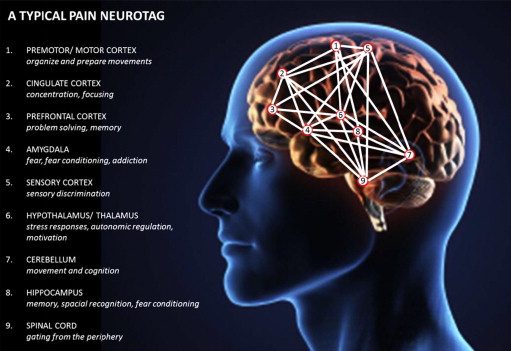
    A neurotag is a "pattern of neuron activation which creates a certain output of the brain, such as a perception, thought, movement or immune system response."(1)
    ".. when someone mentions a slipped disc, and you activate your neurotag for “slipped disc” to think about it, you also activate some of the member cells for your back pain neurotag.  Therefore thinking about a slipped disc will lower the threshold for activation of your back pain neurotag.  Get it?  Reread if necessary! This is a very simple explanation for why pain can be modified by so many different inputs."

    SOURCE: Zac Cupples (3)

    Construction of a neurotag is perfectly normal brain behaviour. It's not about your brain being defiant or evil or mean to you. It's how brains remember what they have learned - they build associations. Synapses are involved. Enhanced signalling is involved. Glia are involved, along with 250,000,000 synaptic proteins that turn over every few days (4). Imagine that.
    When I think of a pain neurotag, I think of a cobweb gathering dust. I also remember the ant swarm that got stuck in a positive feedback loop around the base of a tree, and couldn't break free (5). I think of Erik Meira's post (6) about positive feedback loops, Getting Rid of SomethingPositive.
    "Remember "positive" does not mean "good" when we talk science. It means "additive".


    .......................................

    1. Review of Moseley/Hodges Talk Part Two Todd Hargrove, BetterMovement.org blog, Oct21/2012
    2. What is a Neuromatrix? David Butler, Neuromatrix Training blog, Jan22/2008
    3. Graded Motor Imagery, Zac Cupples, April 24/2013
    4. The Remarkable Neuron: Erin Schuman at TEDxCaltech, youtube video 14:30, Feb8/2013
    5. The Ants go Marching One by One... Diane Jacobs, HumanAntiGravitySuit blog, April30/2014
    6. Getting Rid of Something Positive Erik Meira, The PT Podcast blog, April9/2014

    My take on why manual therapy "works" Part 1

    Part 1: IS MANUAL THERAPY EVEN NECESSARY?

    This series will be a longish look over several blog posts at all the ways I can think of that the nervous system of another will "feel" our own.

    Of course, manual therapy won't work (for pain) without...

    1. some sort of explanation beforehand - hopefully pain ed. that is congruent with reality and doesn't contain any tissue based nocebo.. (1
    2. movement therapy afterward, and suggestions re: avoiding behaviours that people unwittingly do that contribute to a pain presentation unique to them. (E.g., always standing on one leg, always sleeping on the same side, always sitting with the same elbow leaning on the same arm of the couch, always turning the head the same way to watch TV...)
    Let me be clear - manual therapy is optional. The aspects of treatment before and after manual "treatment" will work by themselves, a lot of the time. But manual therapy sandwiched in there can be optimal, in my opinion. 

    Whether it is optimal will depend entirely on how we explain what it's "for" - we need to improve the language around manual therapy!

    As Adriaan points out,
    "First, let’s discuss the assumption that pain comes from tissues. The Cartesian model that correlates tissue issues (nociception) to pain is over 350 years old, and it’s still doctrine in medicine and various therapies. The model is false. You can have tissue injury and no pain. You can have pain and no tissue injury. For too long, practitioners and patients have sought answers to their pain by exploring the various tissues, including joints, muscles, ligaments and more. Pain is leading reason that people seek care, and when they do seek help for pain, they are presented a tissue-based model to explain their pain. Think about it: A patient comes to you seeking help for pain, and you teach the patient anatomy! No wonder pain rates in the US have doubled in the last 15 years alone. Never before have we performed as much surgery or prescribed as much medicine for pain in the history of mankind, and pain rates are ever increasing. A large portion of the blame should be leveled at these outdated models. It’s time practitioners wake up and realize people in pain are interested in…pain! 
    This leads us directly to the second issue."There is also an assumption that patients are not smart enough to learn the latest neuroscience of pain. Shame on us for thinking that. Research has shown patients are in fact able to understand the biological processes of pain. Therapeutic neuroscience education (TNE) takes complex neurobiological and neurophysiological processes and explains pain to patients via metaphors, examples and pictures. We have been teaching people about pain for years, in various countries, to different age groups, in different languages, to various ethnicities, etc. The end result? They all get it. The best part is they experience less pain and disability; move and function better despite no hands-on interventions; catastrophize less; are less afraid and are able and willing to move further into pain during exercise and functional tasks. Healthcare education has simply become a display of knowledge. “Let me tell you how much I know about….” The language we use is completely foreign to patients. Even more worrisome, the current medical vocabulary contains various terms and languages that actually increase fear and anxiety. Ever been guilty of using terms like torn, ripped, instability, bleeding, rupture and so forth?"


    So, let's try to reinvent language around manual therapy.

    1. Every Chronic Pain Patient Has a Brain - Adriaan Louw


    Newer posts in this series:
    Part 2: NEUROTAGS! YOU'RE IT! 
    Part 3: ABOUT "LEARNING"
    Part 4: SKIN STRETCHING AND MOVEMENT ILLUSIONS

    Part 5: TACTILE DIRECTION DISCRIMINATION IN THE DORSOLATERAL PREFRONTAL CORTEX
    Part 6: MORE ABOUT DORSOLATERAL PREFRONTAL CORTEX
    Part 7: TREATMENT CONTEXT, NON-SPECIFIC EFFECTS 
    Part 8: SOME FINAL THOUGHTS ON NON-SPECIFIC EFFECTS


    Wednesday, April 30, 2014

    The ants go marching one by one..


    Recently I read an article in Nautilus that captured my attention - here it is:


    Wow. Great article. I'm still thinking about it days later. 

    Some excerpts:


    "The behavior of each individual in the group is set by the rate at which it meets other ants and a set of basic rules. Its behavior alters that of its neighbors, which in turn affects the original ant, in a classic example of feedback. The result is astonishing, complex behavior. “Individually, an ant is dumb,” Gordon says. She gazes off into the distance and inhales sharply. “But the colony? That’s where the intelligence is.”... 

    Both of these systems (ants and neurons) accumulate evidence about their inputs—returning ants or incoming voltage pulses—to make their decisions about whether to generate an output—an outgoing forager or a packet of neurotransmitter."


    "Each of the brain’s 86 billion neurons can be connected to many thousands of others. When a neuron fires, it sends a signal to nearby neurons that changes the probability that they will also fire. Some neurons are excitatory, and increase the chances that other neurons will fire. Others are inhibitory, and reduce this chance. A combination of inputs from a given neuron’s neighbors will determine if it fires. If two neurons make each other fire often, the synapse between them (a small gap across which chemical or electrical signals are passed) will strengthen, so that they can more readily provide feedback to each other."

    “This is where you get the saying that ‘Neurons that fire together, wire together,’ ” says Dmitri Chklovskii, a neuroscientist at the Howard Hughes Medical Institute. But what is often not appreciated about this adage is that wiring also requires the second neuron to send a message to the first that it, too, has fired."

    “The only way the upstream neuron knows that the second neuron fired is that it produces a feedback spike. This helps the synapse make the decision to get stronger,” ..

    "Feedback is where the similarity with ants begins. “Feedback loops are everywhere on every level. They allow the system to realize that what it used to be doing isn’t working any more, and to try something new.”


    "Both ants and brains actually rely on two types of feedback, held in a delicate balance: negative (or inhibitory) feedback, and positive (or excitatory) feedback. “Negative feedback tends to cause stability. Positive feedback tends to cause runaway behavior,”... “These two simple rules make something very powerful.”  

    "Czaczkes mentions a tale involving the South American army ant, which unlike the harvester ant, relies on pheromones for navigation. In 1936, ant biologist T.C. Schneirla watched a group of army ants fall into an “ant death spiralas they created a pheromone trail completely around a large tree. The lead ants, Schneirla noted in a 1944 paper, discovered and followed their own pheromone trail. More and more ants joined in, following an endless positive feedback loop around the same tree, continuing for days through pouring rain until the ants began to die from exhaustion."

    “Relying only on positive feedback can get you stuck like this,” said Czaczkes. He would later show that positive feedback was balanced by negative feedback in the black garden ant, and that negative feedback allowed for rapid adaptation to the environment."

    "Similar feedback networks are found in the brain, both at the level of individual neurons and of the whole brain. Just as the discovery of a cache of seeds by one or two harvester ants can trigger a massive exodus from the nest, the entry of a few sodium ions into a neuron can trigger a massive influx."

    "This positive feedback raises the voltage of the neuron past a certain threshold, causing it to fire and temporarily stop the influx of sodium ions, while simultaneously letting potassium ions flood out... activity of individual neurons induces electromagnetic fields around the brain that can be recorded with electroencephalograms (EEGs). The EEG signal, too, is a form a positive feedback."

    My bolds.

    I must interject here to remind readers that "positive feedback" used here is not the same meaning as the conventional social meaning, which is "always say nice things to people". The scientific meaning is "
    process in which the effects of a small disturbance on a system include an increase in the magnitude of the perturbation."  Snowball effect. Avalanches. That kind of thing.


    Researchers can study ants a lot easier than brains; behavioural emergence and positive and negative feedback loop observations can eventually be extrapolated to and tested in some yet to be determined way in brains themselves, once the parameters have been figured out and they know what they are looking for. Pretty cool.

    Anyway, the thing that jumped out at me was the part about the ants circling the tree until they died in the rain, the positive feedback loop scenario. Poor ants.


    Like microphone squeal. 

    Like pain? I think so. Maybe. 

    I'll never be able to think about pain neurotags again without thinking about positive feedback loops, and that unfortunate bunch of ants endlessly looping around the base of a big tree, doomed by the pheromonal situation they never asked for but got anyway, unable to exit their colony's death spiral. Natural selection is so completely, blindly, unfeelingly mechanical...

    May 1/ 2014
    Back in to link to Erik Meira's excellent blogpost, Getting rid of something positive. All about positive feedback and getting rid of microphone squeal, in our work as therapists. Great post.  

    Tuesday, April 29, 2014

    "Shifting away from nociception and mesodermalism.." by Alice Sanvito

    Seriously good guide, Alice, seriously good. Alice has a real knack for writing nice, well-constructed guides to things. 
    Here is her guide to learning pain science for massage and other kinds of manual therapists. 


    Shifting away from nociception and mesodermalism and towards "yesciception," neurocentrism, and pain science.

    Wednesday, April 16, 2014

    "We are nature" and nature is fractal, so let's work with that idea


    Yes, we are nature.
    We are a connection of cells, in relationship with each other. Cells that have decided to live together in a coordinated fashion to enhance their own lives. The ultimate coordinator, supporter, manager, protector and initiator of all this multicellular existence and function is the nervous system, and, before it, ectoderm. 

    The river running through us, and through each nerve, through our whole nervous system, is our blood supply. 

    At every level of function, a more complex version of this nervous system can interrupt and substitute another pattern upon a function - provided all the cells can make the right kind of proteins, and provided the immune system remains obedient to the nervous system, and doesn't try to stage some kind of coup d'état.

    .......

    Out in the social world, things often seem organized along similar principles. In fact, society (any society, based on any idea, in any era) seems to make every effort to convince us there is a vast social order with us residing at the bottom.
    Mostly, schooling reinforces this. Please see Seth Godin's remarkable little free e-book all about this; Stop Stealing Dreams. It's great. He would like to see schooling change, a lot. So would I.

    Here are a few excerpts, and some thoughts I have about the profession I inhabit. And am trying to not just redecorate, but renovate, from the studs out. From:
    Stop Stealing Dreams - - Seth Godin


    EXCERPTS:

    1. "Be ashamed to die until you have won some victory for
    humanity." Horace Mann, Civil War era, who installed public schooling.

    2. " To efficiently run a school, amplify fear and reduce passion....fear must be used to keep the masses in line... the flip side.. is that passion will be destroyed. There's no room for someone who wants to go faster, ..do something else, or someone who cares about a particular issue."

    3. "There really are only two tools available to the educator.
    "The easy one is fear.”
    "Fear is easy to awake, easy to maintain, but ultimately toxic."
    "The other tool is passion. A kid in love with dinosaurs or baseball or earth science is going to learn it on her own. She’s going to push hard for ever more information, and better still, master the thinking behind it."

    4. "The industrial structure of school demands that we teach things for certain. Testable things. Things beyond question. After all, if topics are open to challenge, who will challenge them? Our students. But students aren’t there to challenge—they are there to be indoctrinated, to accept and obey... The obligation of the new school is to teach reasonable doubt. Not the unreasonable doubt of the wild-eyed heckler, but the evidence-based doubt of the questioning scientist and the reason-based doubt of the skilled debater."

    My "profession" (physiotherapy) is WAY tilted toward factory style learning and delivery. When I think about it, I'm rare in that my passion managed to stay alive somehow... I carefully nurtured it, like some subversive. I have a LOT of gripes about my profession, and now I see that most of them revolve around style, same style as Seth Godin is saying is obsolete, not because my interior human primate social grooming instincts were wrong. (These instincts were right all along. The style of "training" almost killed them! Good example - the deliberate imposition of biomechanical thinking upon otherwise [already perfect] human primate social grooming in manual therapy. Teaching groomers to groom too hard, too fast, too deep, too operatively. Not letting the brains of the patient, their critter brain and human brain, the opportunity to make new sense from new input, together, and mutually pleasantly. )

    5. "One of the things that school is for is to teach our children to understand and relish the idea of intellectualism, to develop into something more than a purpose-driven tool for the industrial state."

    The zombie model.
    Is it any wonder zombie movies are so popular?
    I caught up on movies while flying to and from Brazil. One of them was WorldWar Z with Brad Pitt.
    Maybe zombie movies are a clue that pushback is happening against the outer social world having tried to turn us *into* zombies. Or at least intellectually suppressed, domesticated humans.

    6. "An artist is someone who brings new thinking and generosity to his work, who does human work that changes another for the better. An artist invents a new kind of insurance policy, diagnoses a disease that someone else might have missed, or envisions a future that’s not here yet. And a linchpin is the worker we can’t live without, the one we’d miss if she was gone. The linchpin brings enough gravity, energy, and forward motion to work that she makes things happen."


    Can any physiotherapist be either, given our (ahem) "training"?
    Remember, our training teaches us:
    1. Outdated concepts
    2. In order to pass exams
    3. To prepare us for an industrial version of health care
    4. That has little or nothing to do with actual individuals or their needs to have their main positive feedback loop interrupted.
    ... See Erik Meira's blogpost about positive feedback loops, http://ptpodcast.com/getting-rid-of-something-positive/ , fear being the main one, and how we must break these loops to help people return to "thoughtless, fearless movement" as per Louis Gifford (2005).

    Passion and drive and some intelligent reworking of concepts, plus some decent information about how the nervous system works, how pain works, could reverse a lot of zombie-like behaviour in my profession and restart its engine, rekindle peoples' intelligence/critical thinking, ability to entertain doubt, embrace uncertainty, reboot PT's effectiveness out there in the world. Support its capacity to become way more than it is right at the moment..

    7. "What we *do* need is someone to persuade us that we *want* to learn those things, and someone to push us or encourage us or create a space where we want to learn to do them better."

    Exactly what the PT profession needs... more teachers willing to be honest about how zombified our profession made us/we let ourselves become, how we each have to take steps that point away from this.

    8. "In a post-industrial school, there is no us and them. Just us."

    And in an ideal post-graduate manual therapy class, there is no "patient" vs. "professional"; there is only the nervous system, and how to learn to help it work smoother so it doesn't bother the person living inside it so much.

    What a lot of work it would save everyone if this were just taught matter-of-factly at the
    undergraduate level!

    9. "Every great teacher you have ever had the good luck of learning from is doing the irreplaceable labor of real teaching. They are communicating emotion, engaging, and learning from the student in return. Emotional labor is difficult and exhausting, and it cannot be tweaked or commanded by management."
    "As our society industrialized, it has relentlessly worked to drive labor away and replace it with work. Mere work. Busywork and repetitive work and the work of Taylor’s scientific management. Stand just here. Say just that. Check this box."
    (Evaluation forms, anyone?)
    "I'm arguing that the connection revolution sets the table for a return of emotional labor. For the first time in a century, we have the opportunity to let digital systems do work while our teachers do labor."
    "But that can only happen if we let teachers be teachers again." - Seth Godin

    As PTs, we are educators crossed with animal trainers. I say that because mostly we deal with critter brains in people. Just because they are in people doesn't mean they aren't critter brains. We want them to stop biting the person trapped in there with them.
    We have to educate nervous systems out of doing whatever they are doing that doesn't work, and help them learn how to do something else. That "something else" is not under our direct control. It will always be under the control of that particular nervous system, unique and individual. All we can do is our best, and hope for the best. Nothing is for certain.
    Still, we have to do our best.

    At the profession level, we have to stop seeing ourselves as trained monkeys, eager to perform for mere cucumber slices or grapes dished out only if the “health care” system approves of our behaviour, and develop our reasoning and critical thinking capacities. How else will this profession truly grow up and become a real profession?

    10. "Leadership isn’t something that people hand to you. You don’t do followership for years and then someone anoints you and says, “here.” In fact, it’s a gradual process, one where you take responsibility years before you are given authority. And that’s something we can teach."

    11. "The librarian isn’t a clerk who happens to work at a library. A librarian is a data hound, a guide, a sherpa, and a teacher. The librarian is the interface between reams of data and the untrained but motivated user."

    My sister is a librarian.

    12. "Five years from now, electronic readers will be as expensive as Gillette razors, and e-books will cost less than the blades...Librarians who are arguing and lobbying for clever e-book lending solutions are completely missing the point. They are defending the library-as-warehouse concept, as opposed to fighting for the future, which is librarian as producer, concierge, connector, teacher, and impresario... "We need librarians more than we ever did. What we don’t need are mere clerks who guard dead paper. Librarians are too important to be a dwindling voice in our culture. For the right librarian, this is the chance of a lifetime."


    We need PTs too. What we don't need are zombie PTs who fill out paper reports and forms and micro-manage. We need PTs who are willing to stick their necks out and teach more people how to be caring human primate social groomers, and to he11 with any negative opinions on my choice of language for *this* valuable service we can easily provide, once we know what is actually entailed..

    "I don’t know what your destiny will be, but one thing I know: The only ones among you who will be really happy are those who sought and found out how to serve."– Albert Schweitzer, via Seth Godin
    .............