Thursday, May 27, 2010

Leaving for home


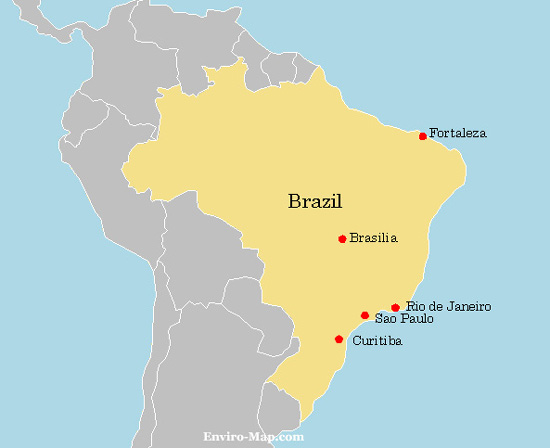
Eventually the dream adventure in Brazil ended and I prepared for home. I had to fly 4 hours south to Sao Paulo to catch an Air Canada flight north for 9 hours to Canada. In Fortaleza I was already almost halfway to Canada, so having to fly south again, land, wait, catch a new plane to fly north again kinda sucked, but oh well... It's the way flights are organized..

I had to sleep sitting up because I had a seatmate this time. I don't recommend it. I experienced the joys of dependent ankle swelling for the first time in my life. Some knee pain was also involved, but fortunately, nothing more serious, like hemorrhoids or deep vein thrombosis.

In the Toronto airport I was selected for random search. The searcher was quite sensitive, I thought - she asked, did I have any body pain? I guess the last thing the searcher would want to do would be to aggravate any existing physical pain with clumsily-conducted body contact. I told her no, I didn't have any pain. Other than mildly annoying, mildly invasive, by default a public experience, and there not being any free toaster to win or even a free coffee voucher to reward me for my cooperation, it was OK I guess. The searcher joked with me a bit, said I could pretend it was a free massage.

My checked bag was lost, but arrived by bus a day later.

Back home, I've been digesting what happened, staying in contact with people I met in Brazil, keeping up a Facebook page and this blog. The next presentation adventure will be in July, at CPA Congress in St. John's. I'll have Angela to help out with that one. So, this closes the series of posts about Brazil. I have a few more pictures to add:

One of Rio's harbours, from SugarLoaf Mountain.

Another shot of the amazing pastry shop's interior- you can see a bit of the mezzanine floor above.

The end of a visit to a beautiful country with beautiful people. Muito obrigado.

Wednesday, May 26, 2010

Conversations, continued

The second conversation, shorter and over only one meal and a couple bus rides, was with Paul Hodges, who did actually attend my second presentation, the one on dermoneuromodulation as a new filter through which to look at manual therapy in the context of the neuromatrix model of pain. I had already presented on the neuromatrix topic earlier, before he arrived.

He's also all about motor control.

He had questions which he took the opportunity to ask following the presentation, and I tried my best to first hear, then understand, then answer. He wanted to know, had I read any of the literature on motor control? If I had, how did I feel about manual therapy in the context of motor control? Something like that.

I replied, I had read some of the literature on motor control, but that because this was a conference on manual therapy, and because manual therapy was what I did, and because I considered motor control issues as mostly self-resolving secondary to pain relief, and because I prepared for a manual therapy congress, I had not covered motor control literature in any thorough way. I stated that motor control was important but unless someone took off the skin, treated muscles, then put the skin back on, I would consider skin input a neurological confound to issues of manual handling in motor control, a cart in front of the horse sort of situation.

As for the second question, if it turned out that motor control (training voluntary efferent output) could trump manual (sensory afferent) input in issues of pain resolution, then manual therapy clearly wouldn't be needed anymore.

This was in front of 1700 people, and both questions and answers had to go through translation.

We continued the conversation later, as I did want to be sure I had understood him correctly. I had. It was as though we talked past each other. I really could not see why, at a manual therapy Congress or anywhere else actually, it seemed so important to negate human contact or any learning somebody's neuromatrix might gain through deliberate skin contact. He couldn't see why I couldn't see why motor control was so vital to understanding the nervous system. Or something.

I said that it was too bad he had missed the first presentation, on neuromatrix model of pain, because this one had been built on that one. He said, I already know the neuromatrix model.

He said that on one of my slides he had seen a reference to Gandevia, who had stated in one of his papers that cutaneous Ruffinis were important for position sense. He said that the range of Gandevia's papers were all about all position receptors in all tissue, not just skin, that muscle spindles were important to the brain... I did a submission gesture about that, saying that I could easily be wrong, that in fact I was usually wrong, that I could have got it wrong even after having read the paper through slowly, twice.. but that I'd been excited to have seen cutaneous Ruffinis mentioned at all. He seemed not to get that a manual therapy perspective should include, at least in my humble, omega human primate opinion, consideration of physical contact, mechanoreception between the sk-interfaces of living humans with threat-detecting neuromatrices. He seemed not to get that from such a perspective, rare as to be practically non-existent other than mine and maybe a handful of other people, any news of any kind about cutaneous receptors being the slightest bit important for anything movement- or position-related was exciting news. It's not my fault that cutaneous mechanoreceptors that fire continuously with lateral stretch of skin, that are found most densely in relaxed skin lines favored by plastic surgeons because incisions along these lines heal better, receptors which Gandevia finally decided to take a close look at, have been pretty much ignored until now. Instead people have been stimulating them without realizing it, and thinking that they are stimulating the fascia or muscle receptors way far within, way deep to skin, way deep to the half inch thick layer of cutis and subcutis that even slender people have encasing them all round, weighing the same as the skelton. Not my fault. This layer and its sensors has never been considered in manual therapy.

That was, and is, my point.

I said I thought biomechanics (joint movements) were usually taught like religion. He said, maybe in Canada, but that in Australia people were taught to palpate layers of the body. I said that was good to hear. I asked him, even if we could treat people without touching them, why would we want to?

I think he agreed we should continue touching people. I can't remember exactly.

However, the impasse between mesodermal and ectodermal concerns and perspectives cropped up over and over and over. We just never got anywhere. He didn't get me, or what I'm on about, or if he did, he discounted it as irrelevant (maybe it's the fallacy of Quantity of evidence substituting for actual Usefulness of evidence in the clinic, for understanding and being able to explain something complex like the nervous system and its care and feeding).

I get him, and what he's about, at least I think I do, and to me it has nothing to do with better understanding and better application of manual therapy for persisting pain in an intact but malfunctioning neuromatrix, or making manual therapy congruent with up-to-date pain models and neuroscience. I don't discount his work - I'm sure it will be important in the long run, but I don't think it's going to help me treat people who hurt, or to understand the nervous system better. And I am definitely not interested in joining any Church of the Transversus Abdominis or any other muscle that he's into - he seems to readily attract large groupie troops who immediately try to build treatment models around whatever his muscle du jour happens to be. I think he recognizes this is a bit of a problem, but not one he allows himself to be concerned with, particularly.


Should our focus be on puppet strings or on puppeteer?

There seems to be no real common ground available with him. Too bad, because he seems like a really nice person, and he IS pretty clear about what motor control training has shown itself helpful for and not helpful for. If only desperate PT people grasping for something, anything that might help their patients, would actually listen to him, and not constantly seize "motor control" as a singular tent pole with which to hold up a whole profession, I'd be a more contented PT human primate social groomer.

He actually does state that too much "stability" (translation: trunk muscles that are too contracted) is just as "bad" as not enough "stability" (based on what I think is an erroneous assumption, of course, or else propagating one unnecessarily, that muscles are bad guys somehow, display defects, not nervous system defenses, that somehow gaining "control" of misbehaving mesoderm will either help pain or else prevent it happening.. a wild goose chase (IMO) that PT has been on ever since its inception).

Too much emphasis on physical, not enough on therapy.

Too much emphasis on the puppet strings and not enough deliberate investigation of or perspective on how to access all the levels, conscious and nonconscious, of the puppeteer, i.e., the entire nervous system including influence of afferent systems and glial considerations.

Too little regard for pain as a neuro-biological phenomenon heavily influenced by cognition; viewing it as a mere abstraction, or distraction, like a fruit fly in the visual field, all importance placed on trying to prove/disprove a profession's mesodermal output control theory. No sitting down and trying to really really understand the nervous system situation first, what a kluge it is, a community of ancient bits and new bits wired together, what it's actually up against in life, where it came from, why it exists, what its role really is, how it operates, apparently ignoring mountains of pain science. Major confusion in the ranks over what our job is/should be, because of all the glare and parade noise from what the profession's over-confident leaders think it should be about. Major ongoing 'Cartesian divide' conceptual behaviour, begun long ago and still continually perpetuated, whether knowingly or unknowingly, by my profession.

I can only hope that one day my profession will take off the damn blinkers that have grown to the sides of its head before the whole parade ends up forced off an intellectual buffalo jump by the knowledge base accumulating all around it. Meanwhile, in the back end of the herd, I'm just a dead woman walking. I might not even be a buffalo anymore. Maybe I never was a buffalo to begin with. Maybe I just got mixed up in the buffalo herd.

A short rest from Brazil...

Well, not really. In fact I think this blogpost series from Greg Laden is actually pertinent to the topic, and highlights some of the issues inherent in the first "Conversation" posted earlier today. I would submit that we could substitute "PT" in for "civilization," and "human primate social grooming (HPSG)" in for "primitive cultures," and it would all make sense.

Primitive Cultures are Simple, Civilization is Complex (A falsehood) I

Primitive Cultures are Simple, while Civilization is Complex: Part 2

Primitive Cultures are Simple, while Civilization is Complex: Part 3

Conversations

Perhaps because of the ease of defaulting into speaking English in a foreign country, I had an unprecedented opportunity to have a couple of extended conversations with two people in PT who work very hard at the delivery system of PT and developing the science which backs it. PT definitely needs these kinds of people or it would cease to exist as a profession, probably.

Both of the conversations were mostly about trying to find common ground and not finding much, really, in my opinion. I had a bit of trouble, actually, figuring out why they were at a manual therapy congress in the first place, as they clearly were not interested in manual therapy. I think they imagine themselves and the profession to have moved beyond it, some how, or if it hasn't, that it should. I got the impression that they find the entirety of manual therapy a bit unseemly somehow, a bit disreputable. They certainly have a right to think that, and I'd have to agree with them that the entire field of endeavor has become progressively botched, both in practice and in concept, more and more as time has gone by.

My position is that there is something about it worth saving. My presentations were all about what and why and perhaps how. Neither of these two people saw both presentations and one of them saw neither, so I can't blame them for not getting what they were about. I guess my status within the profession as being on the lowest-possible rung of the ladder, or maybe even under one of the feet of the ladder being pressed down into the earth, may have been duly noted and registered by them, before, during and after.

It is almost certain that had we not been in Brazil, with the peculiar circumstances of
a) none of us being fluent in Portuguese
b) having been put together by amazingly socially facilitative and forgiving hosts (forgiving because we rudely nattered away in English almost the whole time)
c) having a built-in time limit, end point, and a bit of time to kill in between, over meals...

.... none of these conversations could have transpired. I mean, I would never have gained direct access to prominent individuals or what they think or their apparent attitudes; I would have had to fight my way through a whole PT food chain of handlers/admirers/devotees, would not have bothered. In Brazil I could pick their brains on artificially equal footing, for a brief window of time. This is simply a reflection of the nature of the world, and how PT has evolved, or rather, been culturally selected for, nothing to do with either of these individuals, personally.

So, what on earth is she talking about, one might wonder, reading this...

I'll tackle the conversation with Sarah Mottram first, as I met her first. It transpired over about 4 days and as many meals. She is the one who saw neither of my presentations. My impression after seeing both of hers and our conversations, is that:
a) she wants to see the profession advance (as we all do)
b) she focuses on PT as a delivery system
c) she wouldn't mind if manual therapy stayed completely invisible, unknowable, even unexplored from a neuroscientific perspective.

She said she herself sees manual therapists, from the osteopathic branch of the human primate social grooming troop, whenever she happens to have a pain problem, but seems to think somehow, that this has nothing to do with PT, or any inherent deficiency therein, or that it suggests inherent contradiction. She thinks "motor control" is what PT is supposed to be about, and nice, pain-relieving, contactful interaction as something outside of it. I don't agree. If we are PTs who deal with nervous systems, then I do not think it's appropriate for us to chop them up into culturally convenient and professionally designated categories. A nervous system is fundamentally a biological phenomenon, not a cultural one. Categorization of nervous systems into broad baskets of "we'll deal with this and you deal with that" was a mistake from the start: now pain science/modern neuroscience has come along, like a big mirror, to show us what a colossal mistake it really was.

When I asked her why motor control didn't work for her own personal pain issues, she replied that motor control was more about preventing pain problems than it was about solving them after they had arisen. Well, that's nice (if true), but it won't help those who already have pain then.. will it?

I honestly couldn't figure out what she was doing at a manual therapy conference, other than she possessed credentials as a manipulative therapist, had been involved in a manipulative therapy organization at some point, which I guess has provided her a lifelong passport. But manual therapy or understanding it or redefining it is clearly not where her heart rests.

She acted as if she was interested in my stuff... but I think this was mostly just to be polite. I do not think she is anyone particularly interested in pain science or in examining or thinking about what happens at a skin or nervous system level between two neuromatrices therapeutically in contact with one another, one of which has constructed a pain experience which needs replacing by a new, non-pain experience. To become interested in such a modest question would take her too far off her current trajectory, probably.

Tuesday, May 25, 2010

The Congress

The congress venue was a 40 minute bumpy scary minivan ride away. I didn't mention that the minivans were often without working seatbelts. No matter - apparently I escaped unscathed. I'm back home and all in one piece.

Here is a little map of where the venue, the Centro de Convençöes do Ceará, was located. It was pretty gigantic, with a large PT fair on the main level, the congress above on a mezzanine floor. There were large coolers of filtered water everywhere, and a stand for free coffee, so I was happy. The coffee was served in teesny tiny cups, but this was balanced by the fact that it had a lot of punch. Lunch was a large buffet service, included for free.

I did my first scheduled presentation Thursday, May 13. Here is a picture of me presenting. The woman to my right is Laura, the translator, who had lived in Toronto for a few years and spoke excellent English. She was staying at the same hotel and made herself available to go over the presentations with me beforehand.

I still can hardly believe that's me, wearing a skirt for the first time in about 20 years no less. There were about 1700 people in the room. Behind me were 5 large screens, stretched out in a line, so that everyone could see everything from wherever they were sitting.

I met many of the other presenters, listened to their presentations as best I could, not being fluent in anything but English (which was a surprise to many since I'm from a supposedly bilingual country, and finally, at this late stage of life an embarrassment to me that I never found French something my brain could wrap itself around as easily as it did Spanish).

A lot of the presentations seemed to be mostly 40 minute long advertisements for various schools of osteopathic mesodermalist thought. The Upledger institute was there, being promoted by somebody from Panama .. pictures of dolphins and babies, shots of its white-and-fluffy-haired founder. I thought about, but refrained from asking about, the therapy tragedy in the Netherlands - I had my own presentation to get through.

I was unprepared, actually, for what felt a bit like rock star treatment after I was done. Scores of beautiful young Brazilian PT students, both female and male, came up directly after and wanted their friends to take a picture of them with me, in ones, twos, small groups. It's quite the custom. The camera and I have never been close friends, more like distant acquaintances. So no picture of me ever makes me look good. Whatever. I complied.

Here is a picture of me (wearing my comfortable flat shoes, with foot scabs from a different pair of sandals that had chewed my feet up pretty good the day prior) looking very short, the little fashion schlub from Canada, beside the other women in their 4-6 inch platforms and heels and guapo men; Helder, the organizer, in his guapo suit. Sarah Mottram is second from left. Fourth from left is Marlene, who was Sarah's helper throughout, Palmiro beside her. I met the other two but don't have a working memory of who they are.

Fabulous Fortaleza

A Congress minivan picked us up at the airport and hurried us to the Ponta Mar Hotel. In the lobby a nice woman wearing a Congress badge and high heels who spoke quite good English, named Bea, made it clear that she was the go-to person for any requests or needs. She stayed on duty the entire weekend (in those high heels) arranging buses and rides to and from the venue and the airport.

I could hardly wait to get a shot when I saw the ocean out the window. I've decided I like the ghostly camera in the sky, my reflection in the window.


The food bar was bountiful... I thought the Rio hotel had a good spread, but it paled by comparison to two huge groaning buffet tables as seen on the left, every morning and every evening, filled with platters of sliced treats, twelve kinds of tropical fruit, plenty of hot choices in giant servers, full coffee pots. I started to like hot rice pudding for breakfast, and salmon casserole. No coffee bar, but the regular cafe con laite was just fine.


I couldn't stand being so close to the ocean without getting into it or on it. The same precautions held - no watch, no money if you go to the beach. It was less anxious for both Palmiro, charged with my care and feeding, and I, who am sort of anxious anyway, to go together. We went for a little walk/wade and had a beer in a beach pub. Later we went on a little harbour cruise on a pirate boat.

Monday, May 24, 2010

Leaving Rio for Fortaleza


With the workshop over, I had a chance to see old downtown Rio, visit an incredible pastry shop (see photo), and shop for a new shirt in Ipanama, fashionista that I am (not), with Adriana (Palmiro's girlfriend), a very nice woman with her own practice there.

I had been staying at the Vilamar Copacabana Hotel a number of days before I realized how close I was to Copacabana beach - only about three blocks. I didn't wander around by myself, thanks to Palmiro's warnings; when I did go out, it was usually with him or with other designated handlers, to some preplanned place for a specific task, so I had no clue the ocean was only meters away. On my last evening in Rio a small group of us went out to eat on the beach, and it finally sank in how close it was. We ate in a tent restaurant, right on the beach, the worst food I experienced in Rio (where the food was ordinarily fabulous) - dried out chicken and fries and watered down drinks, a too-loudly-miked-and-guitared singer singing Stairway to Heaven and other old songs, (annoyingly) in English.

The highlight of that last evening was insisting we walk down to the edge of the water, where my feet and the Atlantic ocean finally met and could greet each other. It was dark; a few lit-up ships sparkled in the distance, the air was still, the waves full and slow and warm. We couldn't linger though - the one slightly-built 20-something guy with us was nervous - possibly he had visions of his little flock of older foreign female responsibilities being total mugger bait, might have been overcome by the thought that he wouldn't be able to protect all of us all by himself. He soon wanted us to go back up to the street. So, an excellent moment, one of those rarest of moments that seems to hang suspended all by itself in eternity, one I wish could have lasted a lot longer, was over, and we walked back.

Next morning we were all up early to catch the plane to Fortaleza, 4 hours north, on the north coast of Brazil very near the equator. I had my first ever Congress presentation to make the next day, and stewed over my slides some more on the plane. I sat beside a nervous woman in the window seat who had never flown before and wanted the window cover down the whole time. Palmiro was on my other side. I was informed that Fortaleza was a dangerous city, that people had started noticing that plane loads of men came from everywhere just to buy sex with children, that authorities had begun to deal with the problem. When I asked how large the city was, I was told it was "just a small city," maybe 2 million. (Two million is huge in Canada. Double the entire population of the entire province of Sask. Oh well.) As it turns out, the size of Fortaleza is more like 3.5 million if you count in all the burbs.


What I was completely unprepared for and made me ecstatic was finding out the hotel faced the beach and that I had ended up in the ocean-facing side. I was able to look out every morning and say hello to this roiling turquoise marvel, right across the street from my 4th floor room.

Next, the congress.

Sunday, May 23, 2010

First leg - Rio

I had to get to Rio by flying to Sao Paulo on Air Canada and catching another local flight. The first flight was all night long (9 hours) and covered over 5000 km. I fussed over my slideshows some more and managed to curl up horizontally to sleep, as I had no seatmate. This nice part about flying north-south or south-north is that no jet lag is involved. It was the first time I'd ever been outside North and Central America. I'd never been south of the equator before. So many firsts.

Dinner (with wine) was served on the plane, and shortly thereafter, breakfast. The coolest part of the trip was that even the economy seats have a place to plug in one's computer so that one's battery stays juiced.

I was nervous landing in Sao Paulo. It seemed to take an hour just to fly over the city through smog cloud to get to the airport. It's 20 million people large, after all. I expected the Aeroporto Guarulhos to be enormous (it was), and I'd learned no Portuguese, hoping my rusty Spanish would suffice. How would I find my way around? I didn't have a lot of time between flights. Fortunately, customs there is a perfunctory matter, one's immigration card is merely glanced at, lines move fast, most of the people in uniform speak a bit of English, and there are many many people in uniform, standing around, changing the cloth bands between stands to facilitate new lines and faster movement. The signage is quite small and the distances huge. I did the default female thing and kept checking with new people as I walked along to make sure I was still going in the right direction. I reminded myself that I was English-speaking in a Brazil airport, not Polish-speaking in a Canadian airport.

Eventually I got to the proper gate in the correct wing of the port and on the TAM plane for the 45 minute local flight to Rio. At the Rio airport, things were even more brisk and easy. Palmiro was there to pick me up, so I could finally relax.

First things first - it took a good 45 minutes to get from the airport to the hotel, through Rio traffic. Rio is another huge Brazilian city, about 12 million. It has a bit of a smog bank too, although Rio citizens choose to downplay it. So beautiful though. In the car I was given a lesson on the social stratification of Brazil, and how to stay safe, not be a target. Palmiro has been around some and has had a chance to observe how life is in North America, so he took great pains to inform me about how in Brazil you can be killed for your cheap ten-dollar watch. He wasn't trying to scare me, just protect and inform me. I listened.

That evening I was introduced to caipirinhas and the sort of steak I can't ever remember tasting in my life. Delicious. Then we went up SugarLoaf Mountain in the cable car, in the dark, to see the lights of Rio way down in the distance. The next day we saw it again, in daytime. The other main tourist spot is Corcovado, on top of which is a giant Jesus statue. Giant Rio Jesus is apparently suffering from acid rain, was covered in restoration scaffolding when I visited.
The mountain is so high and the smog was so dense that I couldn't get any pictures of the city - I could not even see the city.


On the way down I took a bunch of pictures of a very dilapidated but still beautiful and elegant hotel, which is slated to be restored in time for the Rio Olympics, I think.


On the weekend I taught a two-day workshop to 26 people, the largest class I have ever taught. Palmiro had translated my treatment manual in Portuguese himself, ahead of time. A translator had been arranged. It couldn't have been a better organized event and it couldn't have been filled with better, more attentive, gentle students with hands like butter and minds like sponges. By the end of the second day several had already left to make flights etc. Here is a picture of who was left. Palmiro is in the back row, second from left. The translator, Dan, is beside him third from the left.

I learned to do Brazilian cheek-contact air-kissing on this first leg of the journey. I was struck, actually, at how contactful the culture in this branch of my human primate social troop. Such a welcome somatosensory, epicritic input.

Saturday, May 22, 2010

Brazil - Prelude

Yesterday I started to write a bit about this adventure-of-a-lifetime undertaken earlier in May. Here's how it transpired.

Last year in either March or April, during the time I was completely buried in preparing to move, I got an email from a perfect stranger in Brazil, Palmiro Torrieri Junior, a PT who teaches Mulligan* in Brazil and elsewhere in South America. He invited me to consider travelling to Brazil to participate in a Manual Therapy Congress scheduled to take place over a year later in Fortaleza.

I do not get these kinds of requests. Ever. Except... apparently Palmiro had tried to invite me two years prior and I had replied, "I never travel." I do not recall this - a lot of email comes my way that just gets automatically deleted or else ignored: it may well have happened - my memory has been pretty faulty, and, if the story is true, Palmiro is remarkably persistent besides being a gentleman and a scholar.

I told him I'd think about it. I did think about it. I also checked him out to make sure he was for real. He was. I told him I had no credentials other than a diploma from 40 years ago and no presenting experience, just a lot of self-study, a set of convictions based on neuroscience and biology, and an online presence. He said, no problem. I talked it over with my set of online PT friends - they all thought I'd be crazy if I didn't go. So, in the end, about a week later, I agreed to go.

Me being me, immediate self-doubt set in. Who did I think I was, anyway? I didn't linger for long with the self-doubt because I was too busy getting myself uprooted and moved away. And besides I had an entire year to come up with something. I didn't have to go out to work until long after it would be over with. I had enough time to come up with something, surely.

Palmiro was great - whenever I had a doubt or a hesitation about the trip he was right there in my inbox, with "No problem Diane, I will look after that." He had a translator. Everything was going to be paid. I would teach a 2-day class in Rio. He would organize the whole thing, find all the students. He would schedule my time so that I would have rest days between gigs. He would look after all the arrangements from the second I got off the plane until the second I got back on. He sent me a detailed itinerary of what we would be doing each day I was there. By email and later by Skype, I found his English to be really quite good (way better than my non-existent Portuguese), got to know him better and decided I would trust him.

Eventually the details at my end were all sorted and a visa, shots, new luggage, some tropic-appropriate clothing were obtained... I had learned to make slides, had put in many many 18-hour days reading and learning and sorting and thinking. I still wasn't satisfied with the presentations but they were as good as they were ever going to be and it was time to make the trip.

Next installment: Rio.
.........
* Mulligan (named after its creator, in standard ortho guru style) - a weird ortho combo of biomechanics and skin stretching, which I do not happen to find unconscionable because its over-arching emphasis is all about not creating more pain for the patient

Friday, May 21, 2010

Fresh spring, fresh start


It helps that I just returned from Brazil, buoyed by an amazing, once-in-a-lifetime adventure of travel, presenting to a crowd of somewhere between 1500 to 2000 people, all-expenses-paid, with a hotel room looking out the south hemisphere's version of the Atlantic Ocean, right across the street. I never dreamed anything like this opportunity would come to me in a million years. Even when it did, I couldn't believe it had. Now that it's over, and I'm back, it feels like a fabulous dream. Except that I have pictures of the trip, and a little trophy for presenting, so I know it must have been real.

I provided two presentations, each 40 minutes, through a translator. The first one was on the Neuromatrix model of pain, an the other was on dermoneuromodulation, my own version of manual therapy and an argument in favor of good handling based on nervous system considerations as opposed to structuralist and other mesodermal considerations.

I had a chance to speak up close and personal with a few of the English-speaking (much much) higher rollers in the profession, Paul Hodges and Sarah Mottram, and engage them in a fierce conversation or two. Both of them are doing nice work, but work from a perspective that (too narrowly, in my opinion) targets only the voluntary efferent aspect of the multi-dimensional human nervous system and leaves out consideration of all its afferent aspects, handling only to "correct" somebody's posture, or to electrically "stimulate" some sort of observable and variable muscular response. Neither of these people have anything much to say about strategic deliberate handling of tissue or what the brain might think about that on all its multiple levels, so I suppose the conversations were mostly just flybys. They were entertaining though.. and these are sweet people - just not on any kind of resonant human primate social grooming level with me at all. In any way. Whatsoever. They believe (at least I gathered they do) that motor output is all there is or should be interesting in PT. The "movement specialist" thing. This to me indicates a seriously blinkered perspective which shrinks the interactive aspects of physiotherapy to "operator" stance only, and doesn't explicitly deal with somatosensory input or the kinds of (usually favorable, provided the nervous system isn't sick) changes, effects on pain perception, which can catalyze in a neuromatrix on multiple levels. Sarah commented that she thought my term "human primate social grooming" was "horrid." Alrighty then...

I have more blog posts to make about this fantastic adventure, and I will. I'll tell you all about Brazil from the vantage point of a human primate social groomer of exceedingly low rank in the greater human troop, who quite suddenly found herself being treated like a queen and knew not quite what to make of it all.

However, now I have to arrange to go back to Vancouver for 5 days, rent a car, dismantle what's left of my practice, deal with paperwork (never my fave), get rid of the "stuff" (treatment table, etc.), stow my patient files appropriately and legally with a PT in BC (already organized) until they have expired, visit the bookkeeper, pick up and file my income tax finally - I have til mid-June apparently.

This is all major organizing-cognitive hard drive stuff for me. I'm never very good at it, or at least I always feel completely incompetent at it, but I have to say I doubt I could have got any of it done the shape my cognitive hard drive was in a year ago or even half a year ago - it has been doing a lot better since moving back into sunshine. Now I can remember lists of items again, as long as they aren't very long. I can make plans again and execute them more seamlessly instead of just following my nose around and course-correcting by bumping into the walls of reality/social troop requirements. Things are looking up this year. Less stress, less depression, less pressure, less rain and fewer foggy grey days.

Saturday, April 17, 2010

Peter Whitehouse on the myth of Alzheimer's

I'm listening to Ginger Campbell's podcast interview with Peter Whitehouse just now. I'm liking it.
He ties in a lot of topics that have been tossing around on the waves lately - the power of narrative, re-framing a story to make it less devastating/more useful, how diagnoses are merely medical frames around stories.. how some frames are more solid than other frames. He is a neuro researcher who takes a long close look at brain aging and has decided that the diagnosis "Alzheimer's" needs a bit of retooling.

The Myth of Alzheimer's blog

Monday, March 22, 2010

Robert Sapolsky on depression

Wonderful lecture, about 50 minutes, with Robert Sapolsky. Ties stress (glucocorticoids) in with depression.

Sunday, March 21, 2010

Speaking of stress...

Found this at Respectful Insolence blog. Pretty clever. It certainly stirred my own noradrenalin pathways, but the dopamine and serotonin (now that I have some of each built back up again) were not far behind.

Take a ride in a Toyota.

Friday, March 19, 2010

Monday, March 15, 2010

Sunday, March 14, 2010

Another anniversary, 10 years ago

Another memory about this time of year which I didn't sift through to, until this morning, is that 10 years ago yesterday, my dad died. He would be 87 now, were he still alive. I must be pretty much over that, because I didn't even consciously remember until now.
These days I live near where he was buried. If it's a nice day I might hike the few miles out along the highway to his spot, and visit, re-member.

Friday, March 12, 2010

Anniversary reactions

So, I thought back to where my life was at a year ago, which in some ways feels like just yesterday; I reminded myself that only a year ago I was dismantling a lifetime, not just a practice from which I have been detached - still responsible for but emotionally detached from - for about 9 months.

I was faced with jettisoning a lot of belongings, books, purging and cleaning and scraping and painting and scouring and selling and usually fell into bed at night exhausted.

I realize that some part of my brain still feels open raw places from having undergone that experience, even while other bits are ecstatic to be back under big bright empty sky. When another stressor comes along, I realize that the reverberation of a year ago is like an echo chamber. I realize that as a brain ripens and ages through a life span the echo chamber doesn't go away, in fact it just gets bigger and bigger as years and anniversary reactions accumulate. If would be lovely if there were a delete key on stress, something easy to simply click and make the anxious stuff disappear. That isn't the case. So I go for long walks instead. It helps.

As I walk I think about how I'm helping my brain produce the millions of different kinds of neurotransmitters it needs to remain healthy and help me, its "I" illusion, to remain calm and content. I think about how lucky I am that I'm on the eve of 60 years old and am in a body, with a brain, and feet, that don't hurt me, that let me walk pretty far (3 or 4 km) without getting the least bit tired or sore. Bored a little, maybe, sometimes, but not in any pain. I think about how nice my nerves feel, sliding around in my body, first one side, then the other, how my spinal cord is slightly rotating within its canal, how blood flow is being engaged to feed it generously through mechanical stimulation. Yeah, mechanical stimulation is a stressor, but it's the right kind of stressor, and I remember that all this slidey motion will spur it to stay juicy and healthy and functional.

As I relax into the rhythm of walking I try out different things to challenge my brain, just a little, try a bit more novelty, explore my body adapting to it. I see how tall I can be as I walk along. I feel the difference between using abs and not using abs while walking. I notice what happens to my breathing. I work with breathing. I place my feet on a narrower trail with out breaking stride. I play with stride length without breaking stride. I experiment with which edge of my feet I'm walking on. I run a little. I play. I stride. On the outside, I am just a woman walking, but on the inside, I'm engaged in a process of discovery and comparison and full body sensing.

I think about how lucky I am to not have to carry a little roof all the time, called an umbrella, shutting out the sky, bumping other umbrellas, being bumped by other umbrellas, or, the alternative, rain on the top of the head - ceaseless remorseless rain. Seventy-five different kinds and sizes of rain.

I note the lack of other people and feel grateful to be in a place where there are no drug dealers being obvious or their customers reeling around or shouting at each other or at nothing at all or thick knots of tourists standing and gawking everywhere or beggars asking me for money or trying to sell me something - people crowding me, people who represent huge obstacles, both physical and psychological, to navigate through and around. I am alone with my own thoughts, and all around is just empty space I can relax into, nobody nearby I have to worry may knock me down and steal my wallet, or knock me down because it's a gang initiation ritual, or knock me down because they are bigger and taller and didn't even know I was there.

I always see a little something I never noticed before, even on familiar routes. I am free to gaze around at sharp contrast of light bouncing off surfaces, at the brightness of snow (well, not lately - it has developed that cavitated, dulldarkgrey look as spring arrives..) at the brightness and blueness of the sky, and think, this is all very good for my brain. I tell myself, it will synchronize and neuroplasticize itself in a positive direction. I tell myself that its emotional buffers will continue to improve every day in direct proportion to increasing clarity of thought and access to cognition and sharpness of logic. I realize these are beliefs, but I also know they are beliefs based on science. Science is my comfort and strength. It always changes but its changes are always for the better, provide ever more solidity.

I go home, look at the pedometer and how many steps I took. I think, OK, I can do better than that. Tomorrow I'll go again. Life is a series of small steps, physical and metaphorical, that accumulate over time, will add up to something, positive or not. Every step should be consciously chosen or result from a habit consciously chosen and feel like the right step to have made, no matter how tiny it may have been. With each step I take, I'm putting distance between myself and what I've left behind; with each step I'm coming closer to whatever it is I want out of life, whoever it is that I am becoming.

Every walk I take is a victory, my pitting of my own life against everything that would do my life harm. I have synchronized myself with me, as best I can, and after, I feel ready to read a paper and make a few slides and write a few thoughts down on a file card. My new life.

I'll deal with that recent workquake in Vancouver as I can, when I can. It's not my life. Not really. Not anymore. I'm not there, not anymore. I'm Here. And this is Now. Things could be much worse.

Tuesday, March 09, 2010

Upheavalment and unravelment

It's strange how stuff seems to arrive in bunches, after long periods of time of relative smoothness. Like, first Haiti, then Chile, out in the geographic world.

The private world seems like that too, these days. I received news on Sunday that the receptionist (in Vancouver) would be resigning, then the very next day (yesterday) I received word that my locum replacement was resigning as of June. That's pretty much my old life in Vancouver finally down for the count. I shall have to dismantle the practice officially, sign papers etc, I suppose. Kill the legal entity. It's not a rumination I really need right now, yet at the same time some little part inside of me feels slightly more free, so that's good, I guess.

The third thing was that this morning I sat down to work on my presentation for Brazil, and discovered the mouse was dead. Very very dead. At times like this, with three big whammies in a row, it's hard not to feel a tad superstitious about life. Superstitious, as in, "what is this all supposed to mean?" The rational part of my brain says, weird coincidence. We move on. We deal. The emotional part of my brain is reeling around in shock and dismay and wants to clutch at straws - "How do I have to live my life differently to avoid experiencing all this stress?"

Long walks help. I've been out doing that quite a bit these days.

Postscript: I started to get ready to go out to buy a new mouse. The more I thought about it the more I thought I should check to see if the problem was to do with the keyboard, not the mouse. I had a spare (new) keyboard anyway, what could it hurt to test it? I did, and taDAH! the mouse isn't dead - it works fine with the new keyboard. Just a bump, not a huge slam into the boards. All is well. Back to business.

Tuesday, February 23, 2010

When apprehensiveness is a Virtue (and a Moir)

I seem to be on some sort of roll today, maybe because of that wonderful ice dance last night won by "Canada," a concept momentarily inhabited by the wonderful young ice dance couple, Moir and Virtue, who in their unbelievably fabulous performance managed to successfully downregulate any negative nervousness and upregulate every particle of their well-honed strength and grace to take the gold in a most transcendent manner. I think they managed to navigate "even keel" through several different potential realities, toward victory. I think their sturdy sea-going vessel was "apprehensiveness." Let me explain:

If there was ever a word to describe human primates in general (perhaps me in particular), I think it would be the adjective "apprehensive." It ordinarily conjures up a sense of suspicion, nervousness, or anxiety, which I think is a negative social meaning that has accrued to it because of how extroverted people like to downplay sensible precaution; in fact, there is way deeper meaning to it than that.

"Apprehensive" means many different things: let's take a look:
1. quick to understand
2. mentally upset over possible misfortune or danger or consequences
3. in fear or dread of possible evil or harm
4. anticipating something with anxiety or fear
5. quick to learn, intelligent, capable of grasping with mind or intellect
6. the cognitive condition of one who understands
7. from Lat. (ad, "to"; prehendere, "to seize"), a term applied to a model of consciousness in which nothing is affirmed or denied of the object in question, but the mind is merely aware of ("seizes") it
8. (as verb) to legally seize or arrest

It was wonderful to hear Tessa Virtue thank her physiotherapist during a post-win interview. She's had injuries, for sure.

Well done, you two. You have made us (Canadians) proud and have entertained us all (wherever we are on the planet) absolutely beautifully and dazzlingly. So pleased you were able to "apprehend" the possibility, "apprehend" each other sufficiently to get the job done, let your combined brains "apprehend" gravity and other physical forces, "apprehend" correct responsiveness in each nanosecond in perfect poise, then "apprehend" the opportunity, and that medal, with all weight of its attached symbolism, graciously smile the whole time, and allow a sense of relief, joy, pride and connectedness to race throughout Canada and likely all round the world. Well done. Well apprehended.

Thank you (as a Canadian) also to the coaches (one from Russia) and the host rink (in the US, I think). It was a great moment to "apprehend" while putting in time in this Big Waiting Room called "life."

Navigating "even keel" between uncertain death and uncertain death, toward certain death

Life, if we are realistic, is just a waiting room in which we amuse ourselves before we can go through a door with a sign on it, upon which is clearly written, DEATH. Lucky for us, the waiting room is huge, big enough to encompass entire oceans, full of brightness, infinite distractions, lots of other people, most of whom are merry, many useful and interesting ways to spend time together or alone.

"Even keel" is a metaphor. It stems from the many centuries, I like to imagine, when humans traveled by ship to visit each others' cultures, trade, conduct war, all those human things. Thinking about "even keel" takes up quite a bit of my personal hard drive. Not only have I learned how to be even keel in my own life (am not finding myself blown sideways by it or capsized as often anymore, that is..), when I am at work I focus on how to help brain parts in another person' nervous system get along better together, or at least I imagine that's what I'm doing. Like an engineer fixing systems in a building, or in a computer. Except, I don't really do anything, I just add bits of provocation and wait for feedback to tell me I'm on the right track. Most of it has to do with waiting for then seizing moments. But I'm geeky enough to want to know everything I can, anyway, about the systems I work with, even though human primate social grooming is really quite instinctive.

"Even keel" applies to nearly everything on any level in human life. I made a little picture (thank you photoshop) out of other little pictures to illustrate the old Greek story about the sea monster and the whirlpool that I first read about in James Willis' excellent essay by the same name. In his essay, the two-headed sea monster represents pseudo- and anti-science, which he does not want to steer too close to in his work as a doctor. The whirlpool represents scientific reductionism, tyranny by protocol. He doesn't want to become sucked into becoming a protocol zombie. Instead he wants to be able to steer his own boat, stay even keel between two extremes, retain his own locus of control within his treatment relationships.

I decided to steal his metaphor, practically intact, for my own work as a human primate social groomer. My sea monster has two heads too - one is anti-science and the other pseudo-science too, although, some days their names change to myofascial release and craniosacral therapy. The whirlpool is orthopaedic manual therapy, which (at least in Canada) is almost a Byzantine religion with its own high priests and devotion toward evidence-based regimented protocols, ostensibly to keep therapists safe from harm or blame, keep them "pure" and untainted, keep the money of society flowing toward our profession. But when I look at OMPT in Canada, I see huge flashes of tooth fairy science as described so succinctly by Harriet Hall. In Beyerstein's excellent essay on pseudoscience (50-page pdf) he stated that in his expert opinion, any "science" which doesn't take neuroscience into account is pretty much, by definition, pseudo. I have never sat in an ortho training workshop in Canada and once heard the slightest whiff of anything to do with neuroscience, not even physical nerves which slide past the beloved joints upon which ortho-lovers are so transfixed. In the workshops I attended they taught that you can actually feel movement in joints and improve movement in joints with fancy pressures at precise angles. From outside the living human body. Maybe this has changed in the last few decades, but judging by the kinds of ortho-esque "studies" I see done... somehow I doubt it.

Anyway, enough rambling on about that. "Even keel" is what each human, regardless of what one ends up doing in the Big Waiting Room called "life" prior to going through the door called DEATH, tries to achieve. We each have a life to navigate and moods to manage. How we each end up doing that and whatever success we manage to demonstrate in the process, has a lot to do with luck and circumstance in terms of genetic makeup plus upbringing, nature/nurture. I found a nice paper today, Psychosocial and Neural Correlates of Resilience, which is open access, at least for now. (Thank you to Integral Options blog.) In it I found:
"In experiments by Meaney and colleagues, the offspring of female rats displaying more nurturing behavior (high licking and grooming compared to low licking and grooming) had less methylation of the glucocorticoid receptor (GR) gene in the hippocampus, resulting in higher GR expression, lower anxiety-related behavior and better HPA axis regulation. In addition, research by Nestler and colleagues has delineated molecular mechanisms underlying resilience to a social defeat stress paradigm in rodents, including the induction of gene expression changes only seen in resilient mice."

Gee, I like to think I'm resilient, even keel, or at least have learned how to be, even though I ended up with a human mother who did not believe much in pleasant licking or grooming. Somehow, even though this happened to be my personal fate, in the big waiting room of life, I was drawn, explicitly and implicitly, to work which is all about (metaphoric) licking and (actual) physical social grooming! The complete and utter simplicity and rightness of it, the naturalness of it to me as a human primate, is the wind that fills my sails, rows my boat, has helped me attain/remain "even keel."

That is pretty much all that is at the core of what I find mysterious in my own life. It's not earth-shaking or dramatic or life-threatening, it's just a story, likely a boring one. But it's my own little one. And I don't mind putting it here, where very few will probably ever find it.

Tuesday, February 16, 2010

It gives me grief and makes me mad

So.. It's high time, my brain has decided, for a bit of a rant.

My last sporadic post was about thinking I probably had chronic contemplation syndrome, and went sideways into being distracted by the Olympics, etc.

This post is about a few reasons why I seem to have chronic contemplation syndrome.

Lately I stumbled across this blogpost on Twitter: Infant Dies After Craniosacral Therapy: Therapist Gets Off Scot-Free. Something inside me seemed to galvanize just a little - I could feel it. The action I took was to post it to my Facebook page and let it sit there, as testament to wrong thinking, and how important it is for manual therapists to move away from piss-poor treatment concepts onto more science-based ones. Naturally there was a hue and cry and protest from a few who apparently thought I ought not mention such a scandal or whose "belief system" I had besmirched somehow. Was the therapist a PT or not? How is craniosacral therapy different in the Netherlands than in N. America? Surely it must be different, the kind "we" use "here" safer. I steadily asked questions, sent out feelers, got more links, as more information came along from those who speak/understand Dutch and are more familiar with the issue posted on the thread about it at SomaSimple.

How I feel about stuff like this, manual therapy memeplexes which are just plain indefensible or which can do real harm, is no secret - I wrote about it here, and here. What's different is that my life is organized such that I'm in a position to really be outspoken about it on many levels. I have time to write, to think, to organize, to present. I've been invited to speak at two separate venues about research I'm doing, opportunities to refute such ill-formed and misleading treatment concepts. I've worked like a Trojan online and offline to study, think, redesign my own brain, mesh the physicality of human primate social grooming with the neuroscientific and pain science basis, context, in which it all starts to make sense. It's a great opportunity.

But I'm mad at myself. For watching TV, for being disorganized, for not knowing how to find my own files on my own desktop, for having a messy bookmark list, messy messy messy, my life feels like it's still in a mess and like I still don't have a clue how to proceed. When I'm not mad at myself I easily get mad about stuff like what happened that poor Dutch therapist, stuff that happens because of very poor thought processes, because of not thinking something through first, because of adopting memeplexes that some extrovert dreamed up out of thin air then sold in a confident manner to gullible hungry-for-info people in a workshop who trusted whatever he said, applied it, then killed a baby. It makes me scream with anger. All of it. Then I look at myself again, and think, OK, I'm not gullible, I'm careful, I know that a stray thought here or an assumption there can make a big difference downstream, I've always sifted things carefully, always chucked out ideas that don't make legitimate sense without a second thought. But to DO that, to be that careful, takes a lot of inner stillness, which I'm now so good at that it feels like my brain has neuroplasticized itself into quite a rut, and when I add my ordinary introversion to it, it feels like I'll never be able to say what I want the way it needs to be said while at the same time smoothly managing to persuade the entire profession over into thinking about manual therapy in a new way, toward science and away from dangerous baseless mesodermal explanations for things. It's like I feel responsible for changing the world, all by myself, and I know that's a crazy unrealistic thing to be thinking. So I feel like screaming. Which is not a solution, just a feeling, so I rant for awhile instead.

Saturday, February 13, 2010

"Chronic contemplation syndrome"

niclucas.com, on "chronic contemplation syndrome."

I'm guilty of this. Or else, my brain is still in recovery from being in the dark for decades, living in rainy Vancouver. While watching the Vancouver Olympic torch run/celebrations on TV yesterday, I kept seeing the pouring rain and thinking, so glad I don't live there anymore. Nice job, though, extroverts. It was a very nice series of moments all strung together serially through TV time, like a string of happy pearls.

So sorry about the luge guy. And the perpetual rain. And that one chunk of cauldron that got stuck/wouldn't lift up. The rest was GREAT! The infinite boundless free-wheeling bright feeling of the prairie vignette was on the mark. Loved the First Nation dancing and diversity. Loved the edgy punky fiddler/dancers, so different from Don Messer days of my childhood. Loved the poet from the North West Territories, riotous colors of fall, whales swimming across the floor, the lit maple leaf motif toward the finale. Loved that you included sonorous Donald Sutherland (who voiced-over in many of the Olympic ads) in the ceremony, one of my all-time favorite actors. Loved that the announcer didn't notice that the torch carried by Wayne Gretzky was smoothly traded at least twice on the way to the outdoor cauldron, causing him to wonder aloud why the Gretzky torch was so long-lasting compared to the normal torches...

But I digress. Back to chronic contemplation syndrome... and for now, chronically contemplating... Having a name for it will help my brain work on a way to overcome it. Just a teeny shift - that might be all it takes, to change the course, the outcome, the direction of accumulation of small efforts over time that amount to a life lived more rather than less successfully. Thank you for that, Nic Lucas.

Tuesday, February 02, 2010

Letter to another Un-happy INtrovert

This excerpt is from a letter written by me, several months back. It has been edited slightly to protect the recipient's identity.

"I think, like the skin horse, we just get more real over time. It's inevitable. We probably get finally as real as can be, one second before our lights go out forever. That would be the last joke life has on us: Haha, guess what, all those little things you thought were so important and fought so hard to swim upstream for, they are nada.

So, you're an Unhappy INtrovert. Doesn't surprise me (the Unhappy part) - the world, the social world, the everyday interaction of the human primate troop, is made by EXtroverted people and reflects their sunny ways, so it becomes the measure against which we non-happies automatically fail. Which I guess is good.. what a rained-on parade introverts would make if we were in charge of setting the overall tone of life. So, us introverts or unhappies or whatever we are have to do double duty figuring out what is, what we are, how to relate to a rear-view mirror image of ourselves while we learn to drive ourselves forward. It seems like a lot more work, so it's kind of a good thing there are endless combinations and permutations available for neuroplastic social adaptation. It has taken me two-thirds of a life time to become even remotely even-keel, let alone consider myself capable of making any kind of contribution beyond one-on-one. What a long process.

I do envy social effortlessness as displayed by extroverts/apparent "Happies". They seem to have so many fewer issues. Maybe they are less transparent to themselves or just fake it better or maybe they feel better just being around someone/anyone else to the point where they placebo themselves automatically, a brain mechanism that others of us (like introverts) must construct consciously instead. It isn't like they aren't smart or don't think, because they do. And they have sadnesses, which they mostly hide, which I used to think meant they were superficial. I misjudged their consideration for the feelings of others in the human primate troop, and their apparent jolliness in being connected and chatting and social, as outright behavioural lying. I didn't realize it was brain food for them, that they absolutely depend on it, crave it every day. Since I've aged, I'm a lot more nuanced about how I judge others' social motivations. We are all total liers, because of how troop-y we are as human primates. No one knows which side is up, because of all those built-in perceptual biases that fool us continually. We are all here, doing the best we can to get along and help each other. Stepping away from troop situations which become, or that we finally realize are, uncomfortable or incongruous with our centroversion.

I decided long ago to hitch my wagon to science, learned to aim for mere "contentment" in life. For me "contentment" is practically synonymous with "containment," in every aspect of life but writing, over which I have temporal and environmental control, i.e., feel safe. Safe enough at least. Steam valve writing."

Friday, January 29, 2010

Exactly backwards


I had a chance last weekend to travel to Saskatoon and visit the PT school there for a few days, talk with a few of the profs, plan a tentative future. My (not very) lofty goal is to somehow gain permission to dissect, photograph and map out, in broad visual terms, the extensive forest of rami that project out to skin from the numerous cutaneous nerves that run along parallel to and beneath skin - even if I have to suck it up and do a Master's. My friend Angela, who characterizes herself as an obstacle remover, has been extraordinarily kind and generous with her time and hospitality toward me. She and I have completed a research project together, yet to be written up.

Everyone was kind, lent me their ear, but the impression I have come away with is that there is an invisible wall I could sense, that I may never be able to unlock, between what my profession has turned itself into, and what I think it could be.

Take, for example, the nervous system.

I had an opportunity to sit in on a two-hour neuroanatomy lecture, with permission; it occurred to me that these first-year students are getting more information handed to them in one day than I ever did in a year. In the space of two hours, the lecturer covered the embryological origin of the brainstem, its organization, an intro to each of the nuclei within it, all the spinal cord tracts that move rostrally through it and descend through it, the medulla, the cranial nerves and what each does and how each can be affected by traumatic head bangs, the branchial arches and neural crest, and which muscles were formed from which arch, and which cranial nerve was associated with each arch. It's a lot for first-year students, probably.

My question is, Why should they care? How hard would it have been to put an overall frame around that headfacethroatbrain zone, as neurological core sensor, effector, consciousness producer, and (according to some, like Jaak Panksepp, emotion initiator), plus metabolic engine for the entire organism, breathing and swallowing, able to operate bi-directionally?

The prof was kind enough to meet with me for an hour or so following. My impression was that the only real teaching he does regarding the peripheral nervous system is that it is segmented, each spinal nerve innervates all the stuff coming from a particular segment, and that the main important thing about its role in the body is that there are muscle spindles and sympathetics. Other than C fibers and A deltas, the sensory aspect was irrelevant to him, it seemed.

While all that is true, there is so much more to it than that!

But I was reminded yet again, about how physiotherapy, in order to gain permission to evolve as a profession, pretty much focused its awareness of neural matters entirely around motor output, and has been stuck there ever since, child as it is of the greater touch-phobic society into which it is embedded. We are licensed to touch people, but we are not permitted, it would seem, to examine, comprehend, conceptualize or even be taught anything about how our touching might be an interactive source of brain food for the recipient brain. Too .... sexy or something, maybe. Thar be monsters, or something. This potential pitfall could easily be bridged by a single class in transference/counter-transference, a standard issue that must be dealt with up front by the psychoanalytic community. Why let it remain in the subconscious of my whole profession? Why not deal with it up front? A preemptive strike? Forewarned is forearmed.

The profession has structured itself entirely around motor output, and a gaping void exists where understanding of how the brain and PNS reads and responds to kinesthetic input should be. To be fair, it was probably easier in the beginning to follow Cartesian divisions - you bunch of therapists go deal with the mind, and us, we'll stick with the body. Neuroscience has put this idea into total eclipse: there is no separation whatsoever.

Yet, emphasis on the INput side of the nervous system, and learning to understand it, is precisely, according to me, where becoming not just a good therapist, but a great therapist, lies. These are totally uncharted waters for our profession. We could be great therapists if we hadn't got our conceptual trajectory exactly backwards. We have been looking in through the wrong end of the telescope, all along. But we no longer have any excuse for continuing to do that. Not if we look at what neuroscience can tell us about ourselves in a body, and about ourselves treating other embodied people. Other humanantigravitysuits. (We DO have that word "therapist" in our name, not just the word "physical"...)

I'm doing my very best, but may never succeed in making a big enough noise about it to be able to make any difference in the status quo whatsoever. I have to realize this yet not allow it to defeat me.

Oh yeah, he's also an OMPT. Forgot to mention that.

Sunday, January 24, 2010

Origin of the brain

Nice video explaining the principles of exaptation.

Tuesday, January 12, 2010

Taking stock

A convergence of sorts has occurred in the new year: today a friend sent me a link to this excellent essay, written by Frank Wildman, on the sad, rather shabby, rather scientifically disjointed state of PT. He was thinking of U.S. PT, I think, and he had his Feldenkrais goggles firmly duct taped to his head while writing, but I'll forgive him for that, because he makes many many good points. I like the way he compares the state of PT to the state of general science before Darwin came along with the unifying theory of evolution. This essay still seems topical, even though it is 22 years old: Learning: The Missing Link in Physical Therapy.

Lately, a New York Times article by Gina Kolata, Treat Me, But No Tricks Please, provided the reading public with a glimpse into the hall of distorting mirrors that is current, American at least, PT. This story has raised comment on a few PT forums/blogs:
1. NY Times: Physical Therapy Useless?
2. Yes, Gina you can tell if your physical therapist is "voodoo less"

There isn't a whole lot to come back with, though.. Frank is still right, I'm afraid.

This short video, "Myofascia," was constructed by a PT student, determined to be a PT who embraces rationality. It's very succinct and immediately was shared by several Facebookers. Facebook really is a networking site, because through it I met a fellow who wanted to counter the video and share that he is helping to organize an entire conference about fascia. He seems like a very nice guy. We struck up a conversation, shared who we are and what we're about. I won't divulge anything about him, as that would be improper, but I'll put here what I told him about me:

"Your enthusiasm for the topic (fascia) is palpable! [/manual_therapy_joke].

Congratulations on helping organize a conference! That's no small task!

I'm a manual therapist too, born and raised in Canada, of physiotherapy descent. ...

Anyway, I moved (grew up in Sask), now have colder weather but WAY more sun, which at my age I need. My interests include deconstruction of faulty treatment concepts, passion for the neuroanatomy, physiological function, understanding, and care and feeding of the human nervous system, and writing. I helped start the Pain Science Division of the CPA. Currently I am on the exec. and run the coast to coast online directory for PSD members/PTs who want to be in it, and for patients who want to find a pain therapist. In my private PT life I have taken what I know about manual therapy, and what I know about neuroscience, and have called the result, "dermoneuromodulation." It's basically skin stretching but with an entirely neurological treatment construct, no mesodermal derivatives involved whatsoever. I've done a pilot research project on this, along with Angela Busch at U. of S, not yet written up. I've done an initial cutaneous nerve dissection (at UBC), took lots of pictures, wrote it up but have failed to have it accepted so far. I'll be talking about dnm, and about Neuromatrix model of pain, at a congress for manual therapists in Brazil in May. Then (hopefully, don't know yet) in St John's at CPA Congress. My life goal is to help develop vast crowds of rationally thinking, compassionate PTs/manual therapists who care deeply about pain and choose to help their patients overcome it in ways and with treatment constructs that are scientifically bullet-proof. Down with woo, IOW. To help that happen my next ambition is to get ensconced in an anatomy lab somewhere and map out the entire cutaneous nervous system so that therapists of the 21st century can realize and visualize and develop treatment constructs around what they are actually touching, and what's actually responding, in the person/body they are handling. I call this an 'interactor' model rather than an 'operator' model. Many therapists learn to do this, but implicitly rather than explicitly. I want self-aware consciousness AND scientific impeccability AND simultaneous, seamless treatment construct. Not too much to ask, is it?..

I run a page here, Neuroscience and Pain Science for Manual Physical Therapists, if you'd like to check it out some time. I also help admin a skeptical PT site/discussion forum called SomaSimple. You are welcome to come, join, discuss there too! We welcome everyone who wants to learn to think more clearly about what we do or who might have light to shed.

Diane"

Thursday, January 07, 2010

Grooming behaviour

Insights into primate social grooming. Yeah. That could be why I was attracted to becoming a manual therapist/HUMAN primate social groomer. I don't like fighting. I'd rather preemptively groom instead. Gives me some sort of illusion of control over a boundary between me and others in my troop who are much bigger/stronger. It makes sense in certain ways, especially if it works. Why it's not considered "smart".. I do not know. I'd call it social intelligence which has been underestimated.

Primates’ Social Intelligence Overestimated: Primates Groom Others If Afraid They'd Lose in a Fight With Them

Wednesday, January 06, 2010

Getting the shot

Yesterday I got the H1N1 vaccination, previously discussed here. I hadn't had any shots since traveling about 25 years ago, and wasn't really looking forward to the poke, but as it turned out, that part was fine..

I will digress for a moment: health care/medical insurance in this province is completely free. Just get a health care card by showing proof of residence, and voilá, you're in the system. I had to get a health card in order to get a vaccination. I needed to get one anyway, but due to an application which had to be downloaded, printed, filled out and sent in, a broken printer, procrastination about getting a new one hooked up due to a case of acute (but not terminal) technophobia, which came at a time of psychological fray... this process was all delayed for awhile. Suffice it to say that my BC coverage lapsed, and I was actually, officially, uninsured for a few weeks. I won't go into how that felt.. let me just say I was glad when that little Sask card arrived in the mail, early December.

There were a series of vaccination clinics downtown, where I live, but for one reason or another, mostly my own disorganization, I missed them all. On Dec 22 there was one scheduled according to the internet, but when I got to it, it wasn't at the mall a few blocks away - it had been moved to the Public Health office, out of prairie winter walking range, where the Weyburn Mental Hospital used to stand before it was completely razed. (I've always thought it odd to call leveling a building down to the ground "razing" it, but that's a different topic for another day.)

Yesterday the clinic was open for H1N1 vaccination, and my mother agreed to drive me over. It was cold and snowing. The clinic is a few miles away. There are no buses in Weyburn. There are taxis, but because I'm not working for a living right now, I've learned how to be cheap.

It was typical Weyburn, a waiting room full of people, smiling and quietly chatting, a couple bored and antsy young children, only one nurse, I was told, in absolutely no hurry apparently, therefore a long wait. There was a long-ish form with a blank for me to write in my new health card number to complete, only three people ahead of me, but it seemed that each shot took a good 15 minutes. I fumed quietly to myself, thinking of how much of my life was getting sucked away sitting there, how in Vancouver this whole process would have been way more streamlined and way more people would have been processed much more quickly and the receptionist would automatically have filled out the health number to lessen the chance of error. I thought of my mother sitting outside in the cold, in a warm car, but still.. Finally I went out and told her it was going to be at least another 45 minutes. To my surprise, she wasn't fussed at all. I was the one fussed.

When it came my turn, I was given a nod by the receptionist who was wearing a cool, hightech headset thingie, through which she communicated to people not in the room. I walked down a long long hallway as directed, turned right to walk down another hallway, and entered a large room, empty of people except the nurse. What a laid-back place, I fumed silently to myself. The nurse collected my form and asked if I had ever had any reactions to any shots. I told her that the only reaction I'd ever had was a swollen, hot, red upper arm that had lasted a week, from a typhoid shot long ago.

Eventually I got my jab, and realized that the hold-up was that the nurse loved to chitchat with her patients after. I expect that what she was really doing was keeping people talking so she could scan them for reactions or something. There was certainly a great deal more focused attention than I remember from 25 years ago..

The shot itself was swift and relatively painless. Today I have a sore arm, but only at skin level - I can move my arm anyway I like. I feel fine. No Guillain-Barré, so ordinary genes must have made my peripheral nervous system. I have done my part for herd immunity.

Friday, January 01, 2010

Gratitude

Dawkins and Dennett, great conversation. About 50 minutes. How improbable our existence. Where and how we fit. Humanity as the nervous system of the planet. Gratitude for a chance to be here, even for a little while. Unedited.