Monday, October 15, 2012

Digesting the Moose Jaw adventure: Part III - Sensory testing for neuropathic pain

Older posts in this series: 

Intro
Digesting the Moose Jaw adventure: Part I
Digesting the Moose Jaw adventure: Part II (NERVES, baby..)

Pam Squire is an anesthesiologist in North Vancouver who sits on boards of organizations who endlessly grapple with defining and redefining and classifying and reclassifying the nebulousness of pain. She has many papers listed in pubMed. She is heavily involved in educating and support for organizations dealing with the issues of people living in pain. 

BACKGROUND
The old idea of neuropathic pain was that it was "pain initiated or caused by a primary lesion or dysfunction in the nervous system". But that simply wasn't adequate to explain a lot of flavours of chronic pain people have that didn't seem to fit into any particular category, so the definition was carefully expanded with new criteria. 
I made a clearer picture of the slide she showed, from Treede et al 2008, Neuropathic pain: redefinition and a grading system for clinical and research purposes: 


Based on 
"Flow chart of grading system for neuropathic pain" 
figure from Treede et al 2008

NEW CRITERIA FOR DIAGNOSING (AND GRADING) NEUROPATHIC PAIN
If "pain" meets the following criteria, it may be considered as "neuropathic":
1. Distinct neuroanatomically plausible distribution. 
2. History suggestive of relevant lesion or disease affecting the peripheral or central somatosensory system.  
3. Demonstration of the distinct neuroanatomically plausible distribution by at least one confirmatory test. 
4. Demonstration of the relevant lesion or disease by at least one confirmatory test. 
If someone has all four indicators they have definite neuropathic pain.
If someone has the first two, and one of the last two, they have probable neuropathic pain. 
If someone has the first two only, they have possible neuropathic pain. 
Neuropathic pain isn't ruled out. It is just a blurrier situation. 

Charting definitive findings is a great idea. It helps people (e.g., insurers) understand what patients are going through. 


SENSORY TESTING TOOLKIT

Most of the session was on how to do sensory testing. First she gave us each a sensory testing toolkit. 


These simple items are available to anybody. Everybody.

TESTING PROCESS
Then she showed us how to use the tools, how to compare one side of the body with the other, little tips on how to help people access the proportional part of their cognition: "If this feels like a dollar... (contact with a toothpick on an intact cutaneous field on the opposite sagittal side of the body).. how much is this worth?..(contact on the affected side with same amount of force)"

She said it was common to get lovely gradated information from this: 60 cents on the elbow, 30 cents on the hand, etc. Quite a good conceptual map could be elicited from the patient's response.

MAPPING
Having patients fill out body diagrams using coloured key identifiers greatly improves the focal length on pain. A different colour for each quality of pain produces a unique map of individual pain that is very helpful to the practitioner - one can see at a glance the patient's pain pattern, how the pain changes over time/treatment, not just in quantity but in quality.

She suggested Yellow for Ache, Red for Sharp, Blue for Burning, Green for Tingling. One could add Purple for Itching, perhaps. She showed some examples; I have manufactured similar examples in colour with photoshop. (Some of her examples can be found in this open access presentation on pain, by her: Workshop)

Arm pain


Shingles pain

I consider this all very useful information, and may actually start tracking this kind of thing a bit more obsessively. Right now, all I use at work is a standard body diagram, filled out by me, mostly to help me remember the patient. But I NOW see that having people map their OWN pain, using colour, would help them interact with their OWN pain better, help them form a clearer cognitive, visual  representation, help them get an idea so they could tackle it better. A copy for them to keep, a copy for the file.

So, thank you Pam Squire!


Sunday, October 14, 2012

Digesting the Moose Jaw adventure: Part II (NERVES, baby..)

This is the third in a series of digestion posts about the Neuropathic Pain Conference in Moose Jaw this weekend. Today is the day after.

Here is the intro post.
Here is Digestion Part I.

This post is about how nerves were discussed.
Yay! Nerves! Finally discussed as if they actually existed and can have feelings!

SAPHENOUS NERVE


My ears first pricked up when Dr. Squire described a patient with persisting medial knee pain, way long-time post-op arthroscopy. She asked for ideas on what it might be. I suggested it might be irritation of the saphenous nerve secondary to minor damage caused by the arthroscopy. She agreed.


From Thieme


CLUNEAL NERVES? OR ILIOHYPOGASTRIC?


WikimediaCommons
A bit later she talked about cluneal nerves, and my ears pricked up. She was pointing to a spot directly lateral at the top of the iliac crest, and calling that a cluneal nerve. I had to object. I said, out loud, "I think you're pointing to iliohypogastric nerve - I think the cluneal nerves are further posterior." A guy sitting behind, a family physician who does trigger point injecting, spoke up in support of her, even had a picture to show me that showed the cluneal nerves coming out the sides of the pelvis, not the back.


ILIOHYPOGASTRIC NERVE
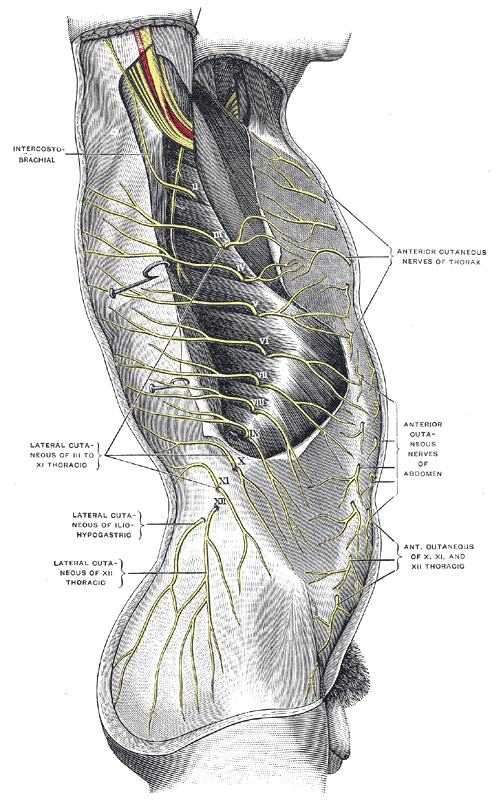
Iliohypogastric nerve comes out the side over iliac crest, with subcostal just in front, and a bit more superiorly, as in this picture to the right.


Iliohypogastric nerve supplies the skin on the side of the pelvis, while cluneal nerves drape down over the back of it, supplying skin at the top of the buttock.

............................................................

SUPERIOR CLUNEAL NERVES
See also this image of superior cluneal nerves (below). It shows cluneal nerves further back, posterior to iliohypogastric.
Via http://jiepou.shmu.edu.cn/

............................................................


Anyway, I insist I'm less wrong than they, about this. They inject, I don't. One wonders what exactly they think they are injecting...
Have I ever mentioned how against needling for pain I am? Or injecting stuff into other stuff? Unless it's to get a tooth pulled? Or a nerve literally frozen in order to stop its activity and have a surgical procedure (a life-saving surgical procedure!) done? 
............................................................

AXILLARY NERVE

A woman attending volunteered to have sensory testing done as a demo to the audience. She fell ten years ago and wrenched her upper limb. To this day she has pain on the outside of that arm, and her movement is restricted.

There was a practical small group session where we practiced asking each other questions related to neuropathic pain. I overheard Squire talking to a table about meralgia paresthetica, entrapment of lateral cutaneous nerve of the thigh, and I guess my ears must have gone straight up in the air, because she spotted me and came over and asked me what I thought. I said I thought it might be axillary nerve entrapment. She asked me how I would know. I said, there would be a very sore spot in the region of the posterior axilla, and her movement would be restricted at the shoulder.

I didn't know that her next move would be to invite me up on the platform to observe the woman's movement or to test her tender spot, but that's exactly what happened. And I was given the mike to explain the quadrilateral space through which the nerve emerges, which can scissor against it.
I did my best. I was nervous and felt like a bit of a smarty-pants being hauled to the front of the class. But nothing bad happened. I do think I got one of the muscular boundaries of the quadrilateral space wrong; however I don't think enough people in the room knew what I was talking about to even stop and correct me. 


Right scapula, quadrilateral space, axillary nerve, lateral cutaneous branch to outside of upper arm
Wikimedia Commons

...............................................................................................................................................................


MY PRESENTATION

I had to zoom through it 3 times in three half hour slots.


People seemed interested but it was really hard to know where the material landed and how. There were a number of comments and questions. I was feeling pretty jangled, actually. It was just me, not anything whatsoever to do with the organizers, who could not have been more gracious and helpful and supportive.

One guy, an MD, an injector type I'm sure, asked me, "Isn't what you're doing the same thing as myofascial release?" I said, "No." He said, "Then what are you doing?" I replied, "Lateral skin stretch." He said, "But isn't it the same?" I replied, "Fascia doesn't release." Someone else asked something and we moved on.

I summed it up by saying that even though my layout and connecting of dots was merely conjecture at this point, and the only evidence consisted of a tiny case series with modest display of help over an 8-week post treatment period, I thought that my explanatory model was less wrong than others floating around out there in manual therapy land.

That was about all I had the nerve to say about that. I hope it was enough.

One very thoughtful guy in front seemed pretty interested in the cutaneous rami angle. Maybe something can come from that. I guess we'll find out some day. Or not.

A few people came up later and wondered if they could have a card. I think the people there who actually have pain might be somewhat interested in checking out treatment some day. I'm certainly available. And I'm willing to travel.


Next post - sensory testing.


Digesting the Moose Jaw adventure: Part I

Today, I feel like I've safely returned from visiting another planet. This planet was much closer, but in many ways, much stranger than the one I visited last weekend. 

Last weekend I was in England, pouring information, as much as I could possibly pour, into eager sponge-like minds and hands; the psychosocial setting was very familiar, even if the geography and surrounding culture was novel. 
It took a very long time to go there and to return - my biological clocks still haven't fully synched back up (e.g., my bowels still think it's just fine to wake me up at 2 or 3 AM to do their thing - all is "normal", but just way too early in the morning, by about 5 or 6 hours. Ah, that critter brain..). 

This weekend I was in Moose Jaw, attending and participating in a Neuropathic Pain Conference, a continuing education event hosted by people from U. Sask, organized by the continuing education branch of the School of Physiotherapy there. This time the surrounding geography and culture were completely familiar, and the traveling practically inconsequential; the psychosocial setting was so unfamiliar as to feel almost foreign. 
There is so much to unpack here that I'll have to do it over several posts, I think. 

Most of the presenters were MDs and PTs - one pharmacist I think. The pharmacy session was concurrent with my own so I missed it. Susan Tupper, who is newsletter editor at the moment for the Canadian Pain Science Division, presented several times. 

Pam Squire, a pain management specialist in BC, presented several times. 
I guess it SEEMED so strange because it seems like forever since I left behind the whole janky biomedical model where knowledge is painstakingly built from case studies and diagnoses with nouns attached. In that world, cognitively, it's as though unless there is a noun officially attached, the "it-ness" of something.. 
a) doesn't exist
b) therefore may not be considered
c) certainly can't be felt as moving if it doesn't exist 
d) is not allowed to just be a verb, passing through

So.. I found myself thrust back into a world concerning itself with proposed "things" called trigger points. I heard about "myofascial" (a tissue "thing".. used as a descriptive adjective)..  pain
The older I get, the more elusive becomes any sense that could possibly be made by using a noun as an adjective to describe a fleeting and un-pin-downable verb such as "pain". But I digress. 

My insular cortex had to sit there and listen about injection of various substances ("things") into these "trigger points" (supposed "things") that are (in my own humble opinion) just mythical concepts, attractive to minds that need nouns to pounce on, because of the overwhelming operator mentality at work within a daily mentation).  There was a presentation about epidural injecting for neuropathic back pain. 
Maybe my insular cortex objected because of a news story I read lately about side effects of spinal injections including fungal meningitis from a bad batch of epidural injection material. I refrained from raising what would likely have been an unwelcome side topic, though. Very adult of me. Or was it? 

I asked Dr Squire, in front of the possibly surprised (and much more august than I) assemblage, would she please define what she meant by myofascial pain? She shot straight back - "Are you a believer?" I replied.. "I'm pretty agnostic about it. I just want to know how you define it."
I had dialed way back on what I would have preferred to say, that I was a complete atheist.. I felt enough out on a limb that I didn't want to create too big a kerfuffle. 

She started talking about some evidence that existed about some sort of tissue change at neuromuscular junctions.. but when I asked if those changes were primary or if they were secondary to a pain presentation she didn't answer, chose to move on, made it clear she wanted to get back on her own track by taking a question from someone else on a different topic. Maybe she never has thought about it. Maybe she has no idea. 
Which was fine. I did not want to derail her in any way - I wanted a thought process, that's all. And I couldn't help myself - it was such a great opportunity. It did involve swimming against the tide, going against the grain, knowing my "place".. and then choosing to not stay inside it. (Which felt a bit liberating, to be honest.) 

Part II will be about how nerves were discussed. 


Saturday, October 13, 2012

Neuropathic Pain Conference, Moose Jaw

Here we are, 8 AM of day II, at the provincial Neuropathic Pain Conference. We have several more speakers this morning, then in the afternoon, the breakout sessions where I will have an opportunity to explain dermoneuromodulation inside a half hour, three times in a row.

I've been madly live tweeting this event - if you want to read along, starting shortly I'll tweet as much as I can for as long as I can, @PainPhysiosCan , hashtag #SNPC .

Obviously the tweeting will go silent when I have to live present instead.

Addition: Here is a link to the entire series of blogposts this conference generated.


Friday, October 12, 2012

DNM adventures in jolly old England

I was invited last spring to teach in Sheffield, and agreed. The organizers on the other side of the Atlantic did a beautiful job of handling all the details. Traveling always stresses me out though, and a day or two prior to leaving home anxiety started to mount - there wasn't much I could do about it but get through it. 

On the weekend I was on and off 6 planes, 6 trains, taught two full days, stayed up for 30 hour stretches twice, mostly long hours of sitting punctuated by short periods of fast walking or taking trains between boarding gates, stressed out. I think I earned my pay. Anxiety and I don't get along very well. I'm sure anxiety and everyone else don't get along well either. In fact some days I'm convinced that most of ordinary daily human culture and ritual, and all of overt culture and ritual, has evolved to prevent it from starting up in the first place. Not that it doesn't anyway.. especially when one's critter brain begins to realize what's going on and starts to squirt out anxiety brain chemistry, when it senses threat, assigns danger salience to the situation. Adrenaline, baby. I have learned adrenaline can be my friend, especially when coupled with caffeine, especially when faced with multiple travel snags at Heathrow airport, or trying to teach live without mumbling incoherently.

I couldn't possibly have been better treated by my hosts, who made sure everything was as good as it ever could get. The hotel was right across the street from the PT practice which had become the workshop venue. Both were huge old Victorian mansions that had been repurposed. (Sheffield was full of these.) The class went fine - there is always the computer/cable/projector hassle at the start, but once we were rolling it went along fine. 

The workshop had attracted people from as far away as Norway, Latvia, and Italy, and nearer to home, Ireland and London. There were people there who had only just graduated, while others had been at it already for decades. Of 18 who attended, only two were women. Teaching massage therapists, the ratio has been more even. There were a couple of massage therapists there -  there was also an osteopath, a shiatsu therapist, even a chiro, childhood friends with the osteopath. On the whole they seemed an intelligent group of individuals. British PT has seen an influx lately of special interest groups determined to install memeplexes of the anti-scientific variety, at least anti-neuroscientific variety, which has most of the British PTs I met quite concerned, and pushing back. 

I didn't have time to go sightseeing, so the only pictures I took were of the class itself, and the inside of my hotel room. Here is a nice one of the whole class, outside in the sun on the lawn, the big banner advertising that it's a PT clinic, hanging down. Looks sort of like a castle, doesn't it? I appear in the second one.

October 7 2012 Sheffield UK


Oct 7 2012 Sheffield UK


If I ever do anything like this again, I'm going to add more days for downtime. It was crazy to go all the way there just to turn around and come straight back. My brain is still jangled, wakes up at 3 AM not able to sleep (like today), then crashes in early afternoon for a couple hours of deep deep sleep. I won't be able to do that today - I have to drive to Moose Jaw, Sask. this morning (two hours away) to participate in a neuropathic pain conference this weekend. My presentation won't be until Saturday, but I'll have to be somewhat sharp for it. It is, after all, an opportunity to have manual therapy of the gentle sort added to the possibilities of treatment for people in chronic pain. The conference is interdisciplinary, and officially provincial; there will be opportunity to network there. I am representing not just manual therapy but also the Canadian Physiotherapy Pain Science Division. So I have to try to stay awake. More adrenaline, please!


Tuesday, September 11, 2012

Deep versus shallow models of treatment

Last week I posted "Deep versus shallow models of manual therapy", but, as we all know, "therapy" isn't necessarily "manual." In fact, most therapy isn't manual at all. So, I'm going to expand the idea of deep versus shallow a bit more, to include therapy in general. This will encompass all the other kinds of treatment out there that has nothing to do with manual or physical contact. 

Joe Brence, in his Open Question to PTs... asks, "In your opinion, what is the one thing you would change about PT and why?" This effort is an answer to that question, I suppose...

But permit me to digress.

This past weekend I spent two days immersed in the small, 7-person think tank known as the executive of the Pain Science Division of CPA, in the beautiful and comfortable home of Dave Walton, current chair, who led the meeting. Almost all have been involved in research of some kind, spanning the range from me, with one paltry case series, to Tim Wideman, our chair elect. Out of 7 people, 4 have PhDs. We turned ourselves into a team. Out of our meeting emerged 1-year, 3-year, and 5-year plans. We intend to be unstoppable. 

General Effects
At that meeting I learned of the work of Maxi Miciak, a colleague of Geoff Bostick from U. Alberta, who is our division research representative. She has written a paper called: 

A review of the psychotherapeutic 'common factors' model and its application in physical therapy: the need to consider general effects in physical therapy practice.


In it she examines the idea that "general effects" count for far more than any sort of skilled technical expertise when outcomes of treatment are examined and put through a detergent cycle of statistical scrutiny. She mentions work done by someone named Jerome Frank*:   

[Jerome Frank's] "..conceptual framework includes four common features: (i) an emotionally charged confiding relationship with a helper, (ii) a healing setting where there is belief the therapist can help and is acting in the client’s best interests, (iii) a rationale, conceptual scheme or myth that plausibly explains the symptoms and prescribes a procedure for resolving the symptoms, (iv) a ritual or procedure that requires active participation of both patient and therapist and is believed by both to be the means of restoring health."   
* Frank JD, Frank JB. Persuasion and Healing: A Comparative Study of Psycho- therapy, 3rd edn. 1991, The Johns Hopkins University Press, Baltimore.

Don't you think, realistically, that manual therapy is mostly "ritual" procedure? It seems to me, after a lifetime of being a therapist, and for most of that time, being a manual therapist, that it's a way to fill up time while the patient's brain changes itself. Hey, you gotta kill time doing something. Hopefully something useful. Hopefully something that will make sense to both of the two people in the treatment dyad, therapist and patient person experiencing pain. 

In other systems, e.g., Peter Levine's Somatic Experiencing (which I attended in 1992), time is killed by just sitting there calmly. Peter Levine referred to this as paw-licking, something cats do a lot when they are just sitting, thinking, cogitating (or whatever cats do in those feline brains they have..), basically just passing time. The point is, you don't want to interrupt while your patient or client or consultee is busy doing what they have paid you good money to facilitate. The other thing to remember is, their brains will do their own changing, automatically. You don't have to "do" anything at all, if you don't want to. You can just sit there and watch. All the facilitation is purely social. Your job as therapist is to stay out of the way, for the most part. Just like siphoning - get the water to come up against gravity by sucking on the hose a bit, recruit normal air pressure to assist, then you can sit back and watch it flow uphill. It will work fine as long as the output end of the hose is a bit lower than the intake end. (In the brain, this has something to do with its finding more efficient metabolism, I think.)
The skill set is to know when to intervene slightly, and when to back off. Like steering while driving. You do not have to devote much hard drive to steering after awhile. The skill set of keeping a car on the highway, between the lines, while avoiding other moving vehicles, becomes completely automatic, implicit knowledge. 

(The challenge as far as I'm concerned, as a manual therapist, is how to keep the process alive and dynamic and fresh with each patient, how to stay tuned in so it doesn't get stale and turn into automaticity.) 

Putting the SOCIAL into biopsychosocial (finally!)
Serendipitously, this little gem turned up: PAINWeek 2012 Conference Keynote Address: The Realities of Pain as a Public Health and Social Issue. In it, 
"Daniel B. Carr, MD, of Tufts University School of Medicine delivered a keynote address titled “Have We Been Backwards, Upside Down, or Both?” at the opening session for PAINWeek 2012."
It's great! He can see how all this time we've all been looking at pain through a telescope backwards! If we start at the social end of biopsychosocial, instead of always at the bio end, we could do better

The social end is where all manual therapy starts. It's interactive, not operational, no matter HOW resistant manual therapists might be to that idea. We are not treating stretchy corpses, we are not treating tissues, we are treating people who have pain. We are treating brains in pain. We are treating nervous systems in pain, nervous systems that span the entire distance, both physically and conceptually, between skin cell and sense of self. 

So, Joe, in answer to your question, I'd say, let's be less physical, more therapist. 


REFERENCE:

Miciak MGross DPJoyce AA review of the psychotherapeutic 'common factors' model and its application in physical therapy: the need to consider general effects in physical therapy practice. Scand J Caring Sci. 2012 Jun;26(2):394-403


Thursday, September 06, 2012

Deep versus shallow models of manual therapy

A long time ago, shortly after I moved online and joined discussion groups (way back in 2001), I encountered Barrett Dorko, who was the first PT I had ever met who differentiated between what he called deep models of manual therapy versus shallow models. It made sense to me. 

Deep models seem to line up well with knowledge of science in general, understanding of neuroscience in particular, and logical deconstruction of the pretence that we, manual therapists, can actually have any direct physical impact on somebody else's (i.e., a patient's) tissues that would result in a therapeutic outcome. 
I could relate. In my mind, deep models equate with what I call "ectodermal" models - "interactor" models. It's where I've always wanted to see PT go - more emphasis on "therapy" - less on "physical". 

Shallow models line up with everything I detested (and still detest) about manual therapy - a tissue is chosen as a target, then an entire world-view built around it, including a whole set of ritual interventions directed toward said tissue target. 
Tissue targets range from the most deep (spinal joints) to the most superficial (fascia, head sutures); muscles, ligaments, tendons - pick some part - any part - of the movement conglomerate, or passive elements that are there to keep it from falling apart! - then have at it. 
Build an entire religion around "correcting" it. 
A large vocabulary is invented, based on pareidolic assessments of biomechanics which are asymmetric and therefore "faulty". These observations are welded to pain manifestations. Therapist "corrects" the "faulty" biomechanical appearance of a person's posture, or position, or movement, and voilá, if the pain diminishes, it has "proven" the therapist's religious-like world view about what was "wrong" in the first place. It's like driving forward while looking in a rear view mirror. 
These are the shallow models.  These line up with what I call "mesodermal" or "operator" models. 

I recently devised a flowchart of sorts, exposed it to my peers, got good feedback, revised it a few times, and posted it to Facebook, where it went out into the world a little way. Here it is again. (Click on it to make it big.)


In my opinion, the problem stems back to language, and particularly to the human brain's difficulty with recognizing that as soon as nouns are applied to treatment, the life gets sucked out of treatment as encounter between two human beings. Life is sucked out of the verb of the encounter, out of the encounter as verb. As process. As something that has a beginning, and a middle, and an end. Like a story. Like a story built by two people, interacting, not by one person who thinks they know everything about everything and treats the other like an object


More information:

1. Beyond the technique- from Operator to Interactor BlogTalk radio podcast interview with Diane Jacobs and Jason Silvernail

2. "Touch is good" - HumanPrimateSocialGrooming manual

3. Manual therapy and its treatment models (google doc)

4. Diane F Jacobs*, PT and Jason L Silvernail, DPT, DSc, FAAOMPT; Therapist as operator or interactor? Moving beyond the technique.  J Man Manip Ther. 2011 May; 19(2): 120–121. (*FYI: This is my only pubmed publication - any other "Jacobs DFs" out there are not me)

5. New Treatment Encounter (I-VI)

6. DNM in a Nutshell

7. Boiling down the problem


Saturday, September 01, 2012

More about Olausson

I have talked about Olausson before, many times (see list of blogposts at bottom of page). 

Last night, late, this piece by Sabrina Richards, writing for New Scientist, came in: Pleasant to the Touch.  (Which meant it was 1:32 AM before I could even think about going to bed!)


There were other great stories to read in New Scientist last night - there was one called A Nose for Touch, by Kenneth Catania about star-nosed moles, all about what incredibly sensorially-well-appointed little feeler-like noses these small mammals enjoy, with a great deal of information about sensory processing in general; Missing Touch by Meagan Scudellari is about the quest to give prostheses haptic capacity. Good Vibrations by Cristina Luiggi is about mechanoreception in all sorts of creatures. The Pliable Brain by Christina Karns is about how deaf peoples' auditory cortex might be used by them, outside awareness, to process mechanoreceptive information. 


A bit outside the exteroceptive sensory processing ball park, but still about feeling, this time interoceptive processing of one's own stress response, is a piece by John Coates, A Story Biological: Coates is a former stock trader, and neuroscience investigator - he wrote a book. "The Hour Between Dog and Wolf: Risk Taking, Gut Feelings and the Biology of Boom and Bust." I happened to catch this CBC interview with him while driving home from CPA Congress in May. It was brilliant. He proposes that in men, a positive feedback loop between excitement and risk taking grows and grows until either victory or devastating defeat occurs. I.e., men just don't feel their growing stress response as anything with warning bells attached - instead they feed on it. (He thinks women and old guys should take care of the money, as they are way more risk aversive.) 


But anyway, back to Kenneth Catania's piece about star-nosed moles... 

Excerpt: 

"Exquisitely sensitive touch
The star-nosed mole’s “nose” is not an olfactory organ, but a skin surface that mediates touch. Innervated by more than 100,000 sensory neurons, the star is probably the most sensitive and highly acute touch organ found on any mammal. Under a scanning electron microscope, the skin surface resolves into a cobbled landscape covered with tens of thousands of tiny epidermal domes. Each is about 60 µm in diameter, and each contains a circular disk in its center. Known as Eimer’s organs, these sensory protrusions cover the entire surface of the star’s 22 appendages. In total, a single star contains about 25,000 domed Eimer’s organs, each one served by four or so myelinated nerve fibers and probably about as many unmyelinated fibers.1 This adds up to many times more than the total number of touch fibers (17,000) found in the human hand—yet the entire star is smaller than a human fingertip."
So, thinking as a manual therapist, if we could make a human hand that contained the sensitivity of a single star nose, we'd need ... let's see.. a hand that was 6 times bigger and just as sensitive as it already is! If you  think of visual data, that would be WAY too big and too fuzzy a "picture"! The pixel size needs to be dense to get such great resolution. 

We could die from all the pleasantness, maybe: (Pleasant to the Touch)
"Scientists hope an understanding of nerve fibers responsive only to gentle touch will give insight into the role the sense plays in social bonding."
"The C-Tactile Story 
When HÃ¥kan Olausson and his colleagues at the University of Gothenburg began studying light touch perception in the early 1990s, most researchers in the field rejected the idea that humans might have slow-conducting nerve fibers sensitive to gentle pressure. “Nobody really thought they existed in humans,” Olausson explains. Textbooks at the time acknowledged that humans had slow-conducting nerves, but asserted that those nerves only responded to two types of stimuli: pain and temperature. Sensations of pressure and vibration were believed to travel only along myelinated, fast-signaling nerve fibers, which also give information about location. Experiments blocking nerve fibers supported this notion. Preventing fast fibers from firing (either by clamping the relevant nerve or by injecting the local anesthetic lidocaine) seemed to eliminate the sensation of pressure altogether, but blocking slow fibers only seemed to reduce sensitivity to warmth or a small painful shock. 
In contrast to the work in humans, experiments in cats, rats, rabbits, and even monkeys found that unmyelinated, slow-conducting nerve fibers were indeed sensitive to light touch, but were found only in hairy skin. Some researchers speculated that humans had lost such fibers to evolution as they shed most of their body hair. While a few isolated studies suggested that facial skin retained the fibers, those studies were often dismissed as merely demonstrating the existence of a vestigial type of nerve fiber, says Olausson...
Then, in 1999, the group looked more closely at the characteristics of the slow fibers.They named these “low-threshold” nerves “C-tactile,” or CT, fibers, said Olausson, because of their “exquisite sensitivity” to slow, gentle tactile stimulation, but unresponsiveness to noxious stimuli like pinpricks... Unlike other types of sensory nerves, CT fibers could be found only in hairy human skin—such as the forearm and thigh... To address the question, Olausson’s group sought out a patient known as G.L. who had an unusual nerve defect. More than 2 decades earlier, she had developed numbness across many parts of her body after taking penicillin to treat a cough and fever. Testing showed that she had lost responsiveness to pressure, and a nerve biopsy confirmed that G.L.’s quick-conducting fibers were gone, resulting in an inability to sense any pokes, prods, or pinpricks below her nose. But she could still sense warmth, suggesting that her slow-conducting unmyelinated fibers were intact... G.L. also afforded scientists the opportunity to observe which areas of the brain respond to the gentle brushing. Sensations of touch stimulate two different brain areas, says Vaughan Macefield, a neuroscientist at the University of Western Sydney who researches how the brain processes pain. The somatosensory cortex registers the quick signals sent along myelinated nerve fibers and tells us where on our body the sensations originate. Slow, unmyelinated fibers send signals to the insular cortex—a section of the brain that processes taste and pain, as well as emotion. Most of our touch perception mingles information from both areas, says Macefield. 
Olausson used functional MRI studies to examine which areas of the brain lit up when G.L.’s arm was gently brushed to activate CT fibers. In normal subjects, both the somatosensory and insular cortices were activated, but only the insular cortex was active when researchers brushed G.L.’s arm. This solidified the notion that CT fibers convey a more emotional quality of touch, rather than the conscious aspect that helps us describe what we are sensing. CT fibers, it seemed, specifically provide pleasurable sensations.Reading these studies while sitting on an airplane some 15 years ago, 
Francis McGlone, whose research at the time focused on pain, had an epiphany. “I said, I know exactly what they’re for: grooming behaviors,” he explains. 
McGlone had already begun hypothesizing that certain behaviors, like applying face creams, were motivated more by an underlying pleasant sensation than by any anti-aging benefits the creams might be providing. People repeat these behaviors, McGlone theorized, because they stimulate a subtle, positive, possibly unconscious sense of reward. CT fibers offered the perfect explanation of how this positive sensation was being transmitted to the brain.
These studies, taken together, led McGlone to think about how touch informs social interaction. In his view, it’s clear that pleasant touch is important during both infant development and adult social interaction. Although rigorous human studies have yet to be performed, anecdotal evidence in humans and studies on rats nurturing their pups supports the role of touch in brain development."


My bold.
References under Richard's story:


  1. Ã….B. Vallbo et al., “A system of unmyelinated afferents for innocuous mechanoreception in the human skin,” Brain Res, 628:301-04, 1993. 
  2. Ã….B. Vallbo et al., “Unmyelinated afferents constitute a second system coding tactile stimuli of the human hairy skin,” J Neurophysiol, 8:2753-63, 1999. 
  3. H. Olausson et al., “Unmyelinated tactile afferents signal touch and project to insular cortex,”Nature Neurosci, 5:900-04, 2002. 
  4. L.S. Löken et al., “Pleasantness of touch in human glabrous and hairy skin: Order effects on affective ratings,” Brain Res, 1417:9-15, 2011. 
  5. I. Morrison et al., “Reduced C-afferent fibre density affects perceived pleasantness and empathy for touch,” Brain, 134:1116-26, 2011. 

Old blogposts re: Olausson:
1. Dermoneuromodulation: Ascending Pathways (March 2012)
2. Dermoneuromodulation: Ruffini Sensory Endings and Dorsolateral Prefrontal Cortex (March 2012)
3. More Insular Matters (May 2008)
4. "Somesthesis" (April 2008)
5. SomaSimple Pain Consensus (Jan 2008)
6. Manipulation and the Brain (Feb 2007)

Also, about grooming behaviours and how they relate to manual therapy:
OPERATOR / INTERACTOR MODELS OF MANUAL THERAPY


Sunday, August 26, 2012

Looking forward and back, post San Diego

I feel rested now, and able to sort through most of the impressions from the San Diego adventure. I always come back from such glaring exposure feeling a bit raw and undone. This never has had anything to do with the teaching itself, which goes well enough, usually, or the hosting which has always made me feel very well-cared for. It has to do with me, and with the fact that my favorite thing in the world to do is sit quietly at home, reading and thinking, not physically jostle up against hundreds of people in unfamiliar airports, or stand up in front of a group pouring it out for a couple days straight, or make dozens of new friends, or see the world. 

I realize that 'what doesn't kill me will only make me stronger' (exercising has taught me that); I've adapted quite well, I think, considering that the number of times I've taught can still be counted on fewer than two hands: Still, I have to factor in that traveling around and teaching sucks a lot of life out of me; this isn't a life I'd ever choose - it's chosen me somehow, and I'm trying to respond to it, comply with it, because the feedback I'm getting is warm and positive, and I figure it must be important to people even though I still scratch my head, wondering, "why me". 

Anyway,  remarkable things do happen at these encounters sometimes. They have a way of emerging all on their own once a set of logical ideas are laid out in a logical way. I'm not saying remarkable emergences are consistently predictable, or expected. Just that there is something about collective human interchange that sparks something, in people, in real time, in groups, that just doesn't spark outside of real time. 

Something which happened as a consequence of this encounter, is a reflective, thoughtful blogpost by one of the attendees, Walt Fritz, a teacher himself, What I did on my summer vacation. In it Fritz lays open a view of his cognitive shift over the years and some back history on SomaSimple. He mentions a thread in which a battle occurred (virtual only, no actual blood was drawn). 

Here is a link to Myofascial Release: The Great Conversation, from 7 years ago. Warning: it's long. Very long. 

I've yet to read any "conversation" about manual therapy, about ideas associated with it, both good and not good, before or since, that covers as much territory from as many angles so passionately or thoroughly. We finally had to lock the thread to stop it: the observation was made by the administrators and moderators that the topics were circling/repeating endlessly, orbiting entrenched, immovable positions. It was deemed time to move on to other topics. 

Bernard put it on the front page of the forum that we might never have to go over any of its content again. Presumably, MFR enthusiasts who might be drawn to the forum find it easily, and after reading it, either stick around because they are interested in learning what else there is to find out, or they find their beliefs too challenged, are repelled, and leave before trying to engage members in pointless debates about fascia, its supposed magical properties, and how great their own hands are at "releasing" it. Anyone who joins the forum and doesn't happen to see the link, and starts to talk about fascia, is quickly provided with it, asked to read through the "great conversation", and get back to us afterward with any thoughts they (might still) have. 

I met Walt in person last weekend, and am reasonably sure that he's a nice, reasonable, genuine, caring therapist, who, although he took some virtual lumps, did so graciously, and appears to have come through the last 7 years right side up.  He has moved away from most of the memplexes of MFR, it would seem (except for the name itself, which is a memeplex all its own.. and I disagree with a commenter who suggested putting the letter "N" in front of the letters "MFR" - sticking neuro in front of a tissue-based operator treatment concept won't help rehabilitate it into being a more ectodermalist, nervous system-friendly, interactive one, I'm afraid).  

Walt has distanced himself from his previous mentor. It seems he has become his own mentor, which is is what the profession needs - people who learn to think for themselves, who choose to not readily buy into crazy, completely off-base ideas promoted for profit by charismatic people.  

SomaSimple actually owes Walt a debt of gratitude, for without that "great conversation", we may not have reached as many minds as we have so far. So, on behalf of SomaSimple, thank you Walt. And welcome back. 

Thursday, August 23, 2012

Back from San Diego. Pleasantly exhausted.

I was gone 6 days, two of which were spent air traveling/airport stress, two of which were spent teaching nonstop, and the other two were spent visiting Sea World, the San Diego Zoo, and the Birch Aquarium with my very congenial hostess, Rajam Roose, who also co-organized the workshop, so I could introduce dermoneuromodulation to massage therapists.

We also walked the halls of the university in La Jolla, where Ramachandran roams. We didn't want to disturb him, obviously, but we saw the door to his office, and quite a thrill it was, I must say.

The tourist destinations involved miles and miles of walking. The zoo in particular is huge. We walked steadily, for  four and a half hours, with lots of hill and stair climbing. Together we estimated we walked about ten miles at the zoo alone.

But it was soooooooo worth it! We saw the baby jaguars, the huge silverback gorilla, and... well, everything else that lives there, actually.

No wonder I'm absolutely exhausted today.
Good thing I booked myself off a hermit day today. I'm too tired to even unload pictures I took. Maybe later..

Monday, August 13, 2012

More from Raven


I feel vindicated.

"Having worked with this anatomical information issue for some years now, I can assure everyone that it's not really as bad as Jacobs suspects.

"It's much, much worse."


..... from Raven's latest blogpost on this annoying and confounding anatomy mis-labeling: 


It all depends on what the meaning of "is" is: 05-Augean Stable Song, part 1 (#12/31)


Also see:


ADD: August 23/12:
There are a couple more of these blogposts by Raven, #13/31, and  #14/31.
I asked her privately if she agreed that just using the term "superficial fascia" (instead of a more appropriate term, such as hypodermis, or subcutis), just contributed more hole to the hole in the hull, to a deepening of an undesirable meme, and she said she did. 

I consider this topic now successfully dealt with, and closed.

Sunday, August 12, 2012

Here's Raven - again!


Ravensara Travillian continues to dig deeply into developing her answer:

It all depends on what the meaning of "is" is: 04-Pandas and raccoons and bears, oh my! (#11/31)


Raven has dug in her shovel, and is carefully unearthing, then brushing into relief, all sorts of archeological strata in order to design the most meaningful and careful answer to a question that anyone has perhaps ever provided anyone else ever. Read her answer closely. Learn about philosophy. Learn about ontology. Learn about taxonomy. 
She likes investigating layers, and not just anatomical layers - layers of knowledge!

This shouldn't come as a surprise to anyone, necessarily, but here we have an actual trained educator talking (not just an amateur who reads a lot and has many opinions, like.. oh, myself for example...), and... AND, she is showing us the inside of her very well-appointed mind
And she's doing it for free. 
And I'm in awe, because a very very tidy mind it is; it appears to be organized into beautiful little coloured bullet points! 

See:

Saturday, August 11, 2012

Heeeeeeere's.... Raven!


Ravensara Travillian has kindly responded to my blogpost from yesterday, Hole in the Hull!, with a set of posts on her POEM blog:


It all depends on what the meaning of "is" is (#7/31)


It all depends on what the meaning of "is" is: 02-What a wicked game we play (#9/31)


My understanding is that she intends to flesh these posts out more. Stay tuned - give the woman space so that she might explain how this whole fascia thing seems to have gone so sideways. 


Update: New blogpost by Raven:

It all depends on what the meaning of "is" is: 03-Are we even talking about the same thing at all? (#10/31)


.........

Afterthought:

This looks promising, like it could turn into one of the most fruitful conversations I may have ever had on the internet. If so, I hasten to get all my ducks lined up in a row, fuelled by anticipation. 

1. I want to include this observation I wrote a long time ago, reflecting on the difference I perceive between operator and interactor models of manual care. 
Manual therapy and its models

2. Also, see Treatment Continuum, a series that added visualization to the operator versus interactor ideas in the previous link. 

3. That series is linked into DNM in a Nutshell, a compilation of compilations in one simple link that I send to people who are interested in learning about the underpinnings of dermoneuromodulation. 

Well, these aren't all the ducks I have, but they're a start. 

If anyone can get to the bottom of the dilemma, I'm sure it will be Raven. She comes complete with scholastic heavy artillery, academic acumen, and a heart large enough to embrace all the foibles that have ever arisen in the world of human primate social grooming. Until later. :-)


Friday, August 10, 2012

Hole in the hull!

Lately on Facebook I've had the opportunity to peer into the abyss of determinedly persistent mesodermalist confusion from several angles:

It all started when I read a post by Ravensarsa Travillian, Finding your space: Anatomical reasoning and our relationship to realism. 
In it, she discusses comments made by a currently popular anatomy teacher in manual therapy circles, and deconstructs them.

This statement (from Ravensara's post) was pointed out in a conversation I was having with another manual therapist, a fascia-based reasoner by my reckoning;
"Superficial fascia, on the other hand, is an organ, but only one of its components has an endocrine function, so again, he's using terminology wrong: it's not an endocrine organ, although one of its components has an endocrine function."

What the???? First I kicked myself for having not seen it. Then I thought maybe Ravensara had made a mistake. So I asked her about whence it had come. She kindly supplied the reference. A verifiable source. She even brought in an anatomist from there to clarify. That's just the sort of careful, kind, even, responsive and generous scholar she is. He verified it, although there is still a bit of an open question about whether superficial fascia is an "organ", or just an "organ part".

I thought to myself.. must investigate this statement a bit further. How can a "tissue" be considered an "organ"? Organ part maybe, but "organ"??

I dug around in Gray's Anatomy online. Here's what Gray's says:


"Fascia is a term applied to masses of connective tissue large enough to be visible to the unaided eye. Its structure is highly variable but, in general, collagen fibres in fascia tend to be interwoven and seldom show the compact, parallel orientation seen in tendons and aponeuroses. 
"Superficial fascia is a layer of loose connective tissue of variable thickness that merges with the deep aspect of the dermis; it is thus also known as the hypodermis. It is often adipose, particularly between muscle and skin. It allows increased mobility of skin, and the adipose component contributes to thermal insulation and constitutes a store of energy for metabolic use. Subcutaneous nerves, vessels and lymphatics travel in the superficial fascia"

My bolded italics.
This is depressing news. 
I had no idea that "fascia" meant, or was synonymous with, anything other than some sort of gluey stuff extruded from sparsely located cells, barely metabolically active except for cranking out vast amounts of sticky molecules, a trick that comes in handy in a heterogenous organism which has some parts hugely expensive to maintain (e.g. nervous system, only 2% of the body but requiring 20% of all the fuel), important for keeping an organism from falling apart, and for giving its more active contractile elements a place to anchor.
My idea of superficial fascia was that it was that fine filamentous spider-webby areolar stuff adhering the hypodermis on to the outside of the body, and to the dense fascia that overlies it. I confess, it was my conjecture, based on what I think is logical.

Now here is Gray's, saying it means hypodermis. Something is definitely wrong on the internet. Something might be seriously wrong in anatomy!

It seems to me Gray's is calling all animals in this layer cows, instead of just some animals. I look at this with jaw resting on floor. I really do think it amounts to a taxonomic error on the part of anatomists. I'm calling them on it, right here.
I think the term "fascia" should be left as a description of a particular connective tissue type, not an assemblage of tissue types that obviously comprise an organ, hypodermis, that has a particular function, i.e. thermoregulation, and through which passes indisputable neural structure which can't be classified with fascia no matter how hard you try to stretch it! (..no pun intended.)

The world of manual therapy is like a spaceship. And I feel like I just discovered the conceptual hole in the hull.

Because of this one single factual misnomer, countless generations of manual therapists have been sucked out into space, have had their minds snapped shut while simultaneously being made to contemplate the bogus idea that they have magical hands that can somehow overcome the logical purpose of fascia, which is to keep the body from coming apart, all because of a careless slip of taxonomic nomenclature stemming from the dissection habit anatomists have of slicing this blubber layer right off so as to get to viscera etc., useless and hindering as it is in a cadaver specimen, not investigating it from the perspective of how it might respond in a living human when touched from the outside, say by a manual therapist, who clearly cannot get his or her hands past the barrier of the heavily innervated outer dermis (not without introducing infection, at least), or past reflexive motor guarding by spinal cord function via autonomic and somatic motor efferent, and visceral afferent neurons. And it has been replicated, as a meme, as an error, by anatomists, apparently with high fidelity.
So, based on this careless anatomical overlook, manual therapists have been taught, carefully, in a stepwise, apparently anatomically acceptable but logically impossible Argument from Authority, a tissue-based myth that they can manually impact "superficial fascia", from the outside in!

To add further insult, this mistake (according to me at least!) has been allowed to sit there uncriticized, confusing generation after generation. When will the madness stop? It could stop immediately, if anatomists, or whoever is in charge of producing anatomical information, would just correct this one tiny assertion/conflation. It would be a necessary and sufficient hull patch.