Luggage finally arrived home yesterday. This is good, because all my notes and materials from the Congress were in it.
Pain Mind and Movement Symposium
A whole day of presentations, lots of science, lots of graphs, lots of dark slides of graphs in a dark room. I gotta say, there wasn't as much zip as I would have preferred. Some presentations stood out, like that of Michael Sullivan who is looking at how to test for a sense of "perceived injustice" in injury cases, teasing out the manner and degree to which it impacts a pain experience. He used video clips - much more interesting than plain old power point. Maureen Simmonds showed video clips of her movement lab - she uses virtual landscapes projected onto walls and tries to determine if illusory surroundings have any effect on perceived pain or effort while walking on a treadmill. Catherine Sabiston talked about mastectomy patients and dragon boating, and something called post-traumatic psychological growth, but not pain specifically. It sounded like if everyone would just bond while being active no one would care if they had pain or not. I don't know - I'm sure there's something to this but I'm also pretty sure that not everything emotionally or physically or socially painful is due to dragon boating deficiency.
There was a break for lunch, which turned out to be lunch from a box, not the most inspiring lunch I've ever enjoyed. Several of us gathered round large round tables. I sat with some people I knew from being online and a young woman from England I had just met. The conversation roamed around and landed on the topic of pain and biomechanics, something I have done some thinking about. As we talked about how to uncouple the two ideas to free the minds of PTs from the shackles of conflated thinking, the English girl said, well, wait a minute, I have a foot pain, and it goes away when I slide T12 to the right over L1. I couldn't let it go by: Really? I asked; Do you think that's the only thing going on in your body that matters, is that you move a few bones relative to each other? How do you "know" you are even doing that? I was questioning her assumptions but she responded as though I had punched her in the gut. She replied that that's what she did, and it took away her pain. I looked at the others and said, mesodermalist. A lively discussion followed but the English girl might as well have been listening to jabber from an alien planet, because she knew what she knew and what she knew was fine by her. Or something. I think she's another meme victim of "motor control." I checked around and see that she wrote a chapter in a book about movement published in 1998. She's been attending congresses like this, one presumes... maybe she still imagines that other innervated tissues in the body, besides bone and muscle, don't matter to the brain. Maybe she's never considered that physically therapeutic ways to approach the problem of pain exist, might include a bit of, but are in no way restricted to, "motor control". It's the 'blinkers attached to the side of the head' problem I've seen ever since I started up in this profession 40 years ago.
The afternoon session included more dark powerpoints in a dark room. The final session was a "roundtable" - a refreshingly lively microphone session where anyone who wanted to take the mike could. Steve George started off with a confession that he was a recovering biomechanist. He had presented earlier but I probably had zoned out by then on all the powerpointage - my ears were sharp now however. He was followed by a bunch of other fed-up people, all on a similar page about the state of PT and what could be done about putting pain further forward in the focus of the profession. I didn't get up at the mike - I'm more interested in what others more eloquent and extroverted than I have to say, and I'm better at writing than talking. It was great to be there and realize how not alone I am in my disquiet.
The wine and cheese slated to follow the day had been canceled.
Wednesday, September 08, 2010


Sunday, September 05, 2010
IASP in Montreal - post event snippets
This is a series of little personal and professional snippets, vignettes, from the IASP Congress, held in Montreal Aug. 29-Sept 2 2010.
Lost luggage (again..)
I got back Friday afternoon (Sept 3), minus my luggage, lost somewhere in the bowels of Toronto airport by Air Canada in connector flight limbo, for the second time in 4 months. It has yet to arrive - the first time it was lost by Air Canada as I came home from Brazil, it arrived the next day. This time the wrong bag appeared at the bus station. Someone else must be in Air Canada luggage hell with me, our suitcases delivered to each other. This is getting very stressful. No more Air Canada for me I'm afraid. I'm already going through a mourning process more severe than should be necessary - especially once I realized I had packed my notebook FULL of scrawled notes taken at all the presentations. That really sux. The clothes? Meh. The shoes? Meh. Replaceable. But the two hard cover books, a dental pick, favorite scratchy Japanese bathing towel, MUCH harder to replace; the bamboo back scratcher that was my dad's before he died, and the note book (!) - irreplaceable!
The Melzack reception
It was the first time I'd ever been to an IASP Congress, ever. I knew they occurred but this time I wanted to go specifically to attend the reception for Ron Melzack. I not only was in the same room as he was, but I got to meet him, shake hands, and have a picture taken with him and the other members of the CPA Pain Science Division who attended. The photographer is a retired neuropathologist married to a Canadian pain physio we know, who said he'd email the photos but hasn't so far. When he does I'll post one. This event is the highlight of my life so far.
John Loeser presented a slideshow of Melzack's life and work, lots of photos of his childhood, family, vacations he was on, people he met and worked with, with lots of hair and without, all the way from age 10 to now. I was previously unaware Melzack had written books of stories of the indigenous peoples of the far north. He was there with his wife in her wheelchair, gracious and charming, shorter than I had expected. There were probably close to a hundred people gathered, beautiful food, plenty of wine, lots of huddle around the guest of honour.
I really wanted to say hello to him, saw that there was sort of de-reception line had formed as he tried to make his way out the door into a larger foyer for a planned photo with his "family" of grad students. I walked over and waited a turn. When he got to me it was clear on his face he had never met me before. He extended his hand anyway. I rapidly introduced myself and reassured him we had never met previously but that I was very pleased to meet him, that I was with the physiotherapy Pain Science Division, that I wanted to thank him for his life's work, that it was already having a large impact on my profession and that if I possibly could I would want all PTs in the world to become conscious neuromatricians. I asked him if he would be willing to have his photo taken with those of us from PSD who were there, and he graciously nodded. And then it happened, out in the lobby, after the more official photos were taken.
SomaSimple thread
A SomaSimple thread was started while IASP Congress was happening, to which we posted highlights (and some photos) when we had time.
More to come. Much more.
Lost luggage (again..)
I got back Friday afternoon (Sept 3), minus my luggage, lost somewhere in the bowels of Toronto airport by Air Canada in connector flight limbo, for the second time in 4 months. It has yet to arrive - the first time it was lost by Air Canada as I came home from Brazil, it arrived the next day. This time the wrong bag appeared at the bus station. Someone else must be in Air Canada luggage hell with me, our suitcases delivered to each other. This is getting very stressful. No more Air Canada for me I'm afraid. I'm already going through a mourning process more severe than should be necessary - especially once I realized I had packed my notebook FULL of scrawled notes taken at all the presentations. That really sux. The clothes? Meh. The shoes? Meh. Replaceable. But the two hard cover books, a dental pick, favorite scratchy Japanese bathing towel, MUCH harder to replace; the bamboo back scratcher that was my dad's before he died, and the note book (!) - irreplaceable!
The Melzack reception
It was the first time I'd ever been to an IASP Congress, ever. I knew they occurred but this time I wanted to go specifically to attend the reception for Ron Melzack. I not only was in the same room as he was, but I got to meet him, shake hands, and have a picture taken with him and the other members of the CPA Pain Science Division who attended. The photographer is a retired neuropathologist married to a Canadian pain physio we know, who said he'd email the photos but hasn't so far. When he does I'll post one. This event is the highlight of my life so far.
John Loeser presented a slideshow of Melzack's life and work, lots of photos of his childhood, family, vacations he was on, people he met and worked with, with lots of hair and without, all the way from age 10 to now. I was previously unaware Melzack had written books of stories of the indigenous peoples of the far north. He was there with his wife in her wheelchair, gracious and charming, shorter than I had expected. There were probably close to a hundred people gathered, beautiful food, plenty of wine, lots of huddle around the guest of honour.
I really wanted to say hello to him, saw that there was sort of de-reception line had formed as he tried to make his way out the door into a larger foyer for a planned photo with his "family" of grad students. I walked over and waited a turn. When he got to me it was clear on his face he had never met me before. He extended his hand anyway. I rapidly introduced myself and reassured him we had never met previously but that I was very pleased to meet him, that I was with the physiotherapy Pain Science Division, that I wanted to thank him for his life's work, that it was already having a large impact on my profession and that if I possibly could I would want all PTs in the world to become conscious neuromatricians. I asked him if he would be willing to have his photo taken with those of us from PSD who were there, and he graciously nodded. And then it happened, out in the lobby, after the more official photos were taken.
SomaSimple thread
A SomaSimple thread was started while IASP Congress was happening, to which we posted highlights (and some photos) when we had time.
More to come. Much more.
Friday, August 27, 2010
Yet another level
In manual therapy one is taught that one can push bits of body around, and that this makes them feel better to the person whose bits one is pushing.
I call this the "operator model" of manual therapy.
One quickly learns (or should) that manual therapy is much less about the bits one thinks one is pushing, much more about one's speed and force, mostly minimalizing thereof, waiting for the opening, waiting for the person's physicality to let one in.
I call this the "interactor model" of manual therapy.
However, it's quite possible to remain stuck in the operator model for good.
As one proceeds through life one begins to realize that it is impossible to prove to oneself or anyone, through any method, specifically scientific but also logical or philosophical, that what one "thinks" one is doing has any bearing on reality. I.e., you cannot prove, even to yourself, that the SI joint, actually is what you are "feeling" with your fingers, as you perform what has been taught to you as a "test" of its "function." Yes, you can feel stuff... stuff is moving, or not moving, but what one feels moving or not under one's fingers, from on top of skin, has absolutely NO bearing on whether or not a buried SI joint is literally moving. There are many layers and structures all moving on each other between skin and joint, even inside "skin" (cutis/subcutis) itself.
It's merely a convenient assumption. It's a belief. There is absolutely no way to show that it is or isn't moving, or that people can or can't palpate it clinically.
In this case, what do you do? You realize (with a sickening feeling) that you've managed to paint yourself into a conceptual corner. There is no way out, except:
1. ... tromp out over wet paint, spreading dirt and paint.
This is the equivalent of insisting that it's possible, it must be, you've always thought so, your patients' results have always verified your magic-hand ability to ferret out movement/non-movement in the SI (except for when they didn't), therefore the premise must be right. Right? (Those patients who don't fit, well, there are always a few patients who don't fit, outliers, right? We can ignore them, can't we?) Wrong.
Trying to set up tests to "prove" you are right/how right you are is a version of what Harriet Hall calls, tooth fairy science.
2. ... admit defeat, stop thinking about escape, sit in the corner, deal with your feelings, and wait for the paint to dry, however long that may take.
This is the equivalent of waking up yet another rational level on the manual therapy mesodermal mesmerization coma scale, reconfiguring/allowing reconfiguration of your own mentation to accept the facts as they are, including that you were a victim of your own conceptual hallucination, perceptual fantasy, that you were dreaming your own bad-logic dream. But it's OK, you're more awake now, and can move your mind differently, more reasonably. You can now reinterpret your work more correctly as interactive with somebody else's neuromatrix, and whatever it is you think you felt in the past, can go ahead and just be whatever it is/isn't, a mystery of function/dysfunction, not having to have any anatomical identity whatsoever. It will change anyway, just like patterns in clouds change. Continuously. That's a good thing, especially when the patterns are associated with something feeling 'wrong'.
Especially freeing is to know you don't have to prove anything, because there is nothing to prove. Instead from now on you can sit back and disprove, which is a heck of a lot more fun.
I call this the "operator model" of manual therapy.
One quickly learns (or should) that manual therapy is much less about the bits one thinks one is pushing, much more about one's speed and force, mostly minimalizing thereof, waiting for the opening, waiting for the person's physicality to let one in.
I call this the "interactor model" of manual therapy.
However, it's quite possible to remain stuck in the operator model for good.
As one proceeds through life one begins to realize that it is impossible to prove to oneself or anyone, through any method, specifically scientific but also logical or philosophical, that what one "thinks" one is doing has any bearing on reality. I.e., you cannot prove, even to yourself, that the SI joint, actually is what you are "feeling" with your fingers, as you perform what has been taught to you as a "test" of its "function." Yes, you can feel stuff... stuff is moving, or not moving, but what one feels moving or not under one's fingers, from on top of skin, has absolutely NO bearing on whether or not a buried SI joint is literally moving. There are many layers and structures all moving on each other between skin and joint, even inside "skin" (cutis/subcutis) itself.
It's merely a convenient assumption. It's a belief. There is absolutely no way to show that it is or isn't moving, or that people can or can't palpate it clinically.
In this case, what do you do? You realize (with a sickening feeling) that you've managed to paint yourself into a conceptual corner. There is no way out, except:
1. ... tromp out over wet paint, spreading dirt and paint.
This is the equivalent of insisting that it's possible, it must be, you've always thought so, your patients' results have always verified your magic-hand ability to ferret out movement/non-movement in the SI (except for when they didn't), therefore the premise must be right. Right? (Those patients who don't fit, well, there are always a few patients who don't fit, outliers, right? We can ignore them, can't we?) Wrong.
Trying to set up tests to "prove" you are right/how right you are is a version of what Harriet Hall calls, tooth fairy science.
2. ... admit defeat, stop thinking about escape, sit in the corner, deal with your feelings, and wait for the paint to dry, however long that may take.
This is the equivalent of waking up yet another rational level on the manual therapy mesodermal mesmerization coma scale, reconfiguring/allowing reconfiguration of your own mentation to accept the facts as they are, including that you were a victim of your own conceptual hallucination, perceptual fantasy, that you were dreaming your own bad-logic dream. But it's OK, you're more awake now, and can move your mind differently, more reasonably. You can now reinterpret your work more correctly as interactive with somebody else's neuromatrix, and whatever it is you think you felt in the past, can go ahead and just be whatever it is/isn't, a mystery of function/dysfunction, not having to have any anatomical identity whatsoever. It will change anyway, just like patterns in clouds change. Continuously. That's a good thing, especially when the patterns are associated with something feeling 'wrong'.
Especially freeing is to know you don't have to prove anything, because there is nothing to prove. Instead from now on you can sit back and disprove, which is a heck of a lot more fun.
Tuesday, August 24, 2010
Accepted
I found out that I've been accepted into a pain management certification program at U. Alberta in Edmonton. This online post grad program would count a bit toward a masters degree at U. of S. (if I decided to pursue one).
Also, plans are afoot for an RCT for me to be involved in. It's still tentative, but if it becomes reality, I'll be making a lot of bus trips back and forth to Saskatoon, 4 hours each way. Fortunately, buses have wifi these days. :)
Still no big urge to "work" (as in, for money), but I've been dreaming about working lately, treating people, so maybe my brain is working up an appetite for doing that once again.
Meanwhile, I look forward to seeing Ron Melzack and meeting some people I know but only from online.
Also, plans are afoot for an RCT for me to be involved in. It's still tentative, but if it becomes reality, I'll be making a lot of bus trips back and forth to Saskatoon, 4 hours each way. Fortunately, buses have wifi these days. :)
Still no big urge to "work" (as in, for money), but I've been dreaming about working lately, treating people, so maybe my brain is working up an appetite for doing that once again.
Meanwhile, I look forward to seeing Ron Melzack and meeting some people I know but only from online.
Tuesday, August 10, 2010
Montreal and Melzack

I finally came up out the long summer torpor I've been in since coming back from St. John's, to get ready to go back east, this time to the IASP World Congress on pain, in Montreal at the end of this month. One of the items under "related events" is a reception on Aug 28 for Ron Melzack, my hero. I managed to get two tickets, one for me and one as a hostess gift for the friend I'm staying with, also a PT and also in our CPA Pain Science Division.
I'm actually excited about this. Feeling pleasantly excited instead of feeling stressed and anxiety ridden is a welcome change. I'll be able to see him in person, and even if I do not get to meet him in person, at least I'll be able to say I was in the same room.
More clothing angst, however, had to be battled - what does one wear to a reception in Montreal? It's a bit like going to Brazil - Montreal is the fashion capital of Canada after all. Therefore motivated by the unfamiliar-to-me default female flap of having 'nothing to wear', plus actually caring about the fact I have nothing to wear (for the second time this year in probably 20 years or more), I went out and bought some black shoes that actually have heels!! (- not high, but still, in order to not break an ankle I'll have to practice walking in them), and a few items of clothing that I think may help me escape fashion police disapproval. Get this - I even bought a necklace! That is how determined I am not to look like a complete fashion schlub at a reception for my hero, Ron Melzack. I'm hoping a) I get to meet him in person and b) that I don't stand out as not dressed properly for the meeting.
Honestly, I can hardly believe that buried under all the years and decades of being depressed and not giving a rip about how I look, as long as I smelled OK, I'm actually going to try to look like a female from across a room. Wearing a necklace and shoes with heels. I feel like such a female impersonator! Nothing motivates my inner fembot, it seems, more than a chance to see Melzack up close and in person. :^)
Saturday, July 31, 2010
Have we overlooked the skin in manual therapy?
In a recent post I showed some pictures of slides I would be using for a presentation a few days later. Since then I've been to Newfoundland, gave the talk, and have returned. Here is a google doc containing the slide show for anyone interested. It's a bit heavy at 37 MB, but anyone interested can download a pdf at this google link. Have we overlooked skin in manual therapy?
Monday, July 19, 2010
Cortical processing of somatosensation


I wrote here about a conversation I had with Paul Hodges of PT motor control distinction, while bumping around in a minivan and while enjoying fabulous food and drink in Brazil. If only I had had this series of slides at that time, there might have been less quibble. Anyway, I found materials and have made them subsequently for a talk I'm giving this coming weekend called "Have we left the skin out of manual therapy?" in which we'll be presenting the results of our pilot project measuring the effects of skin stretching treatment on pain. The two sources for this 7-slide segment were:
1. Smith CUM; Biology of Sensory Systems
2. Keysers C; Somatosensation in social perception
Points to ponder:
1. It would appear there are 4 functioning somatotopic maps up there, not just one.
2. It looks like only one area (about 25% of the cortical real estate dedicated to somatosensory processing), BA3a, deals directly with muscle spindles. The other 75% directly deals with tactile (exteroceptive input) and secondarily with whatever BA3a has already processed.
3. Each of the tactile processing areas deals with a specific sort of mechanosensitivity.
4. It looks like (to me, at least for the moment) that the brain is more concerned (based on how much of its cortex is involved) with somatic exteroception than with somatic (muscular) interoception; might this relate to examining potential threats from the environment?
5. According to the Keyser paper a lot of socially evaluative areas pour their information into the mix as well.
6. As a manual therapist I'm concerned with creating an environment and a therapeutic relationship in which all social threat is reduced, and in which a non-nociceptive, non-noceboic, kinesthetic input will be "added," so that the brain has something to work with to down-regulate pain felt in a "region," while otherwise permitted to be peaceful/safe. I think this information provides a bit of science base to support that inclination.
Wednesday, July 07, 2010
Biomechanics and the virgin Mary in a piece of toast
Position statement
My profession has become ever more insistent (since its takeover by fundamentalist orthopaedic specialists) that its members see the world of patient problems as biomechanical in nature and keep treatment concepts "corrective" of "faults" such as "weakness," "asymmetry,""imbalance" and "poor posture."
Biomechanics
These exist. People are physical, and biomechanics are basically what peoples' bodies do to hold themselves up against gravity and move around. They are patterns of movement, nothing more. They are measurable, sort of, and a science does exist around them, but clinically there is not much point in measuring them - they can change radically, depending on how people feel, whether someone is experiencing pain or not.
I definitely look at biomechanics. We all do. They are useful as feedback to our own therapist visual cortex to gauge if our treatment is being effective or if we should change course.
But biomechanics are like cloud patterns. They will shift anyway, should not be made into more than what they are - sudden changes should not be assumed to be "proof" (explicit or implicit) that "I, therapist," am therefore great.
Patterns on toast
These also do exist, although there is no science as far as I know. They are a natural function of burning a piece of bread. They should not be made into more than what they are - burnt spots. Neither should biomechanics.
Pareidolia
This is the name of a well-recognized perceptual fantasy: people read faces or pictures into patterns on toast or in clouds or whatever, see something that isn't there and which has no bearing whatsoever on the nature of the material they are gazing upon.
Finding "fault"
This is a common human trait. Sometimes "fault" actually exists. Lots of times it does not, and "fault"-finding is mere perceptual fantasy, like pareidolia, i.e., visually projecting onto an external object something that has nothing to do with anything but one's own personal (usually incorrect and off-target) mentation.
Finding things in biomechanics, then labelling them as "weakness" or "imbalance" or "poor posture" is value-judgy. Considering value judgments worthy of categorically diagnosing and treating is to somehow believe that value judgments can be objectified - they are not objectifiable, scientifically, IMO, because value judgments are not objective to begin with. Nevertheless they persist as a collective pareidolia, and people keep trying to couple them with biomechanics, keep cranking out papers full of implicit and explicit linkages. Excuse me - I think there is something wrong with that.
This is me, finding fault.
Prior plausibility
This is something that scientific investigation requires in order to even be scientific. There is no prior plausibility in linking biomechanics (expression of motor output or expression) to fault-finding; correlation is NOT causation, it isn't scientific, instead it leads to conceptual hallucinating all over the place. Conceptual hallucination often results in something known as pseudoscience.
Ritual
This is common human behaviour done to restore order to a universe that seems to go cockeyed viewed from a subjective standpoint. It's magical behaviour in that:
What does this have to do with PT?
There are different camps within PT. Using the religion metaphor, there are:
I checked out the two main sects of PT, but liked neither of them. Became an atheist PT and manual therapist/atheist/heretic/apostate beside being an ordinary atheist, even while continuing to practice hands-on therapy, which I reframed as human primate social grooming, in order to
Not much, as it turned out. No rituals, really. Just a bit of engagement, handling, education, reflection, support, encouragement, help, reinforcement, suggestions for pain management.
My profession has become ever more insistent (since its takeover by fundamentalist orthopaedic specialists) that its members see the world of patient problems as biomechanical in nature and keep treatment concepts "corrective" of "faults" such as "weakness," "asymmetry,""imbalance" and "poor posture."
Biomechanics
These exist. People are physical, and biomechanics are basically what peoples' bodies do to hold themselves up against gravity and move around. They are patterns of movement, nothing more. They are measurable, sort of, and a science does exist around them, but clinically there is not much point in measuring them - they can change radically, depending on how people feel, whether someone is experiencing pain or not.
I definitely look at biomechanics. We all do. They are useful as feedback to our own therapist visual cortex to gauge if our treatment is being effective or if we should change course.
But biomechanics are like cloud patterns. They will shift anyway, should not be made into more than what they are - sudden changes should not be assumed to be "proof" (explicit or implicit) that "I, therapist," am therefore great.
Patterns on toast
These also do exist, although there is no science as far as I know. They are a natural function of burning a piece of bread. They should not be made into more than what they are - burnt spots. Neither should biomechanics.
Pareidolia
This is the name of a well-recognized perceptual fantasy: people read faces or pictures into patterns on toast or in clouds or whatever, see something that isn't there and which has no bearing whatsoever on the nature of the material they are gazing upon.
Finding "fault"
This is a common human trait. Sometimes "fault" actually exists. Lots of times it does not, and "fault"-finding is mere perceptual fantasy, like pareidolia, i.e., visually projecting onto an external object something that has nothing to do with anything but one's own personal (usually incorrect and off-target) mentation.
Finding things in biomechanics, then labelling them as "weakness" or "imbalance" or "poor posture" is value-judgy. Considering value judgments worthy of categorically diagnosing and treating is to somehow believe that value judgments can be objectified - they are not objectifiable, scientifically, IMO, because value judgments are not objective to begin with. Nevertheless they persist as a collective pareidolia, and people keep trying to couple them with biomechanics, keep cranking out papers full of implicit and explicit linkages. Excuse me - I think there is something wrong with that.
This is me, finding fault.
Prior plausibility
This is something that scientific investigation requires in order to even be scientific. There is no prior plausibility in linking biomechanics (expression of motor output or expression) to fault-finding; correlation is NOT causation, it isn't scientific, instead it leads to conceptual hallucinating all over the place. Conceptual hallucination often results in something known as pseudoscience.
Ritual
This is common human behaviour done to restore order to a universe that seems to go cockeyed viewed from a subjective standpoint. It's magical behaviour in that:
- there is no discernible connection in natural law between cause and effect, only in the mind of the conductor
- it helps the ritualist feel better; when conducted excessively, this attempt-to-feel-better behaviour is known as OCD (obsessive compulsive disorder).
What does this have to do with PT?
There are different camps within PT. Using the religion metaphor, there are:
- Hard-tissue fundamentalists - these are the orthopaedic specialists who are convinced that orthopaedic manual therapy is the most smiled-upon. They have taken over the profession, pretty much. People practically bow as the high ortho priests pass by. There are systems in place wherein you can work your way up a hierarchy and earn a black belt in ortho manual therapy. Each stage requires one to drink ever-stronger Koolaid. There are tests to pass. Orthos are identifiable by their strict adherence to biomechanical concepts conflated with value-judgments about joint movement, elaborate rituals devoted to improving joint movement/mobility/function which they suppose will lead to heaven - er, I mean, better movement/less pain. In the last couple decades there has been an influx of dry needling as an added ritual. If cracking it or jiggling it doesn't work, poke it. There are many sects/gurus/professions with this stance outside PT.
- Soft tissue-ists: these are everyone else, mostly the stretch/strengthen/exercise crowd but their numbers include all manual therapists who don't do manipulation of a high-velocity kind. They might have different rituals but they still all see Mary-in-toast: they still all think various mesodermal derivative the source of all evil (pain), that the altar is whatever gym ball or equipment they put their patient on, or machine they hook them up to, and that their hard work to strengthen/lengthen/massage/release it (magically, from the outside of someone else's body, and continuing the "fault-find" in toast patterns) is the way to proceed (make an appropriate sacrifice/make a living).
I checked out the two main sects of PT, but liked neither of them. Became an atheist PT and manual therapist/atheist/heretic/apostate beside being an ordinary atheist, even while continuing to practice hands-on therapy, which I reframed as human primate social grooming, in order to
- make it more palatable to myself
- make it more "scientific" to myself, more in line with evolutionary biology
- make it more compatible with neuroscience/pain science
Not much, as it turned out. No rituals, really. Just a bit of engagement, handling, education, reflection, support, encouragement, help, reinforcement, suggestions for pain management.
Saturday, July 03, 2010
Desuetude
File this one under "cool new words to ponder."
I am finally allowing myself to love weather again. Soaking up the summer.
Can't tell you how perversely smug I feel watching TV news from Vancouver, the daily weather report, noting that nothing has changed or ever will change there, that it's still raining and summer has not yet arrived. Not that it ever will, either. Maybe one or two hot days in a row, then another week of cool cloudy sky, breaking up the "summer" with a week of "winter."
Here, the weather is the kind of hot, sweltering, full-on-sun-boring-down-all-dayl-o-n-g, sleeping-on-top-of-the-bed kind of heat all-night-long, window open (in a place where it's safe to leave windows open) dayafterdayafterdayafterday weather I've missed for so long, weather that brains can revel in after the combination of such a long hiatus and cold winter.
I'm in hot summer heaven.
Not that it's pleasant to be out in such sun; rather it's heat affecting skin, opening pores, challenging sweat glands - it's the feel of a nervous system reversing its normal protective mode, pouring out sweat like an offering.
I do have an air conditioner, but prefer to tough out the heat if I can. These bones feel heat getting all the way into them for a change. My brain enjoys the process of feeling heat getting all the way to bone, does not want stress or pressure or distraction to be somewhere or do anything else, just wants to pay attention to this sensation it remembers from a long long time ago. Childhood. Prior to air conditioning.
So, maybe it's the long hot days drowning head tilts back mouth struggles for air can't speak legs won't move arms push down can't reach.
Maybe the internet and google are making my brain too shallow and distractible.
Maybe it's a combination of all these. Whatever.
Some little grumble deep inside my head reminds me that I have a presentation to get ready for later this month, that I have not yet tackled.
Desuetude is a word to describe the laying aside of something, like a term or word or habit of thought or law no longer useful. A great word. I came across it in a book called Biology of Sensory Systems. If I had to live the rest of my life on a desert island and could take one book to keep from going mad with boredom, it would be this book.
On page 38 the author, Christopher Upham Murray Smith (who has participated in writing many books), culminates a preliminary introduction to the complexity of the visual system with its multiplicity of serial and parallel sensory processing circuitry with this sentence:
I am finally allowing myself to love weather again. Soaking up the summer.
Can't tell you how perversely smug I feel watching TV news from Vancouver, the daily weather report, noting that nothing has changed or ever will change there, that it's still raining and summer has not yet arrived. Not that it ever will, either. Maybe one or two hot days in a row, then another week of cool cloudy sky, breaking up the "summer" with a week of "winter."
Here, the weather is the kind of hot, sweltering, full-on-sun-boring-down-all-dayl-o-n-g, sleeping-on-top-of-the-bed kind of heat all-night-long, window open (in a place where it's safe to leave windows open) dayafterdayafterdayafterday weather I've missed for so long, weather that brains can revel in after the combination of such a long hiatus and cold winter.
I'm in hot summer heaven.
Not that it's pleasant to be out in such sun; rather it's heat affecting skin, opening pores, challenging sweat glands - it's the feel of a nervous system reversing its normal protective mode, pouring out sweat like an offering.
I do have an air conditioner, but prefer to tough out the heat if I can. These bones feel heat getting all the way into them for a change. My brain enjoys the process of feeling heat getting all the way to bone, does not want stress or pressure or distraction to be somewhere or do anything else, just wants to pay attention to this sensation it remembers from a long long time ago. Childhood. Prior to air conditioning.
So, maybe it's the long hot days drowning head tilts back mouth struggles for air can't speak legs won't move arms push down can't reach.
Maybe the internet and google are making my brain too shallow and distractible.
Maybe it's a combination of all these. Whatever.
Some little grumble deep inside my head reminds me that I have a presentation to get ready for later this month, that I have not yet tackled.
Desuetude is a word to describe the laying aside of something, like a term or word or habit of thought or law no longer useful. A great word. I came across it in a book called Biology of Sensory Systems. If I had to live the rest of my life on a desert island and could take one book to keep from going mad with boredom, it would be this book.
On page 38 the author, Christopher Upham Murray Smith (who has participated in writing many books), culminates a preliminary introduction to the complexity of the visual system with its multiplicity of serial and parallel sensory processing circuitry with this sentence:
"The idea of a single hierarchical stream of information proceeding to ever higher "centers" in the brain is falling into desuetude."I'll go back to the book now, now that I've managed to cobble up a blogpost about desuetude and realize I've laid aside my upcoming presentation to the point where I better start to reframe it as a commitment that requires a bit of attention. But I so do want to also continue enjoying my first real summer weather in absolute decades. Maybe I can have it all. Apply myself intensively to the project a few hours a day, lounge around the rest of the time drinking cold tea or coffee out of the fridge over ice cubes, watching TV, working on a jigsaw puzzle, observing the creep of the sun across the balcony until at about 5 PM it blasts directly in through the screen door, tries (and fails, yet again! Haha!) to boil me off my own bones.
Sunday, June 13, 2010
Different day, different mood
Screamingly bright blue sky day, long long walk, purple vetch, dandelions gone to seed, railroad tracks, wild sage (two kinds), lots of fresh salmon and cheap summer berries in the grocery store. A few mosquito bites, but rubbing fresh sage on them takes away the itch. At least, it did for me, today. All feels well outside and inside.


Friday, June 11, 2010
Lull
 A lull and a kvetch.
It's almost the middle of June.
I've been out running every day. I think I'm trying to get rid of stress from a year ago, still.
The weekend before last I spent five rain-sogged days in Vancouver shutting down my practice there. It wasn't much fun, but it also didn't hurt very hard. It was just an annoyance to have to go do that instead of being able to do something else. It wasn't all bad - I stayed with friends who are lovely people, saw some others I hadn't seen in years, met a new friend that I'd only had online contact with prior.
The city has changed a lot - I rode the new rapid transit line to downtown. Very swift. It goes underground, so not a skytrain, a subway. I barely recognized downtown. Well, really it was Yaletown, not downtown... I've only ever been to Yaletown twice before, so no wonder I didn't recognize anything. I met Paul Ingraham, the skeptical massage therapist/writer, for the first time (once we found each other) - for lunch. I have no idea what this statue is about (outside the subway Yaletown station), other than that I liked it visually. It reminds me of me, little pointy head, all tied up on a horse (instinctive self) that has a big curious nose, going nowhere, huge heavy feet welded to the floor.
I think what I feel is sort of like post partum depression. A highly anticipated event associated with a lot of preparation and organizing and execution ends, and what's left is... a void. Oh well. We carry on. It's not like I haven't had this feeling for years already, in different guises, with my left frontal cortex slapping on different meanings one after another as it tries to alleviate concern... It ALSO doesn't help, however, that for whatever strange reason, the weather in Weyburn has been cloudy and rainy! In June! This is bizarre and insane, and NEVER happens. Well, until now I guess. I have sheepskin slippers on my feet, which is riDICulous foot apparel for Saskatchewan in June. Ridiculous! It should be hot and sunny and sweltering outside. Instead I might as well be in f****** Vancouver. I don't get this and I hate it, but it is what it is. Jokes are being made about the fields under water, having to plant rice for a change, etc. Really, it isn't funny. It wasn't funny last year when farmers were still taking off crops in mid-November. Very weird climate changes. There is nothing like having one's expectations of sunny bright weather and the busy-buzzy feeling of increased energy it gives me be cancelled by cloudy rainy day after cloudy rainy day - SAD on the prairies!?
Sheesh.... Where can I escape to now for some decent sunny Canadian weather? I've used up my options.
OK, rant over. I'll have to dig around for some inner motivation instead.
Thursday, May 27, 2010
Brazil, Brazil Brazil
This post is a repository for all the Brazil posts:
1. Fresh spring, fresh start
2. Brazil - Prelude
3. First leg - Rio
4. Leaving Rio for Fortaleza
5. Fabulous Fortaleza
6. The Congress
7. Conversations
8. Conversations, continued
9. Leaving for home
1. Fresh spring, fresh start
2. Brazil - Prelude
3. First leg - Rio
4. Leaving Rio for Fortaleza
5. Fabulous Fortaleza
6. The Congress
7. Conversations
8. Conversations, continued
9. Leaving for home
Leaving for home

Eventually the dream adventure in Brazil ended and I prepared for home. I had to fly 4 hours south to Sao Paulo to catch an Air Canada flight north for 9 hours to Canada. In Fortaleza I was already almost halfway to Canada, so having to fly south again, land, wait, catch a new plane to fly north again kinda sucked, but oh well... It's the way flights are organized..
I had to sleep sitting up because I had a seatmate this time. I don't recommend it. I experienced the joys of dependent ankle swelling for the first time in my life. Some knee pain was also involved, but fortunately, nothing more serious, like hemorrhoids or deep vein thrombosis.
In the Toronto airport I was selected for random search. The searcher was quite sensitive, I thought - she asked, did I have any body pain? I guess the last thing the searcher would want to do would be to aggravate any existing physical pain with clumsily-conducted body contact. I told her no, I didn't have any pain. Other than mildly annoying, mildly invasive, by default a public experience, and there not being any free toaster to win or even a free coffee voucher to reward me for my cooperation, it was OK I guess. The searcher joked with me a bit, said I could pretend it was a free massage.
My checked bag was lost, but arrived by bus a day later.
Back home, I've been digesting what happened, staying in contact with people I met in Brazil, keeping up a Facebook page and this blog. The next presentation adventure will be in July, at CPA Congress in St. John's. I'll have Angela to help out with that one. So, this closes the series of posts about Brazil. I have a few more pictures to add:

One of Rio's harbours, from SugarLoaf Mountain.

Another shot of the amazing pastry shop's interior- you can see a bit of the mezzanine floor above.
The end of a visit to a beautiful country with beautiful people. Muito obrigado.

Wednesday, May 26, 2010
Conversations, continued
The second conversation, shorter and over only one meal and a couple bus rides, was with Paul Hodges, who did actually attend my second presentation, the one on dermoneuromodulation as a new filter through which to look at manual therapy in the context of the neuromatrix model of pain. I had already presented on the neuromatrix topic earlier, before he arrived.
He's also all about motor control.
He had questions which he took the opportunity to ask following the presentation, and I tried my best to first hear, then understand, then answer. He wanted to know, had I read any of the literature on motor control? If I had, how did I feel about manual therapy in the context of motor control? Something like that.
I replied, I had read some of the literature on motor control, but that because this was a conference on manual therapy, and because manual therapy was what I did, and because I considered motor control issues as mostly self-resolving secondary to pain relief, and because I prepared for a manual therapy congress, I had not covered motor control literature in any thorough way. I stated that motor control was important but unless someone took off the skin, treated muscles, then put the skin back on, I would consider skin input a neurological confound to issues of manual handling in motor control, a cart in front of the horse sort of situation.
As for the second question, if it turned out that motor control (training voluntary efferent output) could trump manual (sensory afferent) input in issues of pain resolution, then manual therapy clearly wouldn't be needed anymore.
This was in front of 1700 people, and both questions and answers had to go through translation.
We continued the conversation later, as I did want to be sure I had understood him correctly. I had. It was as though we talked past each other. I really could not see why, at a manual therapy Congress or anywhere else actually, it seemed so important to negate human contact or any learning somebody's neuromatrix might gain through deliberate skin contact. He couldn't see why I couldn't see why motor control was so vital to understanding the nervous system. Or something.
I said that it was too bad he had missed the first presentation, on neuromatrix model of pain, because this one had been built on that one. He said, I already know the neuromatrix model.
He said that on one of my slides he had seen a reference to Gandevia, who had stated in one of his papers that cutaneous Ruffinis were important for position sense. He said that the range of Gandevia's papers were all about all position receptors in all tissue, not just skin, that muscle spindles were important to the brain... I did a submission gesture about that, saying that I could easily be wrong, that in fact I was usually wrong, that I could have got it wrong even after having read the paper through slowly, twice.. but that I'd been excited to have seen cutaneous Ruffinis mentioned at all. He seemed not to get that a manual therapy perspective should include, at least in my humble, omega human primate opinion, consideration of physical contact, mechanoreception between the sk-interfaces of living humans with threat-detecting neuromatrices. He seemed not to get that from such a perspective, rare as to be practically non-existent other than mine and maybe a handful of other people, any news of any kind about cutaneous receptors being the slightest bit important for anything movement- or position-related was exciting news. It's not my fault that cutaneous mechanoreceptors that fire continuously with lateral stretch of skin, that are found most densely in relaxed skin lines favored by plastic surgeons because incisions along these lines heal better, receptors which Gandevia finally decided to take a close look at, have been pretty much ignored until now. Instead people have been stimulating them without realizing it, and thinking that they are stimulating the fascia or muscle receptors way far within, way deep to skin, way deep to the half inch thick layer of cutis and subcutis that even slender people have encasing them all round, weighing the same as the skelton. Not my fault. This layer and its sensors has never been considered in manual therapy.
That was, and is, my point.
I said I thought biomechanics (joint movements) were usually taught like religion. He said, maybe in Canada, but that in Australia people were taught to palpate layers of the body. I said that was good to hear. I asked him, even if we could treat people without touching them, why would we want to?
I think he agreed we should continue touching people. I can't remember exactly.
However, the impasse between mesodermal and ectodermal concerns and perspectives cropped up over and over and over. We just never got anywhere. He didn't get me, or what I'm on about, or if he did, he discounted it as irrelevant (maybe it's the fallacy of Quantity of evidence substituting for actual Usefulness of evidence in the clinic, for understanding and being able to explain something complex like the nervous system and its care and feeding).
I get him, and what he's about, at least I think I do, and to me it has nothing to do with better understanding and better application of manual therapy for persisting pain in an intact but malfunctioning neuromatrix, or making manual therapy congruent with up-to-date pain models and neuroscience. I don't discount his work - I'm sure it will be important in the long run, but I don't think it's going to help me treat people who hurt, or to understand the nervous system better. And I am definitely not interested in joining any Church of the Transversus Abdominis or any other muscle that he's into - he seems to readily attract large groupie troops who immediately try to build treatment models around whatever his muscle du jour happens to be. I think he recognizes this is a bit of a problem, but not one he allows himself to be concerned with, particularly.
Should our focus be on puppet strings or on puppeteer?
There seems to be no real common ground available with him. Too bad, because he seems like a really nice person, and he IS pretty clear about what motor control training has shown itself helpful for and not helpful for. If only desperate PT people grasping for something, anything that might help their patients, would actually listen to him, and not constantly seize "motor control" as a singular tent pole with which to hold up a whole profession, I'd be a more contented PT human primate social groomer.
He actually does state that too much "stability" (translation: trunk muscles that are too contracted) is just as "bad" as not enough "stability" (based on what I think is an erroneous assumption, of course, or else propagating one unnecessarily, that muscles are bad guys somehow, display defects, not nervous system defenses, that somehow gaining "control" of misbehaving mesoderm will either help pain or else prevent it happening.. a wild goose chase (IMO) that PT has been on ever since its inception).
Too much emphasis on physical, not enough on therapy.
Too much emphasis on the puppet strings and not enough deliberate investigation of or perspective on how to access all the levels, conscious and nonconscious, of the puppeteer, i.e., the entire nervous system including influence of afferent systems and glial considerations.
Too little regard for pain as a neuro-biological phenomenon heavily influenced by cognition; viewing it as a mere abstraction, or distraction, like a fruit fly in the visual field, all importance placed on trying to prove/disprove a profession's mesodermal output control theory. No sitting down and trying to really really understand the nervous system situation first, what a kluge it is, a community of ancient bits and new bits wired together, what it's actually up against in life, where it came from, why it exists, what its role really is, how it operates, apparently ignoring mountains of pain science. Major confusion in the ranks over what our job is/should be, because of all the glare and parade noise from what the profession's over-confident leaders think it should be about. Major ongoing 'Cartesian divide' conceptual behaviour, begun long ago and still continually perpetuated, whether knowingly or unknowingly, by my profession.
I can only hope that one day my profession will take off the damn blinkers that have grown to the sides of its head before the whole parade ends up forced off an intellectual buffalo jump by the knowledge base accumulating all around it. Meanwhile, in the back end of the herd, I'm just a dead woman walking. I might not even be a buffalo anymore. Maybe I never was a buffalo to begin with. Maybe I just got mixed up in the buffalo herd.
He's also all about motor control.
He had questions which he took the opportunity to ask following the presentation, and I tried my best to first hear, then understand, then answer. He wanted to know, had I read any of the literature on motor control? If I had, how did I feel about manual therapy in the context of motor control? Something like that.
I replied, I had read some of the literature on motor control, but that because this was a conference on manual therapy, and because manual therapy was what I did, and because I considered motor control issues as mostly self-resolving secondary to pain relief, and because I prepared for a manual therapy congress, I had not covered motor control literature in any thorough way. I stated that motor control was important but unless someone took off the skin, treated muscles, then put the skin back on, I would consider skin input a neurological confound to issues of manual handling in motor control, a cart in front of the horse sort of situation.
As for the second question, if it turned out that motor control (training voluntary efferent output) could trump manual (sensory afferent) input in issues of pain resolution, then manual therapy clearly wouldn't be needed anymore.
This was in front of 1700 people, and both questions and answers had to go through translation.
We continued the conversation later, as I did want to be sure I had understood him correctly. I had. It was as though we talked past each other. I really could not see why, at a manual therapy Congress or anywhere else actually, it seemed so important to negate human contact or any learning somebody's neuromatrix might gain through deliberate skin contact. He couldn't see why I couldn't see why motor control was so vital to understanding the nervous system. Or something.
I said that it was too bad he had missed the first presentation, on neuromatrix model of pain, because this one had been built on that one. He said, I already know the neuromatrix model.
He said that on one of my slides he had seen a reference to Gandevia, who had stated in one of his papers that cutaneous Ruffinis were important for position sense. He said that the range of Gandevia's papers were all about all position receptors in all tissue, not just skin, that muscle spindles were important to the brain... I did a submission gesture about that, saying that I could easily be wrong, that in fact I was usually wrong, that I could have got it wrong even after having read the paper through slowly, twice.. but that I'd been excited to have seen cutaneous Ruffinis mentioned at all. He seemed not to get that a manual therapy perspective should include, at least in my humble, omega human primate opinion, consideration of physical contact, mechanoreception between the sk-interfaces of living humans with threat-detecting neuromatrices. He seemed not to get that from such a perspective, rare as to be practically non-existent other than mine and maybe a handful of other people, any news of any kind about cutaneous receptors being the slightest bit important for anything movement- or position-related was exciting news. It's not my fault that cutaneous mechanoreceptors that fire continuously with lateral stretch of skin, that are found most densely in relaxed skin lines favored by plastic surgeons because incisions along these lines heal better, receptors which Gandevia finally decided to take a close look at, have been pretty much ignored until now. Instead people have been stimulating them without realizing it, and thinking that they are stimulating the fascia or muscle receptors way far within, way deep to skin, way deep to the half inch thick layer of cutis and subcutis that even slender people have encasing them all round, weighing the same as the skelton. Not my fault. This layer and its sensors has never been considered in manual therapy.
That was, and is, my point.
I said I thought biomechanics (joint movements) were usually taught like religion. He said, maybe in Canada, but that in Australia people were taught to palpate layers of the body. I said that was good to hear. I asked him, even if we could treat people without touching them, why would we want to?
I think he agreed we should continue touching people. I can't remember exactly.
However, the impasse between mesodermal and ectodermal concerns and perspectives cropped up over and over and over. We just never got anywhere. He didn't get me, or what I'm on about, or if he did, he discounted it as irrelevant (maybe it's the fallacy of Quantity of evidence substituting for actual Usefulness of evidence in the clinic, for understanding and being able to explain something complex like the nervous system and its care and feeding).
I get him, and what he's about, at least I think I do, and to me it has nothing to do with better understanding and better application of manual therapy for persisting pain in an intact but malfunctioning neuromatrix, or making manual therapy congruent with up-to-date pain models and neuroscience. I don't discount his work - I'm sure it will be important in the long run, but I don't think it's going to help me treat people who hurt, or to understand the nervous system better. And I am definitely not interested in joining any Church of the Transversus Abdominis or any other muscle that he's into - he seems to readily attract large groupie troops who immediately try to build treatment models around whatever his muscle du jour happens to be. I think he recognizes this is a bit of a problem, but not one he allows himself to be concerned with, particularly.
Should our focus be on puppet strings or on puppeteer?
There seems to be no real common ground available with him. Too bad, because he seems like a really nice person, and he IS pretty clear about what motor control training has shown itself helpful for and not helpful for. If only desperate PT people grasping for something, anything that might help their patients, would actually listen to him, and not constantly seize "motor control" as a singular tent pole with which to hold up a whole profession, I'd be a more contented PT human primate social groomer.
He actually does state that too much "stability" (translation: trunk muscles that are too contracted) is just as "bad" as not enough "stability" (based on what I think is an erroneous assumption, of course, or else propagating one unnecessarily, that muscles are bad guys somehow, display defects, not nervous system defenses, that somehow gaining "control" of misbehaving mesoderm will either help pain or else prevent it happening.. a wild goose chase (IMO) that PT has been on ever since its inception).
Too much emphasis on physical, not enough on therapy.
Too much emphasis on the puppet strings and not enough deliberate investigation of or perspective on how to access all the levels, conscious and nonconscious, of the puppeteer, i.e., the entire nervous system including influence of afferent systems and glial considerations.
Too little regard for pain as a neuro-biological phenomenon heavily influenced by cognition; viewing it as a mere abstraction, or distraction, like a fruit fly in the visual field, all importance placed on trying to prove/disprove a profession's mesodermal output control theory. No sitting down and trying to really really understand the nervous system situation first, what a kluge it is, a community of ancient bits and new bits wired together, what it's actually up against in life, where it came from, why it exists, what its role really is, how it operates, apparently ignoring mountains of pain science. Major confusion in the ranks over what our job is/should be, because of all the glare and parade noise from what the profession's over-confident leaders think it should be about. Major ongoing 'Cartesian divide' conceptual behaviour, begun long ago and still continually perpetuated, whether knowingly or unknowingly, by my profession.
I can only hope that one day my profession will take off the damn blinkers that have grown to the sides of its head before the whole parade ends up forced off an intellectual buffalo jump by the knowledge base accumulating all around it. Meanwhile, in the back end of the herd, I'm just a dead woman walking. I might not even be a buffalo anymore. Maybe I never was a buffalo to begin with. Maybe I just got mixed up in the buffalo herd.
A short rest from Brazil...
Well, not really. In fact I think this blogpost series from Greg Laden is actually pertinent to the topic, and highlights some of the issues inherent in the first "Conversation" posted earlier today. I would submit that we could substitute "PT" in for "civilization," and "human primate social grooming (HPSG)" in for "primitive cultures," and it would all make sense.
Primitive Cultures are Simple, Civilization is Complex (A falsehood) I
Primitive Cultures are Simple, while Civilization is Complex: Part 2
Primitive Cultures are Simple, while Civilization is Complex: Part 3
Primitive Cultures are Simple, Civilization is Complex (A falsehood) I
Primitive Cultures are Simple, while Civilization is Complex: Part 2
Primitive Cultures are Simple, while Civilization is Complex: Part 3
Conversations
Perhaps because of the ease of defaulting into speaking English in a foreign country, I had an unprecedented opportunity to have a couple of extended conversations with two people in PT who work very hard at the delivery system of PT and developing the science which backs it. PT definitely needs these kinds of people or it would cease to exist as a profession, probably.
Both of the conversations were mostly about trying to find common ground and not finding much, really, in my opinion. I had a bit of trouble, actually, figuring out why they were at a manual therapy congress in the first place, as they clearly were not interested in manual therapy. I think they imagine themselves and the profession to have moved beyond it, some how, or if it hasn't, that it should. I got the impression that they find the entirety of manual therapy a bit unseemly somehow, a bit disreputable. They certainly have a right to think that, and I'd have to agree with them that the entire field of endeavor has become progressively botched, both in practice and in concept, more and more as time has gone by.
My position is that there is something about it worth saving. My presentations were all about what and why and perhaps how. Neither of these two people saw both presentations and one of them saw neither, so I can't blame them for not getting what they were about. I guess my status within the profession as being on the lowest-possible rung of the ladder, or maybe even under one of the feet of the ladder being pressed down into the earth, may have been duly noted and registered by them, before, during and after.
It is almost certain that had we not been in Brazil, with the peculiar circumstances of
a) none of us being fluent in Portuguese
b) having been put together by amazingly socially facilitative and forgiving hosts (forgiving because we rudely nattered away in English almost the whole time)
c) having a built-in time limit, end point, and a bit of time to kill in between, over meals...
.... none of these conversations could have transpired. I mean, I would never have gained direct access to prominent individuals or what they think or their apparent attitudes; I would have had to fight my way through a whole PT food chain of handlers/admirers/devotees, would not have bothered. In Brazil I could pick their brains on artificially equal footing, for a brief window of time. This is simply a reflection of the nature of the world, and how PT has evolved, or rather, been culturally selected for, nothing to do with either of these individuals, personally.
So, what on earth is she talking about, one might wonder, reading this...
I'll tackle the conversation with Sarah Mottram first, as I met her first. It transpired over about 4 days and as many meals. She is the one who saw neither of my presentations. My impression after seeing both of hers and our conversations, is that:
a) she wants to see the profession advance (as we all do)
b) she focuses on PT as a delivery system
c) she wouldn't mind if manual therapy stayed completely invisible, unknowable, even unexplored from a neuroscientific perspective.
She said she herself sees manual therapists, from the osteopathic branch of the human primate social grooming troop, whenever she happens to have a pain problem, but seems to think somehow, that this has nothing to do with PT, or any inherent deficiency therein, or that it suggests inherent contradiction. She thinks "motor control" is what PT is supposed to be about, and nice, pain-relieving, contactful interaction as something outside of it. I don't agree. If we are PTs who deal with nervous systems, then I do not think it's appropriate for us to chop them up into culturally convenient and professionally designated categories. A nervous system is fundamentally a biological phenomenon, not a cultural one. Categorization of nervous systems into broad baskets of "we'll deal with this and you deal with that" was a mistake from the start: now pain science/modern neuroscience has come along, like a big mirror, to show us what a colossal mistake it really was.
When I asked her why motor control didn't work for her own personal pain issues, she replied that motor control was more about preventing pain problems than it was about solving them after they had arisen. Well, that's nice (if true), but it won't help those who already have pain then.. will it?
I honestly couldn't figure out what she was doing at a manual therapy conference, other than she possessed credentials as a manipulative therapist, had been involved in a manipulative therapy organization at some point, which I guess has provided her a lifelong passport. But manual therapy or understanding it or redefining it is clearly not where her heart rests.
She acted as if she was interested in my stuff... but I think this was mostly just to be polite. I do not think she is anyone particularly interested in pain science or in examining or thinking about what happens at a skin or nervous system level between two neuromatrices therapeutically in contact with one another, one of which has constructed a pain experience which needs replacing by a new, non-pain experience. To become interested in such a modest question would take her too far off her current trajectory, probably.
Both of the conversations were mostly about trying to find common ground and not finding much, really, in my opinion. I had a bit of trouble, actually, figuring out why they were at a manual therapy congress in the first place, as they clearly were not interested in manual therapy. I think they imagine themselves and the profession to have moved beyond it, some how, or if it hasn't, that it should. I got the impression that they find the entirety of manual therapy a bit unseemly somehow, a bit disreputable. They certainly have a right to think that, and I'd have to agree with them that the entire field of endeavor has become progressively botched, both in practice and in concept, more and more as time has gone by.
My position is that there is something about it worth saving. My presentations were all about what and why and perhaps how. Neither of these two people saw both presentations and one of them saw neither, so I can't blame them for not getting what they were about. I guess my status within the profession as being on the lowest-possible rung of the ladder, or maybe even under one of the feet of the ladder being pressed down into the earth, may have been duly noted and registered by them, before, during and after.
It is almost certain that had we not been in Brazil, with the peculiar circumstances of
a) none of us being fluent in Portuguese
b) having been put together by amazingly socially facilitative and forgiving hosts (forgiving because we rudely nattered away in English almost the whole time)
c) having a built-in time limit, end point, and a bit of time to kill in between, over meals...
.... none of these conversations could have transpired. I mean, I would never have gained direct access to prominent individuals or what they think or their apparent attitudes; I would have had to fight my way through a whole PT food chain of handlers/admirers/devotees, would not have bothered. In Brazil I could pick their brains on artificially equal footing, for a brief window of time. This is simply a reflection of the nature of the world, and how PT has evolved, or rather, been culturally selected for, nothing to do with either of these individuals, personally.
So, what on earth is she talking about, one might wonder, reading this...
I'll tackle the conversation with Sarah Mottram first, as I met her first. It transpired over about 4 days and as many meals. She is the one who saw neither of my presentations. My impression after seeing both of hers and our conversations, is that:
a) she wants to see the profession advance (as we all do)
b) she focuses on PT as a delivery system
c) she wouldn't mind if manual therapy stayed completely invisible, unknowable, even unexplored from a neuroscientific perspective.
She said she herself sees manual therapists, from the osteopathic branch of the human primate social grooming troop, whenever she happens to have a pain problem, but seems to think somehow, that this has nothing to do with PT, or any inherent deficiency therein, or that it suggests inherent contradiction. She thinks "motor control" is what PT is supposed to be about, and nice, pain-relieving, contactful interaction as something outside of it. I don't agree. If we are PTs who deal with nervous systems, then I do not think it's appropriate for us to chop them up into culturally convenient and professionally designated categories. A nervous system is fundamentally a biological phenomenon, not a cultural one. Categorization of nervous systems into broad baskets of "we'll deal with this and you deal with that" was a mistake from the start: now pain science/modern neuroscience has come along, like a big mirror, to show us what a colossal mistake it really was.
When I asked her why motor control didn't work for her own personal pain issues, she replied that motor control was more about preventing pain problems than it was about solving them after they had arisen. Well, that's nice (if true), but it won't help those who already have pain then.. will it?
I honestly couldn't figure out what she was doing at a manual therapy conference, other than she possessed credentials as a manipulative therapist, had been involved in a manipulative therapy organization at some point, which I guess has provided her a lifelong passport. But manual therapy or understanding it or redefining it is clearly not where her heart rests.
She acted as if she was interested in my stuff... but I think this was mostly just to be polite. I do not think she is anyone particularly interested in pain science or in examining or thinking about what happens at a skin or nervous system level between two neuromatrices therapeutically in contact with one another, one of which has constructed a pain experience which needs replacing by a new, non-pain experience. To become interested in such a modest question would take her too far off her current trajectory, probably.
Tuesday, May 25, 2010
The Congress
The congress venue was a 40 minute bumpy scary minivan ride away. I didn't mention that the minivans were often without working seatbelts. No matter - apparently I escaped unscathed. I'm back home and all in one piece.
Here is a little map of where the venue, the Centro de Convençöes do Ceará, was located. It was pretty gigantic, with a large PT fair on the main level, the congress above on a mezzanine floor. There were large coolers of filtered water everywhere, and a stand for free coffee, so I was happy. The coffee was served in teesny tiny cups, but this was balanced by the fact that it had a lot of punch. Lunch was a large buffet service, included for free.
 I did my first scheduled presentation Thursday, May 13. Here is a picture of me presenting. The woman to my right is Laura, the translator, who had lived in Toronto for a few years and spoke excellent English. She was staying at the same hotel and made herself available to go over the presentations with me beforehand.
I still can hardly believe that's me, wearing a skirt for the first time in about 20 years no less. There were about 1700 people in the room. Behind me were 5 large screens, stretched out in a line, so that everyone could see everything from wherever they were sitting.
I met many of the other presenters, listened to their presentations as best I could, not being fluent in anything but English (which was a surprise to many since I'm from a supposedly bilingual country, and finally, at this late stage of life an embarrassment to me that I never found French something my brain could wrap itself around as easily as it did Spanish).
A lot of the presentations seemed to be mostly 40 minute long advertisements for various schools of osteopathic mesodermalist thought. The Upledger institute was there, being promoted by somebody from Panama .. pictures of dolphins and babies, shots of its white-and-fluffy-haired founder. I thought about, but refrained from asking about, the therapy tragedy in the Netherlands - I had my own presentation to get through.
I was unprepared, actually, for what felt a bit like rock star treatment after I was done. Scores of beautiful young Brazilian PT students, both female and male, came up directly after and wanted their friends to take a picture of them with me, in ones, twos, small groups. It's quite the custom. The camera and I have never been close friends, more like distant acquaintances. So no picture of me ever makes me look good. Whatever. I complied.
 Here is a picture of me (wearing my comfortable flat shoes, with foot scabs from a different pair of sandals that had chewed my feet up pretty good the day prior) looking very short, the little fashion schlub from Canada, beside the other women in their 4-6 inch platforms and heels and guapo men; Helder, the organizer, in his guapo suit. Sarah Mottram is second from left. Fourth from left is Marlene, who was Sarah's helper throughout, Palmiro beside her. I met the other two but don't have a working memory of who they are.
Here is a little map of where the venue, the Centro de Convençöes do Ceará, was located. It was pretty gigantic, with a large PT fair on the main level, the congress above on a mezzanine floor. There were large coolers of filtered water everywhere, and a stand for free coffee, so I was happy. The coffee was served in teesny tiny cups, but this was balanced by the fact that it had a lot of punch. Lunch was a large buffet service, included for free.
 I did my first scheduled presentation Thursday, May 13. Here is a picture of me presenting. The woman to my right is Laura, the translator, who had lived in Toronto for a few years and spoke excellent English. She was staying at the same hotel and made herself available to go over the presentations with me beforehand.
I still can hardly believe that's me, wearing a skirt for the first time in about 20 years no less. There were about 1700 people in the room. Behind me were 5 large screens, stretched out in a line, so that everyone could see everything from wherever they were sitting.
I met many of the other presenters, listened to their presentations as best I could, not being fluent in anything but English (which was a surprise to many since I'm from a supposedly bilingual country, and finally, at this late stage of life an embarrassment to me that I never found French something my brain could wrap itself around as easily as it did Spanish).
A lot of the presentations seemed to be mostly 40 minute long advertisements for various schools of osteopathic mesodermalist thought. The Upledger institute was there, being promoted by somebody from Panama .. pictures of dolphins and babies, shots of its white-and-fluffy-haired founder. I thought about, but refrained from asking about, the therapy tragedy in the Netherlands - I had my own presentation to get through.
I was unprepared, actually, for what felt a bit like rock star treatment after I was done. Scores of beautiful young Brazilian PT students, both female and male, came up directly after and wanted their friends to take a picture of them with me, in ones, twos, small groups. It's quite the custom. The camera and I have never been close friends, more like distant acquaintances. So no picture of me ever makes me look good. Whatever. I complied.
 Here is a picture of me (wearing my comfortable flat shoes, with foot scabs from a different pair of sandals that had chewed my feet up pretty good the day prior) looking very short, the little fashion schlub from Canada, beside the other women in their 4-6 inch platforms and heels and guapo men; Helder, the organizer, in his guapo suit. Sarah Mottram is second from left. Fourth from left is Marlene, who was Sarah's helper throughout, Palmiro beside her. I met the other two but don't have a working memory of who they are.
Fabulous Fortaleza
A Congress minivan picked us up at the airport and hurried us to the Ponta Mar Hotel. In the lobby a nice woman wearing a Congress badge and high heels who spoke quite good English, named Bea, made it clear that she was the go-to person for any requests or needs. She stayed on duty the entire weekend (in those high heels) arranging buses and rides to and from the venue and the airport.
 I could hardly wait to get a shot when I saw the ocean out the window. I've decided I like the ghostly camera in the sky, my reflection in the window.
 The food bar was bountiful... I thought the Rio hotel had a good spread, but it paled by comparison to two huge groaning buffet tables as seen on the left, every morning and every evening, filled with platters of sliced treats, twelve kinds of tropical fruit, plenty of hot choices in giant servers, full coffee pots. I started to like hot rice pudding for breakfast, and salmon casserole. No coffee bar, but the regular cafe con laite was just fine.

I couldn't stand being so close to the ocean without getting into it or on it. The same precautions held - no watch, no money if you go to the beach. It was less anxious for both Palmiro, charged with my care and feeding, and I, who am sort of anxious anyway, to go together. We went for a little walk/wade and had a beer in a beach pub. Later we went on a little harbour cruise on a pirate boat.
 I could hardly wait to get a shot when I saw the ocean out the window. I've decided I like the ghostly camera in the sky, my reflection in the window.
 The food bar was bountiful... I thought the Rio hotel had a good spread, but it paled by comparison to two huge groaning buffet tables as seen on the left, every morning and every evening, filled with platters of sliced treats, twelve kinds of tropical fruit, plenty of hot choices in giant servers, full coffee pots. I started to like hot rice pudding for breakfast, and salmon casserole. No coffee bar, but the regular cafe con laite was just fine.
I couldn't stand being so close to the ocean without getting into it or on it. The same precautions held - no watch, no money if you go to the beach. It was less anxious for both Palmiro, charged with my care and feeding, and I, who am sort of anxious anyway, to go together. We went for a little walk/wade and had a beer in a beach pub. Later we went on a little harbour cruise on a pirate boat.
Monday, May 24, 2010
Leaving Rio for Fortaleza

With the workshop over, I had a chance to see old downtown Rio, visit an incredible pastry shop (see photo), and shop for a new shirt in Ipanama, fashionista that I am (not), with Adriana (Palmiro's girlfriend), a very nice woman with her own practice there.
I had been staying at the Vilamar Copacabana Hotel a number of days before I realized how close I was to Copacabana beach - only about three blocks. I didn't wander around by myself, thanks to Palmiro's warnings; when I did go out, it was usually with him or with other designated handlers, to some preplanned place for a specific task, so I had no clue the ocean was only meters away. On my last evening in Rio a small group of us went out to eat on the beach, and it finally sank in how close it was. We ate in a tent restaurant, right on the beach, the worst food I experienced in Rio (where the food was ordinarily fabulous) - dried out chicken and fries and watered down drinks, a too-loudly-miked-and-guitared singer singing Stairway to Heaven and other old songs, (annoyingly) in English.

The highlight of that last evening was insisting we walk down to the edge of the water, where my feet and the Atlantic ocean finally met and could greet each other. It was dark; a few lit-up ships sparkled in the distance, the air was still, the waves full and slow and warm. We couldn't linger though - the one slightly-built 20-something guy with us was nervous - possibly he had visions of his little flock of older foreign female responsibilities being total mugger bait, might have been overcome by the thought that he wouldn't be able to protect all of us all by himself. He soon wanted us to go back up to the street. So, an excellent moment, one of those rarest of moments that seems to hang suspended all by itself in eternity, one I wish could have lasted a lot longer, was over, and we walked back.
Next morning we were all up early to catch the plane to Fortaleza, 4 hours north, on the north coast of Brazil very near the equator. I had my first ever Congress presentation to make the next day, and stewed over my slides some more on the plane. I sat beside a nervous woman in the window seat who had never flown before and wanted the window cover down the whole time. Palmiro was on my other side. I was informed that Fortaleza was a dangerous city, that people had started noticing that plane loads of men came from everywhere just to buy sex with children, that authorities had begun to deal with the problem. When I asked how large the city was, I was told it was "just a small city," maybe 2 million. (Two million is huge in Canada. Double the entire population of the entire province of Sask. Oh well.) As it turns out, the size of Fortaleza is more like 3.5 million if you count in all the burbs.
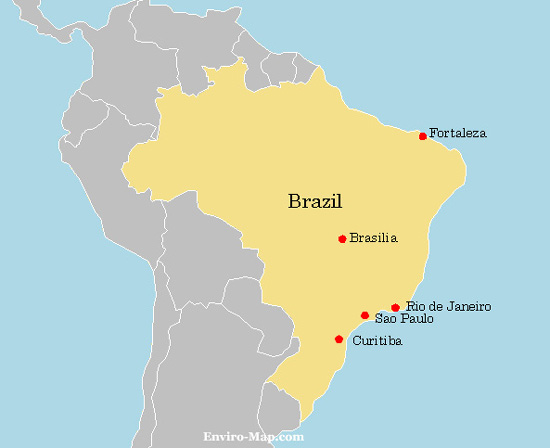

What I was completely unprepared for and made me ecstatic was finding out the hotel faced the beach and that I had ended up in the ocean-facing side. I was able to look out every morning and say hello to this roiling turquoise marvel, right across the street from my 4th floor room.
Next, the congress.
Sunday, May 23, 2010
First leg - Rio
I had to get to Rio by flying to Sao Paulo on Air Canada and catching another local flight. The first flight was all night long (9 hours) and covered over 5000 km. I fussed over my slideshows some more and managed to curl up horizontally to sleep, as I had no seatmate. This nice part about flying north-south or south-north is that no jet lag is involved. It was the first time I'd ever been outside North and Central America. I'd never been south of the equator before. So many firsts.
Dinner (with wine) was served on the plane, and shortly thereafter, breakfast. The coolest part of the trip was that even the economy seats have a place to plug in one's computer so that one's battery stays juiced.
I was nervous landing in Sao Paulo. It seemed to take an hour just to fly over the city through smog cloud to get to the airport. It's 20 million people large, after all. I expected the Aeroporto Guarulhos to be enormous (it was), and I'd learned no Portuguese, hoping my rusty Spanish would suffice. How would I find my way around? I didn't have a lot of time between flights. Fortunately, customs there is a perfunctory matter, one's immigration card is merely glanced at, lines move fast, most of the people in uniform speak a bit of English, and there are many many people in uniform, standing around, changing the cloth bands between stands to facilitate new lines and faster movement. The signage is quite small and the distances huge. I did the default female thing and kept checking with new people as I walked along to make sure I was still going in the right direction. I reminded myself that I was English-speaking in a Brazil airport, not Polish-speaking in a Canadian airport.
Eventually I got to the proper gate in the correct wing of the port and on the TAM plane for the 45 minute local flight to Rio. At the Rio airport, things were even more brisk and easy. Palmiro was there to pick me up, so I could finally relax.
First things first - it took a good 45 minutes to get from the airport to the hotel, through Rio traffic. Rio is another huge Brazilian city, about 12 million. It has a bit of a smog bank too, although Rio citizens choose to downplay it. So beautiful though. In the car I was given a lesson on the social stratification of Brazil, and how to stay safe, not be a target. Palmiro has been around some and has had a chance to observe how life is in North America, so he took great pains to inform me about how in Brazil you can be killed for your cheap ten-dollar watch. He wasn't trying to scare me, just protect and inform me. I listened.
That evening I was introduced to caipirinhas and the sort of steak I can't ever remember tasting in my life. Delicious. Then we went up SugarLoaf Mountain in the cable car, in the dark, to see the lights of Rio way down in the distance. The next day we saw it again, in daytime. The other main tourist spot is Corcovado, on top of which is a giant Jesus statue. Giant Rio Jesus is apparently suffering from acid rain, was covered in restoration scaffolding when I visited.
The mountain is so high and the smog was so dense that I couldn't get any pictures of the city - I could not even see the city.
 On the way down I took a bunch of pictures of a very dilapidated but still beautiful and elegant hotel, which is slated to be restored in time for the Rio Olympics, I think.
 On the weekend I taught a two-day workshop to 26 people, the largest class I have ever taught. Palmiro had translated my treatment manual in Portuguese himself, ahead of time. A translator had been arranged. It couldn't have been a better organized event and it couldn't have been filled with better, more attentive, gentle students with hands like butter and minds like sponges. By the end of the second day several had already left to make flights etc. Here is a picture of who was left. Palmiro is in the back row, second from left. The translator, Dan, is beside him third from the left.
I learned to do Brazilian cheek-contact air-kissing on this first leg of the journey. I was struck, actually, at how contactful the culture in this branch of my human primate social troop. Such a welcome somatosensory, epicritic input.
Dinner (with wine) was served on the plane, and shortly thereafter, breakfast. The coolest part of the trip was that even the economy seats have a place to plug in one's computer so that one's battery stays juiced.
I was nervous landing in Sao Paulo. It seemed to take an hour just to fly over the city through smog cloud to get to the airport. It's 20 million people large, after all. I expected the Aeroporto Guarulhos to be enormous (it was), and I'd learned no Portuguese, hoping my rusty Spanish would suffice. How would I find my way around? I didn't have a lot of time between flights. Fortunately, customs there is a perfunctory matter, one's immigration card is merely glanced at, lines move fast, most of the people in uniform speak a bit of English, and there are many many people in uniform, standing around, changing the cloth bands between stands to facilitate new lines and faster movement. The signage is quite small and the distances huge. I did the default female thing and kept checking with new people as I walked along to make sure I was still going in the right direction. I reminded myself that I was English-speaking in a Brazil airport, not Polish-speaking in a Canadian airport.


Eventually I got to the proper gate in the correct wing of the port and on the TAM plane for the 45 minute local flight to Rio. At the Rio airport, things were even more brisk and easy. Palmiro was there to pick me up, so I could finally relax.


First things first - it took a good 45 minutes to get from the airport to the hotel, through Rio traffic. Rio is another huge Brazilian city, about 12 million. It has a bit of a smog bank too, although Rio citizens choose to downplay it. So beautiful though. In the car I was given a lesson on the social stratification of Brazil, and how to stay safe, not be a target. Palmiro has been around some and has had a chance to observe how life is in North America, so he took great pains to inform me about how in Brazil you can be killed for your cheap ten-dollar watch. He wasn't trying to scare me, just protect and inform me. I listened.
That evening I was introduced to caipirinhas and the sort of steak I can't ever remember tasting in my life. Delicious. Then we went up SugarLoaf Mountain in the cable car, in the dark, to see the lights of Rio way down in the distance. The next day we saw it again, in daytime. The other main tourist spot is Corcovado, on top of which is a giant Jesus statue.
 Giant Rio Jesus is apparently suffering from acid rain, was covered in restoration scaffolding when I visited.
The mountain is so high and the smog was so dense that I couldn't get any pictures of the city - I could not even see the city.
 On the way down I took a bunch of pictures of a very dilapidated but still beautiful and elegant hotel, which is slated to be restored in time for the Rio Olympics, I think.
 On the weekend I taught a two-day workshop to 26 people, the largest class I have ever taught. Palmiro had translated my treatment manual in Portuguese himself, ahead of time. A translator had been arranged. It couldn't have been a better organized event and it couldn't have been filled with better, more attentive, gentle students with hands like butter and minds like sponges. By the end of the second day several had already left to make flights etc. Here is a picture of who was left. Palmiro is in the back row, second from left. The translator, Dan, is beside him third from the left.
I learned to do Brazilian cheek-contact air-kissing on this first leg of the journey. I was struck, actually, at how contactful the culture in this branch of my human primate social troop. Such a welcome somatosensory, epicritic input.
Saturday, May 22, 2010
Brazil - Prelude
Yesterday I started to write a bit about this adventure-of-a-lifetime undertaken earlier in May. Here's how it transpired.
Last year in either March or April, during the time I was completely buried in preparing to move, I got an email from a perfect stranger in Brazil, Palmiro Torrieri Junior, a PT who teaches Mulligan* in Brazil and elsewhere in South America. He invited me to consider travelling to Brazil to participate in a Manual Therapy Congress scheduled to take place over a year later in Fortaleza.
I do not get these kinds of requests. Ever. Except... apparently Palmiro had tried to invite me two years prior and I had replied, "I never travel." I do not recall this - a lot of email comes my way that just gets automatically deleted or else ignored: it may well have happened - my memory has been pretty faulty, and, if the story is true, Palmiro is remarkably persistent besides being a gentleman and a scholar.
I told him I'd think about it. I did think about it. I also checked him out to make sure he was for real. He was. I told him I had no credentials other than a diploma from 40 years ago and no presenting experience, just a lot of self-study, a set of convictions based on neuroscience and biology, and an online presence. He said, no problem. I talked it over with my set of online PT friends - they all thought I'd be crazy if I didn't go. So, in the end, about a week later, I agreed to go.
Me being me, immediate self-doubt set in. Who did I think I was, anyway? I didn't linger for long with the self-doubt because I was too busy getting myself uprooted and moved away. And besides I had an entire year to come up with something. I didn't have to go out to work until long after it would be over with. I had enough time to come up with something, surely.
Palmiro was great - whenever I had a doubt or a hesitation about the trip he was right there in my inbox, with "No problem Diane, I will look after that." He had a translator. Everything was going to be paid. I would teach a 2-day class in Rio. He would organize the whole thing, find all the students. He would schedule my time so that I would have rest days between gigs. He would look after all the arrangements from the second I got off the plane until the second I got back on. He sent me a detailed itinerary of what we would be doing each day I was there. By email and later by Skype, I found his English to be really quite good (way better than my non-existent Portuguese), got to know him better and decided I would trust him.
Eventually the details at my end were all sorted and a visa, shots, new luggage, some tropic-appropriate clothing were obtained... I had learned to make slides, had put in many many 18-hour days reading and learning and sorting and thinking. I still wasn't satisfied with the presentations but they were as good as they were ever going to be and it was time to make the trip.
Next installment: Rio.
.........
* Mulligan (named after its creator, in standard ortho guru style) - a weird ortho combo of biomechanics and skin stretching, which I do not happen to find unconscionable because its over-arching emphasis is all about not creating more pain for the patient
Last year in either March or April, during the time I was completely buried in preparing to move, I got an email from a perfect stranger in Brazil, Palmiro Torrieri Junior, a PT who teaches Mulligan* in Brazil and elsewhere in South America. He invited me to consider travelling to Brazil to participate in a Manual Therapy Congress scheduled to take place over a year later in Fortaleza.
I do not get these kinds of requests. Ever. Except... apparently Palmiro had tried to invite me two years prior and I had replied, "I never travel." I do not recall this - a lot of email comes my way that just gets automatically deleted or else ignored: it may well have happened - my memory has been pretty faulty, and, if the story is true, Palmiro is remarkably persistent besides being a gentleman and a scholar.
I told him I'd think about it. I did think about it. I also checked him out to make sure he was for real. He was. I told him I had no credentials other than a diploma from 40 years ago and no presenting experience, just a lot of self-study, a set of convictions based on neuroscience and biology, and an online presence. He said, no problem. I talked it over with my set of online PT friends - they all thought I'd be crazy if I didn't go. So, in the end, about a week later, I agreed to go.
Me being me, immediate self-doubt set in. Who did I think I was, anyway? I didn't linger for long with the self-doubt because I was too busy getting myself uprooted and moved away. And besides I had an entire year to come up with something. I didn't have to go out to work until long after it would be over with. I had enough time to come up with something, surely.
Palmiro was great - whenever I had a doubt or a hesitation about the trip he was right there in my inbox, with "No problem Diane, I will look after that." He had a translator. Everything was going to be paid. I would teach a 2-day class in Rio. He would organize the whole thing, find all the students. He would schedule my time so that I would have rest days between gigs. He would look after all the arrangements from the second I got off the plane until the second I got back on. He sent me a detailed itinerary of what we would be doing each day I was there. By email and later by Skype, I found his English to be really quite good (way better than my non-existent Portuguese), got to know him better and decided I would trust him.
Eventually the details at my end were all sorted and a visa, shots, new luggage, some tropic-appropriate clothing were obtained... I had learned to make slides, had put in many many 18-hour days reading and learning and sorting and thinking. I still wasn't satisfied with the presentations but they were as good as they were ever going to be and it was time to make the trip.
Next installment: Rio.
.........
* Mulligan (named after its creator, in standard ortho guru style) - a weird ortho combo of biomechanics and skin stretching, which I do not happen to find unconscionable because its over-arching emphasis is all about not creating more pain for the patient
Friday, May 21, 2010
Fresh spring, fresh start

It helps that I just returned from Brazil, buoyed by an amazing, once-in-a-lifetime adventure of travel, presenting to a crowd of somewhere between 1500 to 2000 people, all-expenses-paid, with a hotel room looking out the south hemisphere's version of the Atlantic Ocean, right across the street. I never dreamed anything like this opportunity would come to me in a million years. Even when it did, I couldn't believe it had. Now that it's over, and I'm back, it feels like a fabulous dream. Except that I have pictures of the trip, and a little trophy for presenting, so I know it must have been real.
I provided two presentations, each 40 minutes, through a translator. The first one was on the Neuromatrix model of pain, an the other was on dermoneuromodulation, my own version of manual therapy and an argument in favor of good handling based on nervous system considerations as opposed to structuralist and other mesodermal considerations.
I had a chance to speak up close and personal with a few of the English-speaking (much much) higher rollers in the profession, Paul Hodges and Sarah Mottram, and engage them in a fierce conversation or two. Both of them are doing nice work, but work from a perspective that (too narrowly, in my opinion) targets only the voluntary efferent aspect of the multi-dimensional human nervous system and leaves out consideration of all its afferent aspects, handling only to "correct" somebody's posture, or to electrically "stimulate" some sort of observable and variable muscular response. Neither of these people have anything much to say about strategic deliberate handling of tissue or what the brain might think about that on all its multiple levels, so I suppose the conversations were mostly just flybys. They were entertaining though.. and these are sweet people - just not on any kind of resonant human primate social grooming level with me at all. In any way. Whatsoever. They believe (at least I gathered they do) that motor output is all there is or should be interesting in PT. The "movement specialist" thing. This to me indicates a seriously blinkered perspective which shrinks the interactive aspects of physiotherapy to "operator" stance only, and doesn't explicitly deal with somatosensory input or the kinds of (usually favorable, provided the nervous system isn't sick) changes, effects on pain perception, which can catalyze in a neuromatrix on multiple levels. Sarah commented that she thought my term "human primate social grooming" was "horrid." Alrighty then...
I have more blog posts to make about this fantastic adventure, and I will. I'll tell you all about Brazil from the vantage point of a human primate social groomer of exceedingly low rank in the greater human troop, who quite suddenly found herself being treated like a queen and knew not quite what to make of it all.
However, now I have to arrange to go back to Vancouver for 5 days, rent a car, dismantle what's left of my practice, deal with paperwork (never my fave), get rid of the "stuff" (treatment table, etc.), stow my patient files appropriately and legally with a PT in BC (already organized) until they have expired, visit the bookkeeper, pick up and file my income tax finally - I have til mid-June apparently.
This is all major organizing-cognitive hard drive stuff for me. I'm never very good at it, or at least I always feel completely incompetent at it, but I have to say I doubt I could have got any of it done the shape my cognitive hard drive was in a year ago or even half a year ago - it has been doing a lot better since moving back into sunshine. Now I can remember lists of items again, as long as they aren't very long. I can make plans again and execute them more seamlessly instead of just following my nose around and course-correcting by bumping into the walls of reality/social troop requirements. Things are looking up this year. Less stress, less depression, less pressure, less rain and fewer foggy grey days.
Saturday, April 17, 2010
Peter Whitehouse on the myth of Alzheimer's
I'm listening to Ginger Campbell's podcast interview with Peter Whitehouse just now. I'm liking it.
He ties in a lot of topics that have been tossing around on the waves lately - the power of narrative, re-framing a story to make it less devastating/more useful, how diagnoses are merely medical frames around stories.. how some frames are more solid than other frames. He is a neuro researcher who takes a long close look at brain aging and has decided that the diagnosis "Alzheimer's" needs a bit of retooling.
The Myth of Alzheimer's blog
He ties in a lot of topics that have been tossing around on the waves lately - the power of narrative, re-framing a story to make it less devastating/more useful, how diagnoses are merely medical frames around stories.. how some frames are more solid than other frames. He is a neuro researcher who takes a long close look at brain aging and has decided that the diagnosis "Alzheimer's" needs a bit of retooling.
The Myth of Alzheimer's blog
Monday, March 22, 2010
Robert Sapolsky on depression
Wonderful lecture, about 50 minutes, with Robert Sapolsky. Ties stress (glucocorticoids) in with depression.
Sunday, March 21, 2010
Speaking of stress...
Found this at Respectful Insolence blog. Pretty clever. It certainly stirred my own noradrenalin pathways, but the dopamine and serotonin (now that I have some of each built back up again) were not far behind.
Take a ride in a Toyota.
Take a ride in a Toyota.
Friday, March 19, 2010
Stress
Fabulous set of free access articles with a focus on stress, from Nature Reviews Neuroscience.
Monday, March 15, 2010
Sunday, March 14, 2010
Another anniversary, 10 years ago
Another memory about this time of year which I didn't sift through to, until this morning, is that 10 years ago yesterday, my dad died. He would be 87 now, were he still alive. I must be pretty much over that, because I didn't even consciously remember until now.
These days I live near where he was buried. If it's a nice day I might hike the few miles out along the highway to his spot, and visit, re-member.
These days I live near where he was buried. If it's a nice day I might hike the few miles out along the highway to his spot, and visit, re-member.
Friday, March 12, 2010
Anniversary reactions
So, I thought back to where my life was at a year ago, which in some ways feels like just yesterday; I reminded myself that only a year ago I was dismantling a lifetime, not just a practice from which I have been detached - still responsible for but emotionally detached from - for about 9 months.
I was faced with jettisoning a lot of belongings, books, purging and cleaning and scraping and painting and scouring and selling and usually fell into bed at night exhausted.
I realize that some part of my brain still feels open raw places from having undergone that experience, even while other bits are ecstatic to be back under big bright empty sky. When another stressor comes along, I realize that the reverberation of a year ago is like an echo chamber. I realize that as a brain ripens and ages through a life span the echo chamber doesn't go away, in fact it just gets bigger and bigger as years and anniversary reactions accumulate. If would be lovely if there were a delete key on stress, something easy to simply click and make the anxious stuff disappear. That isn't the case. So I go for long walks instead. It helps.
As I walk I think about how I'm helping my brain produce the millions of different kinds of neurotransmitters it needs to remain healthy and help me, its "I" illusion, to remain calm and content. I think about how lucky I am that I'm on the eve of 60 years old and am in a body, with a brain, and feet, that don't hurt me, that let me walk pretty far (3 or 4 km) without getting the least bit tired or sore. Bored a little, maybe, sometimes, but not in any pain. I think about how nice my nerves feel, sliding around in my body, first one side, then the other, how my spinal cord is slightly rotating within its canal, how blood flow is being engaged to feed it generously through mechanical stimulation. Yeah, mechanical stimulation is a stressor, but it's the right kind of stressor, and I remember that all this slidey motion will spur it to stay juicy and healthy and functional.
As I relax into the rhythm of walking I try out different things to challenge my brain, just a little, try a bit more novelty, explore my body adapting to it. I see how tall I can be as I walk along. I feel the difference between using abs and not using abs while walking. I notice what happens to my breathing. I work with breathing. I place my feet on a narrower trail with out breaking stride. I play with stride length without breaking stride. I experiment with which edge of my feet I'm walking on. I run a little. I play. I stride. On the outside, I am just a woman walking, but on the inside, I'm engaged in a process of discovery and comparison and full body sensing.
I think about how lucky I am to not have to carry a little roof all the time, called an umbrella, shutting out the sky, bumping other umbrellas, being bumped by other umbrellas, or, the alternative, rain on the top of the head - ceaseless remorseless rain. Seventy-five different kinds and sizes of rain.
I note the lack of other people and feel grateful to be in a place where there are no drug dealers being obvious or their customers reeling around or shouting at each other or at nothing at all or thick knots of tourists standing and gawking everywhere or beggars asking me for money or trying to sell me something - people crowding me, people who represent huge obstacles, both physical and psychological, to navigate through and around. I am alone with my own thoughts, and all around is just empty space I can relax into, nobody nearby I have to worry may knock me down and steal my wallet, or knock me down because it's a gang initiation ritual, or knock me down because they are bigger and taller and didn't even know I was there.
I always see a little something I never noticed before, even on familiar routes. I am free to gaze around at sharp contrast of light bouncing off surfaces, at the brightness of snow (well, not lately - it has developed that cavitated, dulldarkgrey look as spring arrives..) at the brightness and blueness of the sky, and think, this is all very good for my brain. I tell myself, it will synchronize and neuroplasticize itself in a positive direction. I tell myself that its emotional buffers will continue to improve every day in direct proportion to increasing clarity of thought and access to cognition and sharpness of logic. I realize these are beliefs, but I also know they are beliefs based on science. Science is my comfort and strength. It always changes but its changes are always for the better, provide ever more solidity.
I go home, look at the pedometer and how many steps I took. I think, OK, I can do better than that. Tomorrow I'll go again. Life is a series of small steps, physical and metaphorical, that accumulate over time, will add up to something, positive or not. Every step should be consciously chosen or result from a habit consciously chosen and feel like the right step to have made, no matter how tiny it may have been. With each step I take, I'm putting distance between myself and what I've left behind; with each step I'm coming closer to whatever it is I want out of life, whoever it is that I am becoming.
Every walk I take is a victory, my pitting of my own life against everything that would do my life harm. I have synchronized myself with me, as best I can, and after, I feel ready to read a paper and make a few slides and write a few thoughts down on a file card. My new life.
I'll deal with that recent workquake in Vancouver as I can, when I can. It's not my life. Not really. Not anymore. I'm not there, not anymore. I'm Here. And this is Now. Things could be much worse.
I was faced with jettisoning a lot of belongings, books, purging and cleaning and scraping and painting and scouring and selling and usually fell into bed at night exhausted.
I realize that some part of my brain still feels open raw places from having undergone that experience, even while other bits are ecstatic to be back under big bright empty sky. When another stressor comes along, I realize that the reverberation of a year ago is like an echo chamber. I realize that as a brain ripens and ages through a life span the echo chamber doesn't go away, in fact it just gets bigger and bigger as years and anniversary reactions accumulate. If would be lovely if there were a delete key on stress, something easy to simply click and make the anxious stuff disappear. That isn't the case. So I go for long walks instead. It helps.
As I walk I think about how I'm helping my brain produce the millions of different kinds of neurotransmitters it needs to remain healthy and help me, its "I" illusion, to remain calm and content. I think about how lucky I am that I'm on the eve of 60 years old and am in a body, with a brain, and feet, that don't hurt me, that let me walk pretty far (3 or 4 km) without getting the least bit tired or sore. Bored a little, maybe, sometimes, but not in any pain. I think about how nice my nerves feel, sliding around in my body, first one side, then the other, how my spinal cord is slightly rotating within its canal, how blood flow is being engaged to feed it generously through mechanical stimulation. Yeah, mechanical stimulation is a stressor, but it's the right kind of stressor, and I remember that all this slidey motion will spur it to stay juicy and healthy and functional.
As I relax into the rhythm of walking I try out different things to challenge my brain, just a little, try a bit more novelty, explore my body adapting to it. I see how tall I can be as I walk along. I feel the difference between using abs and not using abs while walking. I notice what happens to my breathing. I work with breathing. I place my feet on a narrower trail with out breaking stride. I play with stride length without breaking stride. I experiment with which edge of my feet I'm walking on. I run a little. I play. I stride. On the outside, I am just a woman walking, but on the inside, I'm engaged in a process of discovery and comparison and full body sensing.
I think about how lucky I am to not have to carry a little roof all the time, called an umbrella, shutting out the sky, bumping other umbrellas, being bumped by other umbrellas, or, the alternative, rain on the top of the head - ceaseless remorseless rain. Seventy-five different kinds and sizes of rain.
I note the lack of other people and feel grateful to be in a place where there are no drug dealers being obvious or their customers reeling around or shouting at each other or at nothing at all or thick knots of tourists standing and gawking everywhere or beggars asking me for money or trying to sell me something - people crowding me, people who represent huge obstacles, both physical and psychological, to navigate through and around. I am alone with my own thoughts, and all around is just empty space I can relax into, nobody nearby I have to worry may knock me down and steal my wallet, or knock me down because it's a gang initiation ritual, or knock me down because they are bigger and taller and didn't even know I was there.
I always see a little something I never noticed before, even on familiar routes. I am free to gaze around at sharp contrast of light bouncing off surfaces, at the brightness of snow (well, not lately - it has developed that cavitated, dulldarkgrey look as spring arrives..) at the brightness and blueness of the sky, and think, this is all very good for my brain. I tell myself, it will synchronize and neuroplasticize itself in a positive direction. I tell myself that its emotional buffers will continue to improve every day in direct proportion to increasing clarity of thought and access to cognition and sharpness of logic. I realize these are beliefs, but I also know they are beliefs based on science. Science is my comfort and strength. It always changes but its changes are always for the better, provide ever more solidity.
I go home, look at the pedometer and how many steps I took. I think, OK, I can do better than that. Tomorrow I'll go again. Life is a series of small steps, physical and metaphorical, that accumulate over time, will add up to something, positive or not. Every step should be consciously chosen or result from a habit consciously chosen and feel like the right step to have made, no matter how tiny it may have been. With each step I take, I'm putting distance between myself and what I've left behind; with each step I'm coming closer to whatever it is I want out of life, whoever it is that I am becoming.
Every walk I take is a victory, my pitting of my own life against everything that would do my life harm. I have synchronized myself with me, as best I can, and after, I feel ready to read a paper and make a few slides and write a few thoughts down on a file card. My new life.
I'll deal with that recent workquake in Vancouver as I can, when I can. It's not my life. Not really. Not anymore. I'm not there, not anymore. I'm Here. And this is Now. Things could be much worse.
Subscribe to:
Posts (Atom)