Thursday, June 12, 2014

Why language matters: "Avoiding Stupidity is Easier than Seeking Brilliance"

Sometimes it feels like the pile just grows higher and deeper with every year that passes.

What pile in particular?


The pile of cognitive bias and poor use of language - that pile.


Recently a blogpost appeared promoting a tissue-blaming and tissue-based manual therapy method that combines a kind of handling with a very botched explanatory model, historically so pounded into/conflated with the handling itself, that it would seem no one ever gave a fig about explaining it better. I replied a bunch of times, which has become a slideshow  now.. the conversation itself is still ongoing. A SomaSimple thread exists about it, too. 


Tissue-based targeting and tissue-based reasoning have GOT to be separated out, some day, from what we really do, which is try to help people with pain problems. (Before I die, I hope..)
Why? Who cares?

It matters because tissue-based referencing is noceboic to patients, that's why. Adriaan Louw says so.

It matters because patients don't care about tissue, they want to be able to move easier, or at least, not be afraid of moving even if their pain isn't the kind that responds to manual treatment. Bronnie Thompson says so. 

From this blogpost:

"In expert tennis, about 80 per cent of the points are won; in amateur tennis, about 80 per cent of the points are lost. In other words, professional tennis is a Winner’s Game – the final outcome is determined by the activities of the winner – and amateur tennis is a Loser’s Game – the final outcome is determined by the activities of the loser. The two games are, in their fundamental characteristic, not at all the same. They are opposites..." 
Think about it.

Eighty percent of professional games are won because the professional knows how to avoid mistakes.

Eighty percent of amateur games are lost, because one amateur makes more mistakes than the other does.
To win, all you have to do is make fewer mistakes!

In manual therapy terms, that might translate into not looking for, finding, or most of all not talking about postural defects, or bio-mechanical faults, to the patient, instead looking at only gross movement amounts and comfort levels instead.
Why not? Because "tissue faults" are misleading, and don't have anything to do with causing pain. Chances are higher that if they exist at all, they are a result of pain, not a cause, apart from any someone might have been born with.

The lesson to take away: Avoiding stupidity is easier than seeking brilliance.

One way to look at the mess manual therapy is in and always has been in would be to ignore the mess it's in and always has been in, with it's postural/structural/biomechanical/bio-medical/all the purely imagination-based cause-effect posthoc reasoning inherent in it. 


Yes, one could simply learn to ignore it. But I can't. Why not? Because I AM a manual therapist, and I want it to be better. 

That's why. 
For all the reasons I care about helping people who hurt. 
For all the reasons I hate when I get into pain myself (so fortunate that it's a very rare experience for me). 
For all the reasons that it matters in general for people in my profession to grow up intellectually and learn how to use their own brain instead of relying on manual therapy "culture" to do all their thinking for them or to have worked through all its own fallacious reasoning already. It hasn't, and it will never be able to, unless each of us does our own heavy lifting first.

And I don't care how many certifications someone has, or letters appear behind his or her name, or "big names" they can brag about treating. That sort of thing simply doesn't impress me any more.
.......


Yesterday I was listening to the radio as I worked on a new image for my treatment manual. I learned that at McGill University, and for historic reasons unique to Canada, the law program prepares its students for the world by teaching civil law and common law simultaneously. It's done that way because it was noted that in the past, if one set of law was taught before the other in a linear manner, students would prefer whichever version they were taught first, that form would take over their brains, and from then on they would consider that form more important than the other form. So, the instructors decided to teach them simultaneously because both are equally important in Canada.

I thought about manual therapy, how it's taught operator-style to therapists, how that skews them into being egoists, thinking they have control over a process which in its essence is a dance between two nervous systems, equally, and over tissue targets that they can't even touch except via a blubber layer that slides all over the place and swiftly informs the brain about whatever is going on with its organism. So delusional.

What if manual therapy were taught from the start that it's about the dance, instead? 

I try hard to do that. I'm sure I fail, but I do try.
...........


I learned a new word today - conspicuity. This idea backs up the law school at McGill's idea that you have to be careful how information is presented or students will end up skewed toward a particular cognitive bias. 


Conspicuity refers to an object's ability to catch a person's attention. When something is conspicuous it is easily visible. There are two factors which determine conspicuity: sensory conspicuity and cognitive conspicuity. Sensory conspicuity factors are the physical properties an object has. If an item has bright colors, flashing lights, high contrast with environment, or other attention-grabbing physical properties it can attract a person’s attention much easier. For example, people tend to notice objects that are bright colors or crazy patterns before they notice other objects. Cognitive conspicuity factors pertain to objects that are familiar to someone. People tend to notice objects faster if they have some meaning to their lives. For example, when a person hears his/her name, their attention is drawn to the person who said it. The cocktail party effect describes the cognitive conspicuity factor as well. When an object isn’t conspicuous, it is easier to be intentionally blind to it. People tend to notice items if they capture their attention in some way. If the object isn’t visually prominent or relevant, there is a higher chance that a person will miss it.

Gee, do you think that cognitive conspicuity could refer to learning tissue-based treatment models, instead of nervous system-based treatment models, as well?  I think so..


Wednesday, June 04, 2014

Mice, learned helplessness, navy seals, depression (in no particular order)

This morning Tord Helsingeng in Norway posted an interesting piece to the Dermoneuromodulation group on Facebook:


Stress and the susceptible brain(1), by Bethany Brookshire, aka Scicurious, about a paper(2).


Here's the story:
1. The objective is to unravel depression.
2. Mice were put into cages with floors that shocked they little tiny tender feets, randomly, for an hour. They had to endure this for two days straight. Then they were allowed a place to escape to.
3. Eighty percent (80%) of the mice dove for the escape route; 20% didn't bother. These ones also lost weight and didn't appear to have much fun anymore.
4. The 80% that escaped were considered "resilient", i.e., could "still change their behaviors in response to stress", while the 20% that didn't bother were considered "susceptible", and a model for depression.
5. Here is the abstract:
When facing stress, most individuals are resilient whereas others are prone to developing mood disorders. The brain mechanisms underlying such divergent behavioral responses remain unclear. Here we used the learned helplessness procedure in mice to examine the role of the medial prefrontal cortex (mPFC), a brain region highly implicated in both clinical and animal models of depression, in adaptive and maladaptive behavioral responses to stress. We found that uncontrollable and inescapable stress induced behavioral state-dependent changes in the excitatory synapses onto a subset of mPFC neurons: those that were activated during behavioral responses as indicated by their expression of the activity reporter c-Fos. Whereas synaptic potentiation was linked to learned helplessness, a depression-like behavior, synaptic weakening, was associated with resilience to stress. Notably, enhancing the activity of mPFC neurons using a chemical–genetic method was sufficient to convert the resilient behavior into helplessness. Our results provide direct evidence that mPFC dysfunction is linked to maladaptive behavioral responses to stress, and suggest that enhanced excitatory synaptic drive onto mPFC neurons may underlie the previously reported hyperactivity of this brain region in depression.


Tord wondered why. Excellent question. Why would susceptibility/depression/failure to run away from an obvious stressor be associated with stronger synaptic activity in the medial prefrontal cortex?


When I went to look up medial prefrontal cortex, I found this:


Though depression involves an overall reduction in brain activity, some parts of the brain are more affected than others. In brain-imaging studies using PET scans, depressed people display abnormally low activity in the prefrontal cortex, and more specifically in its lateral, orbitofrontal, and ventromedial regions. And the severity of the depression often correlates with the extent of the decline in activity in the prefrontal cortex.


Wait... my bold. Isn't "low" the opposite of "stronger"? 
Or maybe: if the synapses are stronger, they don't have to be as active to ferry around the same amount of information. So the brain can make do with less activity and still know what it's doing.
Also this:
One of the regions of the prefrontal cortex that is most affected both by depression and by the manic phase of manic depression is the ventromedial cortex (also known as the subgenual cortex, because it sits beneath the genua, or knee, of the corpus callosum). This area deep inside the frontal lobes, on either side of the centre line separating the two hemispheres, lets us switch from one kind of affect to another. It is also heavily involved in feelings of pleasure and positive reinforcement.


Wait... pleasure?
Isn't this a contradiction? Would the 20% of mice who grimly stuck out the foot shocks be enjoying it?

I couldn't find anything about a dorsomedial prefrontal cortex in Brain from Top to Bottom, so I googled.. found this:


The PFC can be divided into ventromedial and dorsolateral regions, each of which is associated with posterior and subcortical brain regions. The ventromedial PFC (vmPFC) has reciprocal connections with brain regions that are associated with emotional processing (amygdala), memory (hippocampus) and higher order sensory processing (temporal visual association areas), as well as with the dorsolateral PFC (dlPFC). The dlPFC has reciprocal connections with brain regions that are associated with motor control (basal ganglia, premotor cortex, supplementary motor area), performance monitoring (cingulate cortex) and higher order sensory processing (association areas, parietal cortex). The vmPFC is well suited to support functions involving the integration of information about emotion, memory and environmental stimuli, and the dlPFC to support the regulation of behaviour and control of responses to environmental stimuli....

According to the SEC framework, counterfactual reasoning about action versus inaction preferentially recruits the dorsomedial PFC (dmPFC). Several neuroscience studies have implicated the dmPFC in the continuous internal monitoring of action (Botvinick et al. 2004). Barch et al. (2001) report an extensive meta-analysis of functional imaging studies that included data from a broad range of action monitoring tasks (e.g. involving the inhibition of prepotent responses) that recruited the dmPFC. Along the same lines, Waltonet al. (2004) observed activity in the dmPFC when participants monitored the outcome of self-selected actions. These findings suggest that the dmPFC is critical for monitoring the addition versus subtraction of actions for counterfactual reasoning. 

So... trying to figure out the mice business, none of the authors are clear about which bit, ventral or dorsal, they are examining. Maybe in mice there isn't enough in there to subdivide. Or maybe there is and they didn't. 


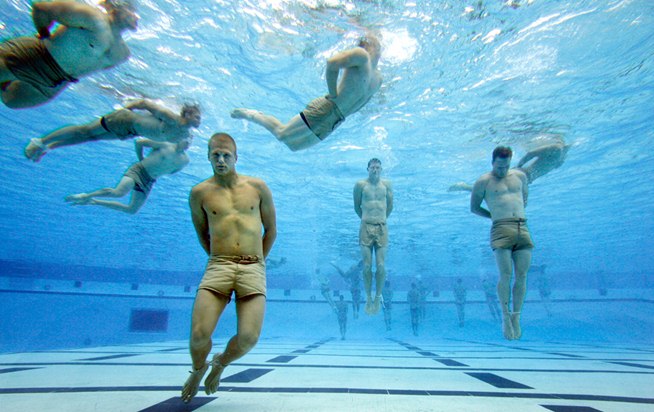
I have yet to fathom all that, but in the back of my mind I keep thinking about Navy Seals, what they have to go through in their training, how the situation is designed to weed out anyone who caves to the stress, who can't take the combination of socially imposed stress and physical stress.

"If you want to change the world, start by making your bed."

(Then, find people to help you paddle, measure people by the size of their heart, not their flippers, get over being a sugar cookie, don't be afraid of circuses, learn to slide down an obstacle head first, punch sharks right in the nose, don't lose it in the darkest moment, when you're up to your neck in mud, sing, and don't ever ever ring the bell.)
................


Maybe those little mice were doing their own version of navy seal training. Maybe they were inhibiting their own behaviour because that way, they could "enjoy"(if that's the right word..) maintaining an internal locus of control. 
Maybe the mice that headed off for the escape hatch were being driven to it by the external locus of control, handlers, which in human terms might be the equivalent of external "society" - an Other-Determined locus of control. Maybe the 20% who stayed put were thinking, screw you, I'm going to stay right here - this isn't so bad, I'm used to it now. Those jerks think they can make me go toward that spot where 80% are going, but I'll show them I'm different/I'm tough/ I'm an individual/I'm no sissy/I can take whatever they dish out/eff them - how much worse could it get?


SOURCE
Speaking of mouse handlers, it has come up that mice respond to the sex of the handler. If the handler is male, mice will not exhibit the same sorts of behaviours as when the handler is female. I.e., they don't exhibit "pain" behaviours. Even their chemistry (descending modulation) is different. 
So there is another twist. We don't know what sex the handler is in the "depression model" study, not from the abstract at least..

........................

1. Brookshire B; Stress and the susceptible brain. Scicurious ScienceNews blog June 3/2014


2. Wang M, Perove Z, Arenkiel BJ, Li, B; Synaptic Modifications in the Medial Prefrontal Cortex in Susceptibility and Resilience to Stress. The Journal of Neuroscience, 28 May 2014, 34(22): 7485-7492


5. Parrish S; 10 Life Lessons From a Navy Seal. Farnam Street blog, May 27/2014

6. Brookshire B; You smell, and mice can tell. Scicurious ScienceNews blog May 2/2014


7. BIM: Of Mice and Men - Jeff Mogil on Grimacing, BodyInMind blog May 21/2014

8. Robert E Sorge, Loren J Martin, Kelsey A Isbester, Susana G Sotocinal, Sarah Rosen, Alexander H Tuttle, Jeffrey S Wieskopf, Erinn L Acland, Anastassia Dokova, Basil Kadoura, Philip Leger, Josiane C S Mapplebeck, Martina McPhail, Ada Delaney, Gustaf Wigerblad, Alan P Schumann, Tammie Quinn, Johannes Frasnelli, Camilla I Svensson, Wendy F Sternberg, & Jeffrey S Mogil; Olfactory exposure to males, including men, causes stress and related analgesia in rodents. Nature Methods 11, 629–632 (2014)


Sunday, June 01, 2014

Back to back to back

Low back pain supposedly affects about 1 in 10 people. Probably this means "at any given time" ... most people will have a bout of it at some time in their life.

In April, Jorge Fuentes published this paper,  Enhanced therapeutic alliance modulates pain intensity and muscle pain sensitivity in patients with chronic low back pain: an experimental controlled study. Some subjects with chronic low back pain were given real interferential current therapy and others sham interferential current, but what was really being tested was the therapeutic alliance. It turned out that therapeutic alliance had the biggest effect on pain scores. 

One of the co-authors was Maxi Miciak. See her blog posts on the importance of finding a theory base for physiotherapy in to place therapeutic context within, here, here and here.  


Lately Bronnie Thompson, an OT in New Zealand who writes, studies and teaches about pain, offered a brilliant suggestion: let's not discuss back pain in terms of injury at all. Let's talk about it like one would a headache: 

"Given that most people will have a bout of back pain in their lifetime (up to 90% of people in some studies), I keep wondering if perhaps we could think of back pain as a lot like having a headache. A headache of the back. We don’t think of head pain as “head injury”, we think of it as a headache – we usually take a bit of pain relief, go for a walk, de-stress, and it’ll settle down. Occasionally a headache is a sign of something more serious – but most of the time it’s a nuisance and a wakeup call to take more care of our wellbeing."
I couldn't agree more. 

So much institutionalized inertia.

....................


1. Sifferlin A, This Is the No. 1 Cause of Disability Worldwide, Time, March 25/2014

2. Fuentes J, Armijo-Olivo S, Funabashi M, Miciak M, Dick B, Warren S, Rashiq S, Magee DJ, Gross DP;  Enhanced therapeutic alliance modulates pain intensity and muscle pain sensitivity in patients with chronic low back pain: an experimental controlled study. Phys Ther. 2014 Apr;94(4):477-89.

3. Miciak M; Finding Freud in Physiotherapy Parts I, II, III. Ignite Physio blog, May 2014


4. Thompson B; Sticky Back Beliefs, HealthSkills blog, May 26/2014.

5. Zusman M; 
Belief reinforcement: one reason why costs for low back pain have not decreased.  J Multidiscip Healthc. 2013; 6: 197–204. May 16/2013


Tuesday, May 27, 2014

Therapeutic Neuroscience Education: finally, a book that says it like it is.

I fall asleep every night after reading a few pages in Therapeutic Neuroscience Education. I love this book, so far.. I particularly love the first chapter (OK, haven't read anything else yet..), wherein Adriaan/Emilio start right off the bat by demystifying OMT. Thank you thank you thank you guys. Maybe this book will help de-ossify, de-orthopaedicalize, PT in Canada. (Maybe not.. maybe it's beyond hope.. )

Anyway, here is what Adriaan and Emilio have to say (references removed for brevity, for now): 

Quote:
There is evidence that therapists struggle when treating patients with chronic pain... Although it is likely that many factors are involved, it is believed that a significant contribution to this clinical struggle is the lack of training and preparedness for treating chronic pain.. Not only are therapists under-prepared to treat this challenging population, but the pain models they follow are outdated and the treatment options that flow out of these models are often ineffective, leading to additional frustration. Therapy, especially orthopedic therapy, is traditionally rooted in a biomedical model that focuses on tissues and tissue injury. This traditional biomedical model of therapy suggests that every disease process (dysfunction) can be explained in terms of an underlying deviation from normal function, such as a pathogen or injury. The model implies that pathology and symptoms are correlated such that a greater expression of symptoms in patients would indicate greater underlying pathology. The model proposes that correction of the underlying pathology with treatment (for example, injection, surgery, manipulation, or exercise) should result in elimination of the symptoms and subsequent restoration of normal function in the patient. Clinical experience and pain science research tells us otherwise. Many patients will demonstrate physical and diagnostic signs that they have recovered from injury, yet they will continue to report symptoms/pain. Conversely, it has been well documented that many healthy asymptomatic people and patients often have significant tissue pathology (arthritis of the spine, bulging discs, bone spurs, etc.) yet experience little to no pain.

The time has come for therapists to take on the more comprehensive biopsychosocial model (which) encompasses more than just the biological factors (anatomy, physiology, pathoanatomy) in human functioning by addressing the psychological (thoughts, emotions, behaviors) and social (work, culture, religion) factors, which are known to play a significant role in patients experiencing pain A true biopsychosocial model includes a greater understanding of how the nervous system processes injury, disease, threat and emotions.

Thank you, Adriaan and Emilio, for your refreshing bluntness. 

I will quote these 2 little paragraphs every time I bump into anyone in my own country who jumps down my throat at the mere suggestion that orthopaedic manual therapy isn't the highest and most deserving of reverence kind of PT available on the face of the planet.
(Oh yeah... it has happened. It wasn't pleasant.)

I like this excerpt from pages two and three so much that I think I might blog on it for awhile, dig up the references, even..
Just these two paragraphs.

1. Louw A, Puentedura E; Therapeutic Neuroscience Education. 
Orthopedic Physical Therapy Products; 1 edition (August 19, 2013)


Tuesday, May 20, 2014

SOME FINAL THOUGHTS ON NON-SPECIFIC EFFECTS

My take on why manual therapy "works", part 8.


OLDER POSTS IN THIS SERIES
Part 1: IS MANUAL THERAPY EVEN NECESSARY?  
Part 2: NEUROTAGS! YOU'RE IT!  
Part 3: ABOUT "LEARNING"  
Part 4: SKIN STRETCHING AND MOVEMENT ILLUSIONS  
Part 5:  TACTILE DIRECTION DISCRIMINATION IN THE DORSOLATERAL PREFRONTAL CORTEX 
Part 6: MORE ABOUT DORSOLATERAL PREFRONTAL CORTEX 
Part 7: TREATMENT CONTEXT, NON-SPECIFIC EFFECTS 

The last statement in the SomaSimple post is:

"Non-specific effects is the term used when the word "placebo effect" is too contentious."


That was meant to be a bit tongue-in-cheek.. but when I use this slide from Benedetti, I do cross out the word "placebo" and substitute, "Non-medical, non-surgical, non-pharmaceutical non-specific effects follow processing of  YES-ciception".


Source
Updated Jun 4/2018


A big piece of this is avoiding nocebo. Why? Because nocebo makes the brain produce cholecystokinin or CCK. So what, you might ask. Well, consider this: CCK antagonizes the effect of endogenous opioids and thereby reduces the effect we want, i.e., descending inhibition of a favourable kind down the spinal cord of the patient we are treating from nuclei in and around and through the periaqueductal grey or PAG, a deep deep part of the critter brain.

How does nocebo do that? It messes with rostral centres which are busy trying to gauge threat, inside a neuromatrix which has many opinions based on prior experience and learning.
We have no idea what the neurotags might be in any given patient. However, the more we can stay away from words like torn or frayed or degenerated or even tissue, when we talk to patients, the better, as Adriaan Louw pointed out in his excellent blogpost. 


About placebo response then, or non-specific effects if you prefer, or just learning a new idea which can change the brain over time, in an old blogpost I compared placebo to a match to be lit for anything to be able to happen in terms of eliciting descending modulation of a favourable kind, to kill that other fire that is pain. Not that a bunch of other stuff doesn't need to be there too.. fuel, a place to burn it safely, maybe someone on the outside who will help the flame come to life then stay alive long enough to do some good. Nocebo is like putting matches under the tap first. Trying to strike them while standing in the shower.
Just the idea that someone else thinks the situation isn't hopeless is usually enough to encourage hope. Hope can light the match quite well, provided the match is kept nice and dry, and provided the patient is taught about caring for their own matches.
..........


This concludes the series on "
My take on why manual therapy "works""


1.  The Placebo and Nocebo Effect: How the Therapist’s Words Act on the Patient’s Brain. Fabrizio Benedetti, writing for Karger Gazette. 

2. Every Chronic Pain Patient Has a Brain - Adriaan Louw, OPTP blog, April 2014
3. Pain and fire - HumanAntiGravitySuit blogpost,  Jan 21 2012


Thursday, May 15, 2014

TREATMENT CONTEXT, NON-SPECIFIC EFFECTS

My take on why manual therapy "works", part 7.


OLDER POSTS IN THIS SERIES
Part 1: IS MANUAL THERAPY EVEN NECESSARY?  
Part 2: NEUROTAGS! YOU'RE IT!  
Part 3: ABOUT "LEARNING"  
Part 4: SKIN STRETCHING AND MOVEMENT ILLUSIONS  
Part 5:  TACTILE DIRECTION DISCRIMINATION IN THE DORSOLATERAL PREFRONTAL CORTEX 
Part 6: MORE ABOUT DORSOLATERAL PREFRONTAL CORTEX
NEWER POSTS IN THIS SERIES
Part 8: SOME FINAL THOUGHTS ON NON-SPECIFIC EFFECTS

..............

The next statement in the SomaSimple post is: 

"7. Even if you think you have to mobilipulate people (i.e., engage in manual therapy overkill), you still have to properly set a patient's expectation, because no matter WHAT you think you're doing, it still all boils down to non-specific effects being the crucial variable."
I linked to the Bialosky paper from 2008 (1), to include all those at the far end of the manual therapy spectrum, the extremes of the operator mentality endemic in manual therapy. To their credit, these manual therapy researchers took what I like to call the "operator model" of manual therapy to its limit, analyzed the method, and, according to this paper at least, concluded that it's not the method, it's the non-specific effects that are important in pain resolution.  Effects that happen to correlate with a technical application of force into an alive awake person's body being protected by an alive awake nervous system, but still don't "prove" that the method is important, only that people will get better with manual therapy because... brain.*

Some Canadian PTs from Edmonton's University of Alberta have the right idea (according to me, at least). One is Jorge Fuentes(2), whose PhD thesis demonstrated that  "how a physiotherapist interacts with a patient verbally, through eye contact, body language and listening skills is almost as important as the treatment itself."

Another is Maxi Miciak(3) who says,

"[Jerome Frank's] (4) "..conceptual framework includes four common features: (i) an emotionally charged confiding relationship with a helper, (ii) a healing setting where there is belief the therapist can help and is acting in the client’s best interests, (iii) a rationale, conceptual scheme or myth that plausibly explains the symptoms and prescribes a procedure for resolving the symptoms, (iv) a ritual or procedure that requires active participation of both patient and therapist and is believed by both to be the means of restoring health."   
Be sure to read her blog posts on the topic, Finding Freud in Physiotherapy Part 1(5) and Part 2 (6).

I'm pretty confident these two are on the right track.
If they are, one can extrapolate that the heavy-duty-industrial-strength kinds of manual therapy can be allowed to go extinct. So can any of the professions or branches of the human primate social grooming tree that support them. Those branches can come crashing down for all I care but I hope the tree will live on. We are still primates, after all, needing physical contact for our brains to grow, then periodically thereafter. Until or unless we become fully cyborg-ed.. fully wired up to/into/chemically controlled by the society we depend on... but this isn't about that, so I'll leave that topic alone at this point.
 

*In a later paper they tried to revert to saying, "Yeah, we said non-specific in that earlier paper, but really people, we should all do high-velocity stuff, because... evidence." Whereupon Jason Silvernail and I protested in a letter to the editor(7) which was published (resulting in my one and only citation), thanks entirely to Jason Silvernail who spotted the incongruence, because he follows all that mobilipulation literature, whereas I think outcome studies, although necessary I guess, are mostly tooth fairy science, so I let my interests travel elsewhere. The letter was built around a google doc I wrote, trying to analyze what therapists do in terms of doing things "to" people as opposed to doing things "with" people, that I called Operator/Interactor models of therapy(8). Will Stewart interviewed us following its publication. (9)

.......................


1. Joel E Bialosky, Mark D Bishop, Michael E Robinson, Josh A Barabas, and Steven Z George; The influence of expectation on spinal manipulation induced hypoalgesia: An experimental study in normal subjects. BMC Musculoskeletal Disorders 2008, 9:19 (open access) 

2.  Richard Siemens;  Physiotherapy patient interaction a key ingredient to pain reduction, research says. U Alberta via Medical Xpress June5 2013

3. Miciak M1, Gross DP, Joyce A. A review of the psychotherapeutic 'common factors' model and its application in physical therapy: the need to consider general effects in physical therapy practice.  Scand J Caring Sci. 2012 Jun;26(2):394-403

4. Frank JD, Frank JB. Persuasion and Healing: A Comparative Study of Psychotherapy, 3rd edn. 1991, The Johns Hopkins University Press, Baltimore.
5. Miciak M; Visioning Practice Through a Psychotherapeutic Lens. IgnitePhysio.ca blogpost May3 2014 6. Miciak, M; Contextual Theory –An Unexpected Ally. IgnitePhysio.ca blogpost May 9 2014


7. Diane F Jacobs, PT and Jason L Silvernail, DPT, DSc, FAAOMPT; Therapist as operator or interactor? Moving beyond the technique. J Man Manip Ther. May 2011; 19(2): 120-121

8. Diane Jacobs; Operator/Interactor: Manual Therapy and its Treatment Models. Google doc 2011

9. Will Stewart; Moving Beyond the Technique: From Operator to Interactor. Podcast interview with Diane Jacobs and Jason Silvernail, 102:26 minutes, 2012.