Wednesday, July 03, 2013

Melzack & Katz, Pain. Part 12c: Motor output and nervous systems - where they EACH came from

The paper, Pain


Most recent blogposts:

Part 12: Action! 12b: Examining the motor system, first pass

SEE ALL PREVIOUS BLOGPOSTS IN THIS SERIES LISTED AT THE END

We are still working through the Melzack and Katz paper, in the section "Beyond the gate."
We have decided to explore one of the many inlets of this river, a very large one. It's about motor output. So far we have learned that Wolpert argues that movement is what the brain "does." Movement is what it is for. 

Well, I beg to differ a bit with that idea... let me explain:


Life and movement came before brains

We wouldn't need any brain, or any nervous system,  to move, if we were just single celled animals - they can move in all sorts of ways without needing to have a brain. Even some of the multicellular animals, like sea squirts, don't need a
Source
SEA SQUIRT
brain (as Wolpert pointed out, they digest the one they have as sea squirt larvae once they land on and attach to a rock). After that, they function pretty much as just little stomachs. They're alive, and everything that is alive eats, digests, expels waste... No brain, but they can still "squirt." It's completely reflexive. One contractile cell pulls upon another, and a chain reaction occurs. No nervous system needed. It's kinda creepy when you think about it, but our own digestive tracts are still like that. Yes, we do have neurons in ours, a  completely autonomous nervous system built from neural crest cells called the enteric nervous system, probably because it's a massive long system being carried around inside a multi-cell body, and neurons do make things more efficient - but it's mostly just reflexive, triggered by food and triggering its own self, to function.

Presumably therefore, you could argue (and I do) that "movement" arose before brains did. You could argue that mobility of multicellular creatures is what needs something more sophisticated, like a nervous system, to cancel out environmental "noise," bring a creature closer to a food source it can smell because of a chemogradient.. and help it move away fast from being some other creature's food source.. You could argue that mobility is something different from mere movement, or mere locomotion even... 


Then, environmental "noise"...

Back to single cell organisms for a minute - these creatures do everything through their membrane. Well, through pores in their membrane. Like ion channels. At some point in far-back evolutionary history, there was nothing but single-cell life on the planet. It got along just fine for billions of years, being single-celled, making and exporting oxygen to the environment as a waste product. Some sort of planetary tipping point occurred where there was too much oxygen floating around and it was starting to be toxic. Cells huddled up together to save themselves. Well, OK, they didn't have brains, so they couldn't experience fear - instead they huddled up because of thermodynamic gradient reasons. See Into the Cool for more on that. 


All cells still do everything through their membranes, including the ones that comprise our bodies, all the way back to the very first cell we individually "were" - our mom's fertilized egg cell. Cells in our bodies might not be able to "move" by themselves anymore - they've become plastered onto each other and entrapped by each others' multitudinousness.. but they can still sense each other through pores in their membranes; they still have lives - metabolism and excretion, growth and reproduction, eventual death or else, splitting into two new cells - inside their own movement confines. The trade for a safer life as part of an oxygen degrading multi-cellular being they could be part of, was to "export" their freedom-to-move to whatever larger 
SOURCE
of PDF
creature they ended up part of. 


Synapses (nervous systems) evolved from single-cell organisms' membrane functions

If you dig deep enough, you'll learn that the nervous system is thought to have evolved by exaptation  of this membrane sensing function. 

If you poke around a little more you'll discover Seth Grant, and his fascinating work unraveling the mysteries of evolution by way of studying synaptic proteins. 

If you check out what happens when a nerve is cut - the cut axon develops a growth cone on the cut end, which searches around for a target tissue! Just like a little single cell autonomous animal! Each neuron has its own sensory-motor function! [.....It's alive!.....]

When you stop to think about it, there really isn't anything mysterious about a nerve cell. It's just a body cell, but programmed to be very long and skinny with a whole lot more sensitive membrane per unit volume, than other body cells which retained their original blob-shape [lot less (metabolic) work to maintain, given the slings and arrows of outrageous environmental forces]. This makes a nerve cell very very vulnerable, and very very sensitive. But evolution took care of that by wrapping nerve cells in neural crest cells to protect them from the rest of the cells, by managing the sensitivity. So that was a nice thing that happened. And not by design, just by fluke. Because... noise cancelling..?

Anyway, enough of the long digression. 
We learned where the vertebrate arrangement of our nervous system, the one we share with all other land animals - from frogs to snakes to birds to cows- came from; ancient fish, 500 million years ago. Without this arrangement it's unlikely we could ever have evolved a way to grow large (think dinosaurs) or even grow limbs in the first place, to move around on land. Then we had to evolve brain parts to help us coordinate all the extra limbs etc. Not that fish hadn't already developed the essential bits first..

Peggy Mason says this about the cerebellum, on p. 11:
"This mini-brain piggybacks on the back of the brainstem and ensures that the movements we make are those we intend to make."
  • acts on movements involving several muscles and acting across several joints, like a conductor of an orchestra
  • learns to smooth and coordinate voluntary action
  • learns what signals to send to which muscles to generate the forces necessary to achieve a designated action
  • learns to anticipate and prevent errors before they occur
  • adjusts gait and other movements to an ever-changing environment
    SOURCE

But c'mon. 
We're talking about human brains now. 
Well, not more than a page turn away... 

Peggy Mason says (p. 13) the basal ganglia* choose which movements occur. 

"The only obstacle to performing multiple actions simultaneously is within the brain." Apparently the brain chooses to do one or a very few related actions while simultaneously suppressing all other movement. Within the human brain, the "chooser" is the basal ganglia. The basal ganglia are the ultimate arbiter, deciding which movement occurs and whether a movement continues or is interrupted by a more pressing action. But that's not all they do! Just as the number of actions that we make at one time is limited, you can only have one perception at a time. In any of many visual illusions, a person switches between seeing two images but does not see both images at any one instant. For instance, in one popular illusion, one sees either a white vase or two silhouetted profiles facing each other, but not both images simultaneously. As we explore in Chapter 25, just as the basal ganglia choose movements, they are also critical for choosing perceptions, thought, and emotions."


Allright!! Now I feel like we're getting somewhere! Basal ganglia are totally part and parcel of the neuromatrix. If I perceive pain, I can blame them! 

We'll look around for a little while in Chapter 25 tomorrow.  
* It turns out fish evolved basal ganglia too. 
"Modern evidence, in fact, shows that both striatum and pallidum have been the basal ganglia constituents since the earliest jawed fish."


.......

Previous blogposts

Part 1 First two sentences Part 2 Pain is personal Also Pain is Personal addendum., Neurotags! Pain is Personal, Always.

Part 3a Pain is more than sensation: Backdrop Part 3b Pain is not receptor stimulation Part 3c: Pain depends on everything ever experienced by an individual

Part 4: Pain is a multidimensional experience across time

Part 5: Pain and purpose

Part 6a: Descartes and his era; Part 6b: History of pain - what’s in “Ref 4”?; Part 6c: History of pain, Ref 4, cont.. : There is no pain matrix, only a neuromatrix; Part 6d: History of Pain: Final takedown Part 6e: Pattern theories in the history of pain Part 6f: Evaluation of pain theories Part 6g: History of Pain, the cautionary tale. Part 6h: Gate Control Theory.

Part 7: Gate control theory has stood the test of time: Patrick David Wall;  Part 7b: Gate control: "The theory was a leap of faith but it was right!"
Part 8: Beyond the gate: Self as mayor Part 8b: 3-ring circus of self Part 8c: Getting objective about subjectivity
Part 9: Phantom pain - in the brain! Part 9b: Dawn of the Neuromatrix model Part 9c: Neuromatrix: MORE than just spinal projection areas in thalamus and cortex Part 9d: More about phantom body pain in paraplegics
Part 10: "We don't need a body to feel a body." Part 10b: Conclusion1: The brain generates its own experience of being in a body Part 10c:Conclusion 2: Your brain, not your body, tells you what you're feeling Part 10d: Conclusion 3: The brain's sense of "Self" can INclude missing parts, or EXclude actual parts, of the biological body Part 10e: The neural network that both comprises and moves "Self" is (only)modified by sensory experience
Part 11: We need a new conceptual brain model! Part 11b: Intro to a new conceptual nervous system Part 11c: Older brain models just don't cut it Part 11d: The NEW brain model!

Tuesday, July 02, 2013

Melzack & Katz, Pain. Part 12b: Examining the motor system, first pass

The paper, Pain


Most recent blogposts:
Part 12: Action! 

SEE ALL PREVIOUS BLOGPOSTS IN THIS SERIES LISTED AT END

We are still working through the Melzack and Katz paper, in the section "Beyond the gate." We
SOURCE
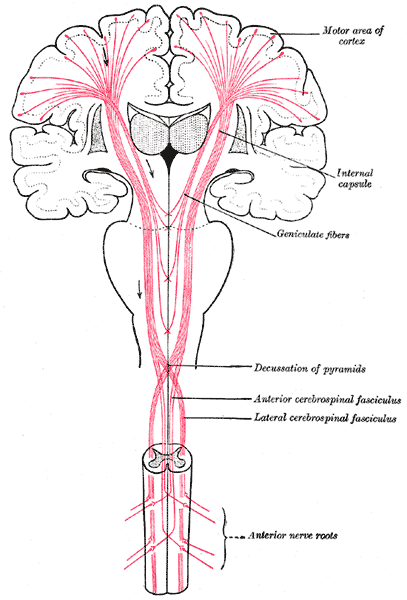
covered the subsection, Action neuromatrix. Well, sort of. Once through lightly. I told you how I didn't know much about it. The picture to the right, from Wikipedia, is the kind of image that comes to mind. It's decades old and awfully static. 

Because it's been ages since I've read much about the motor output system, I feel obliged to add something about it in here, and this seems a good place. [Remember, I warned you (all three of you..) that there might be side trips up inlets. Get ready for a little review of the motor output system, including pictures of brain bits.]

So, the problem is, how can I study the motor output system in a way that makes it feel more alive, more than just a bunch of pretty pink lines on a picture? 

I like what Peggy Mason has to say in her text, Medical Neurobiology, page 10: 
"The motoneuron is critical to movement but is not active in isolation. Therefore, motoneurons produce muscle contractions only when activated by inputs."
All right! This is starting to sound more neuromatrix-y to me. 
"Furthermore, when a motoneuron is activated in patterns dictated by neurons in the cerebral cortex, cerebellum, and basal ganglia, smooth motions involving multiple joints and muscles are produced. Since all central neurons influence motoneuron activity, directly or indirectly (in many cases, very indirectly), one can view the whole brain as "pre-motor," functioning to control the activity of motoneurons."
Source
Yes! That's exactly the right lead-in to make the whole project more fun and less daunting. Like the image at the left, motor control starts at the brain (top bowl), flows down through spinal cord (middle bowl) and out to the body (bottom bowl). 


Looked at another way, brain is the pre-motor puppeteer. The body is
Source
puppet. The motoneurons are strings. 


Mason starts at the lowest level on the hierarchy, reflexive movement. Another text, Mayo Clinic Medical Neurosciences,  has a beautiful image of how interneurons and motor neurons connect in the spinal cord. This would be way way down in the anterior horn of the spinal cord. 


IMAGE: from page 271
MayoClinicMedicalNeurosciences

Note that there are two sets of influences on a motor neuron - descending pathways (i.e., from the brain or at least from more rostral in the system), and primary afferents. E.g., hitting the knee with a reflex hammer. Looks a bit like the gate control diagram Melzack developed way back in the 60's.
Based on Wolpert (from yesterday), maybe the primary afferents are like "noise", and descending pathways are like "noise-cancelling headphones." Or maybe I'm stretching that noise metaphor a bit too much. On second thought, I don't think I am.  This whole nervous system evolved within an environment, a "noisy" environment, subject to upheaval and stress and unpredictability. It evolved from bottom to top, not the other way round. It would have had "noise" to deal with, the entire time it was evolving (and still is). So it makes sense that there would be some sort of rudimentary noise-cancelling "motor control" features at the anterior horn, even at a stage when there wasn't much rostral to descend. The first kind of brain in existence was the "aquatic brain," the original critter brain, 500 million years old, still going strong in there. 

Fish ancestors gathered the nerve net into a spinal cord. It is from them we inherit our vertebrate nervous system layout. Lest we forget. 

According to the link, it contained spinal cord, hindbrain, midbrain and forebrain. All the bits needed to run the system started there, and it has emerged, unfolded itself, ever since.  

........


Previous blogposts

Part 1 First two sentences Part 2 Pain is personal Also Pain is Personal addendum., Neurotags! Pain is Personal, Always.

Part 3a Pain is more than sensation: Backdrop Part 3b Pain is not receptor stimulation Part 3c: Pain depends on everything ever experienced by an individual

Part 4: Pain is a multidimensional experience across time

Part 5: Pain and purpose

Part 6a: Descartes and his era; Part 6b: History of pain - what’s in “Ref 4”?; Part 6c: History of pain, Ref 4, cont.. : There is no pain matrix, only a neuromatrix; Part 6d: History of Pain: Final takedown Part 6e: Pattern theories in the history of pain Part 6f: Evaluation of pain theories Part 6g: History of Pain, the cautionary tale. Part 6h: Gate Control Theory.

Part 7: Gate control theory has stood the test of time: Patrick David Wall;  Part 7b: Gate control: "The theory was a leap of faith but it was right!"
Part 8: Beyond the gate: Self as mayor Part 8b: 3-ring circus of self Part 8c: Getting objective about subjectivity
Part 9: Phantom pain - in the brain! Part 9b: Dawn of the Neuromatrix model Part 9c: Neuromatrix: MORE than just spinal projection areas in thalamus and cortex Part 9d: More about phantom body pain in paraplegics
Part 10: "We don't need a body to feel a body." Part 10b: Conclusion1: The brain generates its own experience of being in a body Part 10c:Conclusion 2: Your brain, not your body, tells you what you're feeling Part 10d: Conclusion 3: The brain's sense of "Self" can INclude missing parts, or EXclude actual parts, of the biological body Part 10e: The neural network that both comprises and moves "Self" is (only)modified by sensory experience
Part 11: We need a new conceptual brain model! Part 11b: Intro to a new conceptual nervous system Part 11c: Older brain models just don't cut it Part 11d: The NEW brain model!

Monday, July 01, 2013

Melzack & Katz, Pain. Part 12: Action!

The paper, Pain

Most recent blogposts: Part 11: We need a new conceptual brain model! Part 11b: Intro to a new conceptual nervous system Part 11c: Older brain models just don't cut it Part 11d: The NEW brain model!
SEE ALL PREVIOUS BLOGPOSTS IN THIS SERIES LISTED AT END

[So, we arrived back at the river, eased our canoes back in the water, and are on our way again. It was a gruelling portage through dense forest, but we made it!] 

We're still looking at the Melzack and Katz paper, and if you scroll down a little, you'll see today's topic, Action Patterns: The "Action-Neuromatrix."

Action!

We will have to proceed with caution here, mostly because I don't really know the terrain as well as I should. About all I learned about the movement generating part of the brain (way back in PT school when dinosaurs roamed the earth) is that if you want to make a move, something happens in the motor cortex, a signal goes down the corticospinal tract through a upper motor neuron, gets passed to a lower motor neuron, and ends up being sent to, registered and carried out by a muscle. I think we might have touched on basal ganglia, etc., but it's all kind of dim... I confess, it's never fascinated me to the point where I wanted to learn about motor output or motor control in detail. I think I might be more interested in all that from the perspective of understanding the neuromatrix better, though, so get ready for possible sidetrips up side inlets, and so on. 

I think the best possible place to begin is with Daniel Wolpert. Here is his 20 minte TED talk video once again: The Real Reason for Brains.


Here are some notes: 

  • Brain evolved to perform adaptable and complex movements
  • Movement is the only way you have of affecting the world around you.
  • All movement, apart from sweating, goes through contractions of muscles. 
  • Communication: speech, gestures, writing, sign language
  • Sensory memory and cognitive processes are only important for suppressing or driving future movement [e.g., no evolutionary advantage to perceiving the colour of a rose if it isn't going to affect the way you're going to move later in life]
  • Sea squirt - rudimentary animal, starts out with a nervous system, swims around, plants on a rock,  then digests its own brain. Once you don't need to move, you don't need luxury of a brain [they are metabolically expensive to maintain] 
  • How brain controls movement, look to machines we built to move for us: e.g., a machine to play chess [machine wins], compared to one built for moving a chess piece - a child wins easily - cognitive algorithms are easier to develop than dexterity algorithms - "not even clear what algorithm you have to solve to be dextrous"
  • have to both perceive and act 
  • manipulation robotics is still in the dark ages, compared to the cup-stacking champ
  • we are trying to reverse engineer how humans control movement
  • Problems: sensory feedback is "noisy"
  • noise does not mean sound - noise means a random noise corrupting the signal - e.g. static on a radio - e.g., one finger under a table and one finger over, try to place fingers together, can be several centimeters off because of the noise
  • motor output is extremely noisy
  • lots of movement variability, task noise/ variability - e.g., lifting a teapot - teapot could be full or empty
  • so movement has to occur in a soup of noise
  • society places premium on the reduction of movement noise, e.g., good golfing
  • brain works hard to limit noise
  • Bayesian decision theory - recently, a unifying way to think about how the brain deals with uncertainty
  • fundamental idea: make inferences and take action
  • want to generate beliefs about the world, e.g., where are my arms in space, am I looking at a cat or a fox - then represent beliefs with probabilities - 0 means I do not believe it at all, 1 means absolutely certain, numbers in between represent levels of uncertainty
  • key idea is you have 2 sources of information from which to make an inference, data (e.g., sensory input) and prior knowledge (e.g., memory)
  • Bayesian decision theory gives you the mathematics of the optimal way to combine your prior knowledge with sensory evidence to generate new belief

    SOURCE
  • formula explains the probability of different beliefs given your sensory input
  • e.g., tennis, where will the ball bounce as it comes over the net towards you; you won't know exactly - the ball will land somewhere in a zone - based on purely sensory information calculated by observing trajectory and speed (sensory data), you can guess one zone, but prior experience will tell you, zone might be anywhere along the net; where the two zones overlap is the most likely place the ball will land
  • we are Bayesian inference machines - our brains learn statistics of the world, and how noisy our own senses are, and combine those in a Bayesian way, make predictions of the future (beliefs), changes your perception by what you do
  • how the brain deals with sensory input: you send a command out, you get sensory feedback back, the transformation is governed by the physics of your body and sensory apparatus - the brain becomes a predictor - "you send a motor command down, you tap a copy of that off into your neural simulator, to anticipate the sensory consequences of your actions"

Brain's "neural simulator" / "predictor"
  • E.g., you shake the ketchup bottle and get sensory feedback that matches what the predictor predicts 
  • Imagine someone comes along and taps it as you shake it - this is an added source of sensory information, but it becomes combined (from the senses point of view) into one source of information
  • It's good to be able to distinguish external events from internal events - external events are actually much more behaviour relevant than what's going on inside one's own body
  • "one way to reconstruct that is to compare the prediction, which is only based on your movement commands, with the "reality" - and any discrepancy should hopefully be external"
  • e.g., example where sensation arranged by self is different from sensation arranged by another person - tickling - it hasn't really been shown that you can't tickle yourself because you have a neural simulator.. we can use a robot for self-tickling, add a time-delay to elicit the predictor in the brain
  • right hand always does the same sinusoidal movement
  • as we go from 0 to 0.1 second, it becomes more ticklish, and by 0.2 it becomes equivalent to as if the robot tickles you without you doing anything
  • extremely tightly coupled to temoral causality
  • conclusion is the brain is making precise predictions and subtracting them off from sensory input
  • there are all sorts of noisy variabilities in this work - a more objective way to observe is to watch children get into fights in the back seat of cars on long road trips - they escalate - who hits who harder as claimed? How to measure inconsistent truths? the one doing the hitting is predicting the sensory consequences of the movement and subtracting it off so they think they've hit less hard than they have, like the tickling; the passive recipient hasn't made a prediction so they feel the full blow
  • Set up a tit-for-tat game with a little motorized force transducer - player 2 presses down on player 1's finger for 3 seconds, then stops; player 1 tries to remember how much force and use the same amount for pressing player 2's finger, and so on. Repeatedly.
  • The players have been told the rules in separate rooms so they don't know what the other person has been told - outcomes will be objective
  • There is a 70% escalation of force in the game in all pairs (*this has big implications for manual therapists, I should think! No wonder it's hard to find any standardized way to do it.. given the high amount of doubtful feedback, best to go very slow and very light in my humble opinion*)
  • Brain is cancelling the sensory consequences and underestimating the force its producing
  • Brain makes predictions and fundamentally changes the percept
  • Action selected should be optimal, but there's a big gap between the task and the movement system - huge amount of choice to make. 
  • "We are extremely stereotypical - we all move the same way pretty much"
  • Our brains have dedicated neural circuitry to decode the stereotypy - e.g., understanding that dots on a screen moving mean a person dancing - you will know from the 15 dots if the person is happy, sad, old, young etc.
  • Why is it we move the particular ways we do? evolution selects some patterns of movement over others that are less successful, and individual brains refine movements as we develop
  • what makes a movement good or bad? remember the noise factor.. every time a movement is executed, it's noisy, and it's differently noisy each time - the variability will be different from one time to another. Certain ways of moving will reduce variability. The ways that reduce variability will be favoured by the brain, because negative consequences will be reduced
  • variability or noise increases as amount of force increases  - avoiding big forces is one way..
  • relevant for disease and rehabilitation
                                                                         .....
Next, we'll look at what Melzack had to say about the action neuromatrix, and his references, and compare it to what Wolpert outlined. This piece on stochastic resonance is good background reading according to me, Joys of Noise via Nautilus. 

"there are times when adding noise is the only way to pick up a weak periodic signal.....it works something like this: Imagine you’re trying to count the number of waves at the seashore, and your detector is a wall built across the middle of a beach. The height of the wall represents the threshold of detection: Only if water washes over the top of the wall will it be registered. But our imaginary wall is high enough that the swell of the water never quite rises to the top of the wall. Adding noise is like adding some rapidly changing wind—it whips up waves in a random pattern. With the right amount and right variation of wind, when the wave comes in the water will splash over the top of the wall and be detected. If there’s too little wind, the calmer waves will never make it over the top; too much wind and the water level may stay over the wall for long stretches, drowning out the signal of the waves."
RESOURCES:

I highly recommend Buzsaki's book, Rhythms of the Brain (full pdf)

Excerpt: 
"The short punch line of this book is that brains are foretelling devices and their predictive powers emerge from the various rhythms they perpetually generate. At the same time, brain activity can be tuned to become an ideal observer of the environment, due to an organized system of rhythms. The specific physiological functions of brain rhythms vary from the obvious to the utterly impenetrable. A simple but persuasive example is walking. Bipedal walking is a periodic series of forward falls interrupted regularly by alternate extensions of each leg. It is almost as natural to us as breathing. This effortless exercise is made possible by the predictive nature of spinal cord oscillators. On smooth terrain, the alternation of leg movements can take us any distance. Perturbation of the clocking, on the other hand, signals a change in the terrain. This general mechanism is the same in all animals, including eight-legged scorpions and centipedes. The notion that oscillators or “central pattern generators” are responsible for the coordination of motor patterns, such as breathing and walking, is old and well accepted in neuroscience. But the tantalizing conjecture that neuronal oscillators can be exploited for a plethora of other brain-generated functions, including cognition, is quite new and controversial. And it is the latter topic, the contribution of oscillations to the invisible, inferred operations of the brain, that this book is mostly about."
VIDEO 
This BBC doc about Ian Waterman, "The Man Who Lost His Body": it explains the importance of sensory input in general, for movement. This man developed a condition whereby he lost his sensory feedback.
He did learn to move again, but this is so rare that he might be the only person who has ever succeeded. About 48 minutes. 


                                                                          .......

Previous blogposts

Part 1 First two sentences Part 2 Pain is personal Also Pain is Personal addendum., Neurotags! Pain is Personal, Always.

Part 3a Pain is more than sensation: Backdrop Part 3b Pain is not receptor stimulation Part 3c: Pain depends on everything ever experienced by an individual

Part 4: Pain is a multidimensional experience across time

Part 5: Pain and purpose

Part 6a: Descartes and his era; Part 6b: History of pain - what’s in “Ref 4”?; Part 6c: History of pain, Ref 4, cont.. : There is no pain matrix, only a neuromatrix; Part 6d: History of Pain: Final takedown Part 6e: Pattern theories in the history of pain Part 6f: Evaluation of pain theories Part 6g: History of Pain, the cautionary tale. Part 6h: Gate Control Theory.

Part 7: Gate control theory has stood the test of time: Patrick David Wall;  Part 7b: Gate control: "The theory was a leap of faith but it was right!"
Part 8: Beyond the gate: Self as mayor Part 8b: 3-ring circus of self Part 8c: Getting objective about subjectivity
Part 9: Phantom pain - in the brain! Part 9b: Dawn of the Neuromatrix model Part 9c: Neuromatrix: MORE than just spinal projection areas in thalamus and cortex Part 9d: More about phantom body pain in paraplegics
Part 10: "We don't need a body to feel a body." Part 10b: Conclusion1: The brain generates its own experience of being in a body Part 10c:Conclusion 2: Your brain, not your body, tells you what you're feeling Part 10d: Conclusion 3: The brain's sense of "Self" can INclude missing parts, or EXclude actual parts, of the biological body Part 10e: The neural network that both comprises and moves "Self" is (only)modified by sensory experience